13
LIQUID-COUPLED HEAT EXCHANGER ECONET
®
Installation & Maintenance Manual
13
FläktGroup DC_9010GB 20180327_R0 Specifications are subject to alteration without notice
MAINTENANCE INTRUCTIONS
GENERAL MAINTENANCE INSTRUCTIONS
The ECONET
®
unit does not require regular maintenance, other
than observing the maintenance instructions provided by the
anti-freeze liquid manufacturer. On the other hand, we recom-
mend that regular performance checks are carried out to ensure
that the unit operates as it should.
Check and pay special attention to the following:
– abnormal noise and vibrations, if any
- corrosion on piping and brazed pipe joints, if any
- loose pipe clamps, if any
CLEANING THE STANDARD ECONET
®
COILS
Even an effective air filter cannot remove all the dust from the
air. The coating of dust on heating surfaces obstructs the air
flow and gives poorer heat transfer. The coils must be kept
clean, which is best performed with one of the following alter-
natives or combinations of these.
1. Blowing clean with compressed air.
2. Blowing clean with steam
3. Washing or rinsing with water.
In the case of heating surfaces that
are coated with grease, an appropriate
detergent should be added.
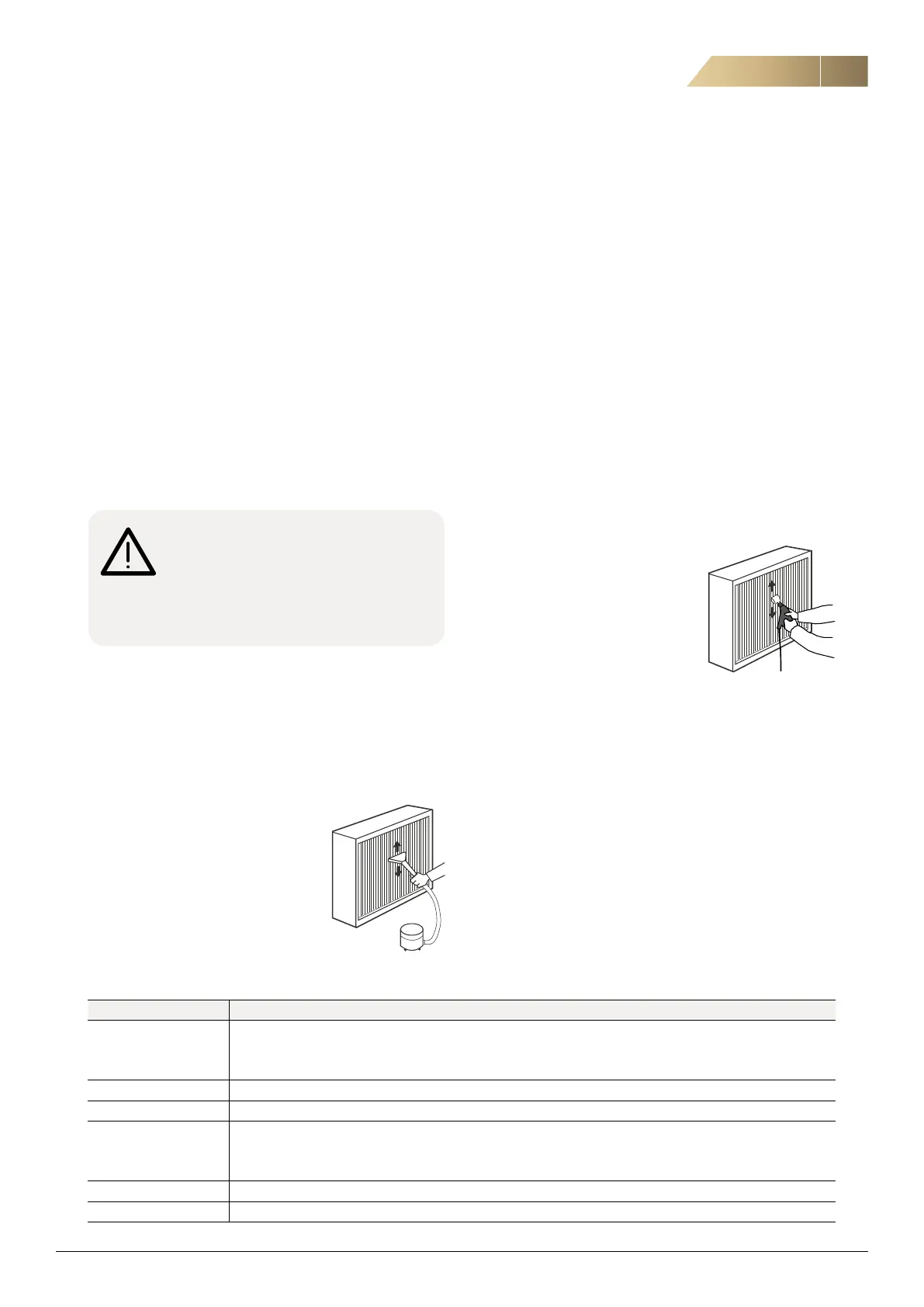
4. Vacuum cleaning. After cleaning,
all the fallen dust should be removed
before starting the fan.
The drip trays for the coils should be cleaned as appropriate.
Also ensure thet the water trap is cleaned and filled with water.
CLEANABLE COILS FOR HYGIENE APPLICATIONS
All ECONET
®
coils with hygiene fins are fully cleanable accor-
ding to the standards VDI3803 and VDI6022. This means that
the coil can be cleaned with a high-pressure water system
right through the core. The cleaning nozzle used for coils with
a fin pitch of 2.0-2.5 mm and deeper than six tubes is THD
Power Clean manufactured by TECHNISCHER HYGIENE DIENST
GMBH (E-mail: info@thd.info, web: www.thd.info). If the coil is
six tubes deep or less, an ordinary nozzle can be used.
1. Make sure that no sensitive
equipment, either inside or outside
the unit, can be harmed by
the water. Be extra careful not to
damage the filter. If the unit has
an empty section (EQTC), use
the special drip plate to protect
the rest of the unit.
2. Clean the coil with a high-pressure cleaner. If the coil is
deeper than six tubes, a THD Power Clean is needed to
ensure a full cleanability.
3. Point the nozzle at a 45-degree angle to have a free passage
for the water jet through the coil. Make sure that the water
penetrates the coil.
4. Remove all dirt.
5. Dry all surrounding parts in the unit.
ANTI-FREEZE LIQUID
Follow the instructions from the anti-freeze liquid manufacturer
regarding controls, maintenance, flushing and intervals for filling
with fresh liquid, etc.
Warning!
Avoid flushing with water near the electrical
connections of the inverter and cabinet, since
water could then seep into them and may
cause a short circuit.
TASK INTERVAL, EACH YEAR
Liquid status Check the freezing point of the frost protection fluid and follow the instructions from the anti-freeze liquid
manufacturer, controls of frost protection/quality, purity, colour, etc.
Check the system pressure and top up with ethylene glycol mixture if necessary.
Check the liquid flow against the balancing report.
Coils Check that the finned surfaces of the coils are not dirty, and clean if necessary.
Water trap Check that water is present in the water trap for the exhaust air and supply air coils.
Air purging Check frequently initially. An annual check is sufficient after the first year.
Shut off the pump and wait a couple of hours to make sure that the air bubbles have risen to the highest points in the
system, where the air-valves should be present. Open/close all valves in the system so that all trapped air can be
removed.
Valve checking Shut down the system and open/close every valve to make sure it has a smooth operation.
Pump seats Check the seals, and replace them if leakage is excessive.


 To Next Page
 Loading...