ON
ThE
ROAd
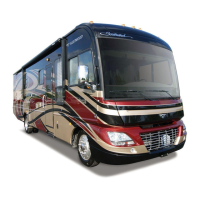
Driving your motor home will be different from driving your
family car or truck. Your motor home is large and heavy.
You
may have to adjust or learn new driving techniques to safely
operate your motor home.
Downhill driving puts extra strain on many drivetrain
compo-
nents
of
your motor home. The brakes are easily overloaded
and overheated when used for downhill slowing. Brake fade
will occur
if
the brakes overheat.
When driving down long grades, shift the transmission to a
lower gear at the top
of
the grade. Rule
of
thumb:
Use
the
same lowest gear going
dOlVn
as
it
took to go
lip
the hill.
Crest the hill in the lower gear. Monitor your speed.
Your motor home is equipped with a diesel engine.
Diesel-
equipped vehicles are less responsive than gas-powered vehi-
cles. Acceleration will be slower. Attempts at "jack-rabbit"
starts from stops may damage the engine and drive-train
components.
If
you anticipate overtaking and passing other
vehicles, remember that your motor home may not achieve
the required speed
as
quickly
as
you expect.
DRIVING
AND
VEHICLE
CONTROL
ENGINE
AND
TRANSMISSION
CAUTION
Engine overs peed (en-
gine speed
in
excess of
high
idle,
no load
RPM)
can
damage the engine .
.II
NOTE
Driving a diesel-powered
vehicle
is different from
driving
a gasoline-pow-
ered vehicle. Engine
over-revving can cause
serious internal engine
damage.
1---



 To Next Page