Need help?
Do you have a question about the FLOJET 03526-144 and is the answer not in the manual?
Diagnoses for pump failure to prime, including intake/discharge restrictions and air leaks.
Troubleshooting steps for when the motor fails to start, checking power and connections.
Addresses causes of pulsating flow, like restricted lines or undersized fittings.
Solutions for pumps that do not shut off after fixtures are closed, checking tank level and pressure switch.
Identifies issues causing reduced flow or pressure, such as air leaks or debris.
List of key service parts for 3426, 3526, and 3626 series pumps.
Overview of quick connect port system accessories and fittings.
Details on pump series, strainer numbers, inlet/outlet types, and screen mesh.
Instructions for winterizing the water system to prevent damage from freezing.
Procedure for sanitizing potable water systems using household bleach.
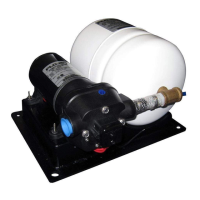
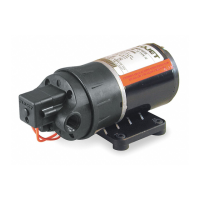
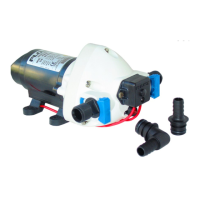
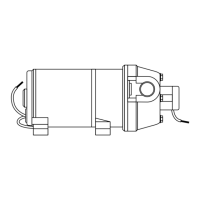
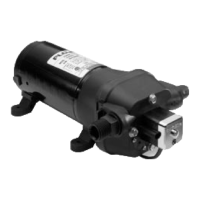
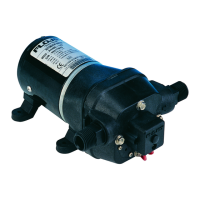
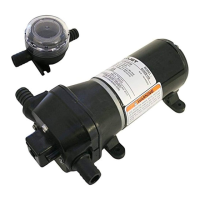
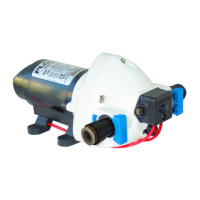
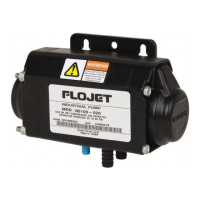
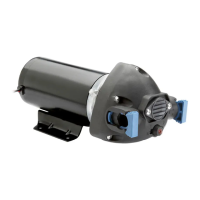
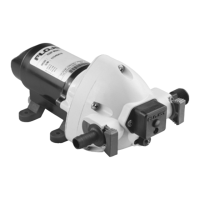
The Flojet "Triplex Diaphragm" 3426/3526/3626 Series Automatic Water System Pump is designed to provide a reliable and consistent water supply for various applications, particularly in RVs and other mobile or off-grid systems. This self-priming pump is engineered for ease of use and durability, ensuring a steady flow of water whenever needed.
The core function of this device is to automatically deliver water from a tank to the plumbing system. It operates on a three-chamber diaphragm design, which allows it to self-prime up to 9 feet (2.7 meters) of suction lift. This means it can draw water from a tank located below the pump, making installation flexible. A key feature is its ability to run dry without sustaining damage, which is beneficial in situations where the water tank might run empty, preventing potential pump failure. The pump is equipped with a permanent magnet motor with ball bearings, ensuring efficient and reliable operation. For CE models, the motor is totally enclosed and fully suppressed, contributing to its safety and compliance with standards. The automatic nature of the pump means it will start and stop based on demand, maintaining pressure in the system. When faucets are opened, the pressure drops, and the pump activates to restore flow. When all faucets are closed, the pressure builds, and the pump shuts off, conserving energy and preventing continuous operation.
The Flojet water system pump is designed with several features that enhance its usability and integration into a water system. It includes soft noise-absorbing mounts, which help to minimize operational noise and vibration, contributing to a quieter environment. Snap-in port fittings simplify the connection process to the plumbing system, making installation quicker and more secure. A built-in bypass mechanism is incorporated to reduce pulsation in the water flow, providing a smoother and more consistent stream from faucets. The pump is constructed from corrosion-resistant materials, ensuring longevity and reliable performance even when exposed to water over extended periods. It also meets ISO 8846 standards, indicating its compliance with international safety and performance requirements.
To begin using the pump, after ensuring the battery is fully charged and the water tank is filled, all faucets should be opened. The pump switch is then turned on, allowing water to flow and purge air from the system, including the water heater, toilet, and shower lines. Once the water runs free of air, the faucets can be turned off. The pump will then stop automatically as the system pressure builds. If the pump fails to stop, the user is advised to turn off the switch and consult the troubleshooting guide.
Installation involves several straightforward steps. First, shipping plugs must be removed from the pump ports. The supplied fittings are then connected to the RV's plumbing, ideally using 1/2-inch I.D. flexible hose (braided or reinforced) to further reduce vibration. Hose clamps should be used on slip-on barb hose connectors for secure attachment. The pump's rubber mounts slide into four mounting tracks. It can be mounted vertically with the pump head down or horizontally in an accessible location. If mounting vertically with the motor up, motor mounts should be attached first, followed by pump head mounts, while supporting the pump's weight. Inlet and discharge port connectors are installed, and slide clips are pushed forward to lock them in place. A Flojet strainer must be installed between the tank and the pump inlet in an accessible location for inspection and cleaning. This strainer is crucial for pump warranty validity.
Wiring the pump is also a critical step. For power sources up to 20 feet away, 14 gauge stranded wire should be used, and for distances up to 50 feet, 12 gauge wire is recommended. A 10-15 amp rated on-off switch should be installed on the positive (red) motor lead. Additionally, a 10 amp fuse protection must be installed on the positive lead to safeguard the system. To further reduce noise and vibration, flexible lines should be used on both the inlet and outlet of the pump, ensuring they are rated not to collapse under pump vacuum.
Proper maintenance is essential for the longevity and optimal performance of the Flojet water system pump. This includes specific procedures for winterizing and sanitizing the water system.
For winterizing, it is crucial to prevent water from freezing in the system, as this can cause damage to the pump and plumbing. Non-toxic antifreeze, suitable for potable water, can be used following manufacturer recommendations. Automotive antifreeze should never be used, as it is highly toxic. The process involves draining the water tank, which can be done by opening the tank drain valve or by using the pump to empty the tank through the faucets (without running the pump continuously for more than 15 minutes). All faucets must then be opened to purge water from the plumbing system, and power to the pump should be turned off. The quick connect inlet and outlet fittings should be removed from the pump, and the pump turned on briefly to expel any remaining water from the pump head. A catch pan or rag should be used to prevent spills. The fittings should remain disconnected until the system is ready for use again, and a note should be placed on the tank filler to indicate that the plumbing is disconnected. Finally, all faucets should be left open to protect the plumbing from damage.
Sanitizing the water system is recommended periodically, especially before storage or after a period of disuse, to ensure a consistent flow of fresh water and prevent contamination. This procedure aligns with RVIA ANSI A119.2 and US Public Health Service guidelines. To sanitize, the amount of common household bleach needed is determined by multiplying the tank capacity in gallons by 0.13 (for ounces of bleach) or in liters by 1.0 (for milliliters of bleach). This bleach is then mixed with water in a container and poured into the tank, which is then filled with potable water. All hot and cold faucets should be opened until the distinct odor of chlorine is detected. The standard solution requires four hours of contact time for complete disinfection. Doubling the solution concentration can reduce contact time to one hour. After the contact time, the tank is drained, refilled with potable water, and the plumbing is purged of all sanitizing solution.
Troubleshooting guidance is provided for common issues. If the motor operates but there is no pump discharge (failure to prime), potential causes include a restricted intake or discharge line, an air leak in the intake line, debris in the pump, a punctured pump diaphragm (indicating leaks), or a crack in the pump housing. If the motor fails to turn on, issues could be a loose wiring connection, no power to the pump circuit, a blown fuse, a pressure switch failure, or a defective motor. Pulsating flow typically indicates restricted pump delivery, suggesting a need to check discharge lines, fittings, and valves for clogging or undersizing. If the pump fails to turn off after all fixtures are closed, the water tank might be empty, there could be insufficient voltage to the pump (low battery), a punctured pump diaphragm (leaks), a discharge line leak, or a defective pressure switch. Low flow and pressure issues can stem from an air leak at the pump intake, accumulation of debris in the pump or plumbing, worn pump bearings (causing excessive noise), a punctured pump diaphragm, or a defective motor.
 General
| Model | 03526-144 |
|---|---|
| Category | Water Pump |
| Type | Diaphragm Pump |
| Voltage | 12 VDC |
| Self-Priming | Yes |
| Dry Prime | Yes |
| Housing Material | Polypropylene |
| Diaphragm Material | Santoprene |
| Valve Material | EPDM |
| Pressure | 30 PSI |
| Maximum Temperature | 140°F |
| Dimensions | 7.5" x 4.5" x 4.5" |
| Motor | 12 VDC Permanent Magnet, Intermittent Duty |
| Port Size | 1/2" |

 To Next Page