Copyright Reserved, DONGYANG Corporation 6
4.0 CAUTIONS FOR INSTALLATION
Mounting Positions
• Pipes must be fully filled with liquids. It
is essential that pipes remain fully filled
at all times, otherwise flow rate
indications may be affected and
measurement errors may be caused.
• Avoid Air Bubbles. If air bubbles enter
a measurement pipe, flow rate
indications may be affected and
measurement errors may be caused.
• Avoid all pipe locations where the flow
is pulsating, such as in the outlet side of
piston or diaphragm pumps.
• Avoid locations near equipment
producing electrical interference such as
electric motors, transformers, variable
frequency, etc.
• Install the meter with enough room for
future access for maintenance purposes.
• The mag meter isolating liner, whether
if it is PTFE or Rubber, is not intended
to be used as gasket material. Standard
gaskets (not provided) should be
installed to ensure a proper hydraulic
seal. When installing the gaskets, make
sure they are properly centered to avoid
flow restriction or turbulence. Do not
use graphite or any electrically
conductive sealing compound to hold
the gaskets in place during installation.
This could affect the reading accuracy
of the measuring signal.
Warning: Precaution for direct sunshine and rain when the meter is installed outside.
Required Lengths of Straight Runs
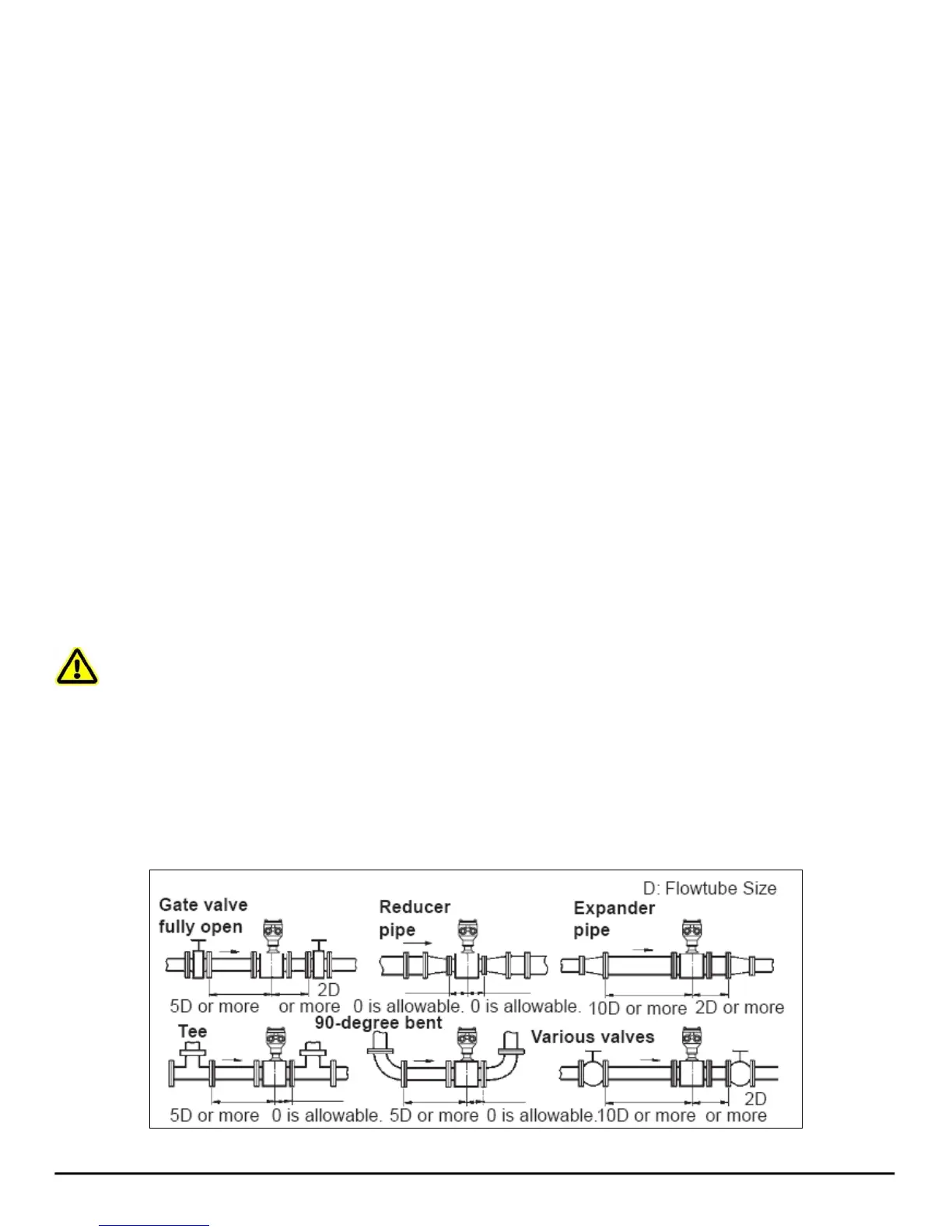
For optimum accuracy performance, it is required to provide sufficient inlet and outlet straight
pipe runs. An equivalent to 3 diameters of straight pipe is required on the inlet side, and 2
diameters on the outlet side. There are no special requirements for standard concentric pipe
reducers. See diagram1 for required straight runs when there is altering device.
Diagram 1. Required straight runs


 To Next Page