1732/1734
Users Manual
8
Thin-Flexi Current Probe
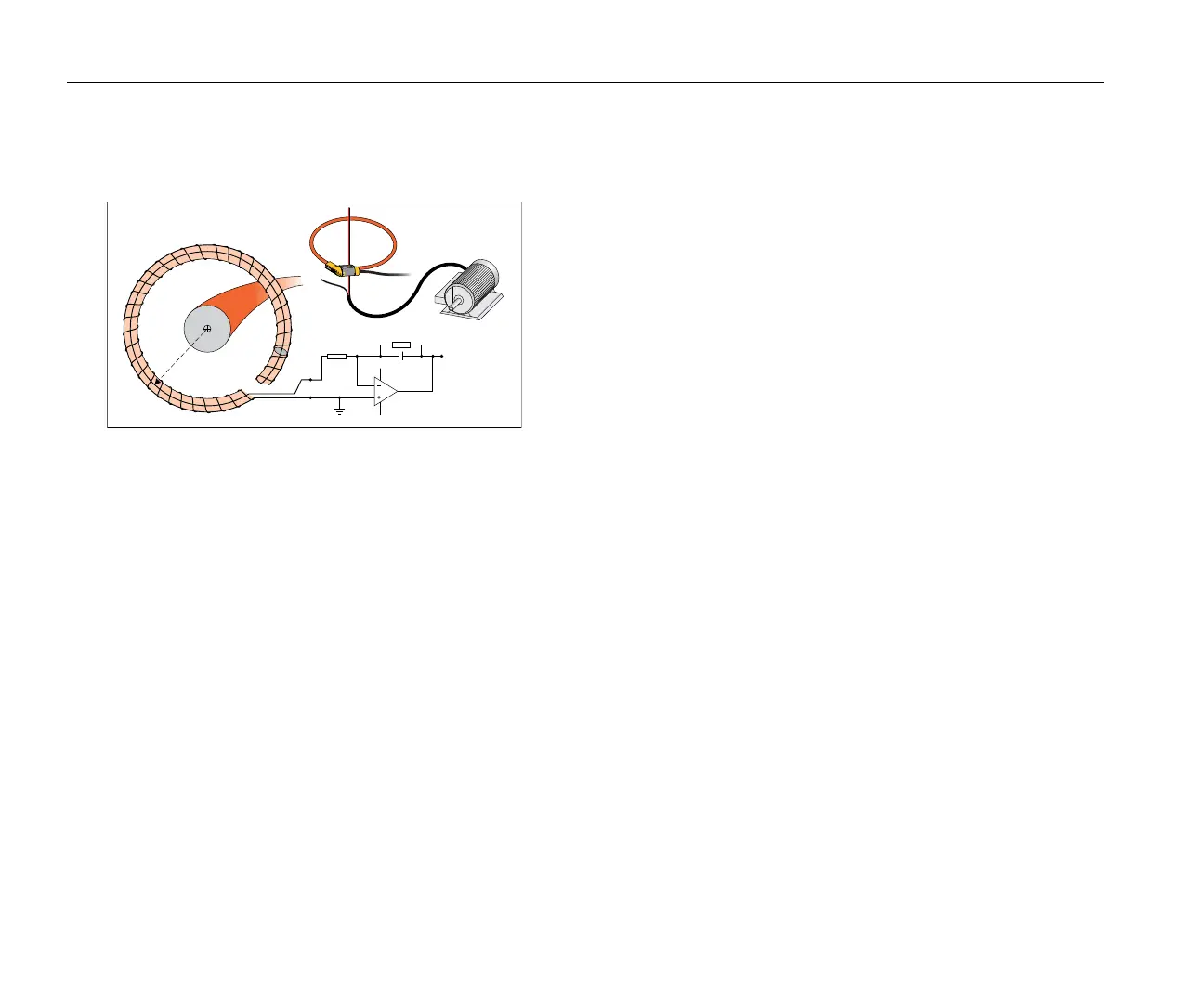
The Thin-Flexi Current Probe works on the Rogowski coil (R-coil)
principle that is a toroid of wire used to measure an alternating current
through a wire encircled by the toroid. See Figure 3.
Figure 3. R-Coil Operation Principle
The R-coil has advantages over other types of current transformers:
•
It is not a closed loop. The second terminal is passed back through
the center of the toroid core (commonly a plastic or rubber tube)
and connected along the first terminal. This allows the coil to be
open-ended, flexible, and able to be wrapped around a live
conductor without disturbing it.
•
It has an air core rather than an iron core. It has a low inductance
and can respond to fast-changing currents.
•
Because it has no iron core to saturate, it is highly linear even
when subjected to large currents, such as those used in electric
power transmission or pulsed-power applications.
A correctly formed R-coil, with equally spaced windings, is largely
immune to electromagnetic interference.
i(t)
v(t)
A
r
10 k R3
330 k R1
10 nF C1
LF347
UI:A
1
GND
2
114
3
V
in
V
out



 To Next Page