Need help?
Do you have a question about the Fluke i410 and is the answer not in the manual?
Essential safety warnings and precautions to prevent electrical shock, fire, and personal injury when using the product.
Explanation of various safety symbols used in the manual and on the product.
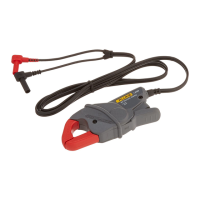
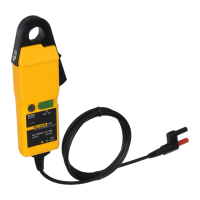
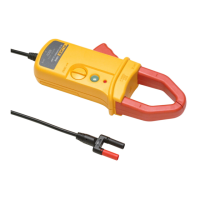
Identifies key features and connection points of the AC/DC Current Clamp.
Step-by-step guide for performing DC current measurements using the clamp.
Step-by-step guide for performing AC current measurements using the clamp.
Instructions on how to test the product's battery status.
Procedure for replacing the product's battery for optimal performance and longevity.
Guidance on diagnosing and resolving problems when the current clamp does not work.
Proper methods for storing and cleaning the product to maintain its condition.
Key safety parameters including voltage limits, operating temperature, and humidity.
Detailed performance metrics like current range, accuracy, bandwidth, and dimensions.
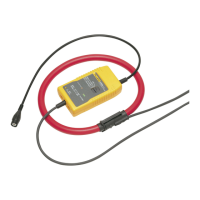
The Fluke i410/i1010 AC/DC Current Clamp is a versatile and essential tool designed for accurate current measurements in various electrical applications. This device allows users to measure both alternating current (AC) and direct current (DC) without breaking the circuit, providing a safe and efficient way to diagnose and troubleshoot electrical systems. Its primary function is to convert current into a proportional voltage signal, which can then be read by a compatible voltmeter, offering a convenient method for current analysis.
The i410/i1010 current clamp operates on the principle of the Hall effect for DC measurements and transformer action for AC measurements. When the jaws of the clamp are placed around a conductor carrying current, the device senses the magnetic field generated by that current. This magnetic field is then converted into a voltage signal that is output through the device's cable to a connected voltmeter. The output signal is typically scaled at 1 mV per Ampere (1 mV = 1 A), making it straightforward for users to interpret the readings on their voltmeter.
For DC current measurements, the device features a "Zero Adjust" function. This is crucial for ensuring accuracy, as residual magnetic fields or internal offsets can affect DC readings. Before taking a DC measurement, the user must ensure the jaws are empty and then use the zero adjust knob to set the output to zero. This calibration step eliminates any potential errors from the device itself, providing a precise baseline for the measurement. Once zeroed, the clamp can be placed around the conductor, and the voltmeter will display the DC current.
For AC current measurements, the process is similar but does not require the zero adjustment. The clamp is simply placed around the conductor, and the voltmeter, set to an AC voltage range, will display the corresponding AC current. The device is designed to handle a wide range of AC frequencies, making it suitable for various industrial and residential applications.
The current clamp is equipped with a tactile barrier, a safety feature that helps users maintain a safe distance from hazardous live conductors. This barrier ensures that the user's hand remains in a safe zone while operating the clamp, minimizing the risk of electrical shock. The jaw centering marks on the clamp assist in accurately positioning the conductor within the jaws, which is important for obtaining precise and consistent readings.
Operating the Fluke i410/i1010 is designed to be intuitive and user-friendly. Before any measurement, users are advised to read all safety information and instructions carefully to prevent electrical shock, fire, or personal injury. The device should only be used as specified, and any alteration could compromise its protective features. It is crucial not to use the product in explosive gas, vapor, or damp environments, or if it appears to be operating incorrectly.
To begin a measurement, the output cable of the current clamp is connected to a compatible voltmeter. The voltmeter should meet specific requirements, including accepting safety-shrouded banana plugs, being able to display 1 mV (with 0.1 mV preferred for better resolution), having an accuracy of at least 0.75%, and an input impedance of 1 MΩ or less than 100 pF.
For DC current measurements, after connecting to the voltmeter, the user selects the mV DC range on the voltmeter. The clamp is then turned ON, and with the jaws empty, the "Zero Adjust" knob is used to set the voltmeter reading to zero. Once calibrated, the jaws are clamped around the conductor, ensuring it is centered within the jaws. The voltmeter will then display the DC current, with 1 mV corresponding to 1 A.
For AC current measurements, the process is slightly simpler. After connecting to the voltmeter, the user selects either the mV AC or V AC range on the voltmeter, depending on the expected current magnitude and desired resolution. The clamp is then turned ON, and the jaws are clamped around the conductor, again ensuring proper centering. The voltmeter will then display the AC current, with 1 mV corresponding to 1 A.
The device includes an ON indicator light, which confirms that the clamp is powered on and ready for use. The ON/OFF switch allows for easy control of the device's power, helping to conserve battery life when not in use.
Proper maintenance of the Fluke i410/i1010 is essential for ensuring its longevity and continued accuracy. One of the key maintenance aspects is battery management. The device operates on a 9 V alkaline battery (IEC 6LR61). To access the battery compartment, the battery door must be opened, which is located on the back of the device. Before opening the battery door, all probes, test leads, and accessories must be removed from the product to prevent accidental contact with live circuits.
The battery life is typically around 60 hours of continuous use with an alkaline battery. To test the battery, the user turns the clamp OFF, connects it to a voltmeter, and selects the V DC range on the voltmeter. If the voltmeter reads 7.0 V DC or less, the battery needs to be replaced. When replacing the battery, it is important to use only specified replacement parts.
For long periods of non-use (exceeding 60 days), it is recommended to remove the battery from the clamp and store it separately. This prevents potential battery leakage, which can damage the product or create a shock hazard. Batteries contain hazardous chemicals and should be handled with care; exposure to chemicals requires immediate cleaning with water and medical aid. Batteries should also be kept away from heat, fire, and direct sunlight.
Cleaning the current clamp is straightforward. Periodically, the case should be wiped with a damp cloth and a mild detergent. Abrasives or solvents should never be used, as they can damage the device's housing and markings.
In the event that the current clamp does not work as expected, a simple troubleshooting guide is provided. Users should check if the battery is OK (by performing the battery test), verify the voltmeter connections (Red to + or Black to COM), and ensure the voltmeter function/range is correctly set to mV DC/mV AC (or V AC). If these steps do not resolve the issue, the device should be serviced only by a qualified service technician. Contacting the nearest Fluke dealer or service center is recommended for service information and repairs. The product should not be altered or repaired by unauthorized personnel, as this could compromise its safety and performance.
 General
| Interface | Banana plugs |
|---|---|
| Cord length | 1.6 m |
| Product color | Red, Yellow |
| DC voltage (max) | 600 V |
| Measurement category supported | CAT III |
| Quantity per pack | 1 pc(s) |


 To Next Page