Power Factor Correction Systems
Commissioning and Maintenance
Note: As the control relays always adapt to the installed supply
system conguration, it can be necessary in individual cases to
enter the required parameters manually.
When the low voltage supply system is fed by several transformers
arranged in parallel, the capacitor current is distributed between all
the transformers. If this current is not measured via totalizing cur-
rent transformers, the change in current measurable by the cont-
rol relay when the capacitor stages are switched in is too small,
which would result in too low response current for automatic C / k
detection. In cases of this type and also in networks with continu-
al load changes (e. g. saw mills, automatic presses, welding lines
and drop forges with switching periods < 2 seconds), the c / k value
has to be entered manually.
No-volt release
The reactive power control relays are provided with a no-volt re-
lease function. This prevents all the capacitor stages being swit-
ched in simultaneously following an outage of the supply voltage
when the latter is restored. The contactors are released on power
failure, and are then energized again to suit requirements.
Standard systems are wired so that the control voltage for the con-
tactors is tapped from the voltage supply to the control relay. It is
strongly advised not to use an external control voltage, since with
this the no-volt release would no longer function, with the possi-
bility that damage might be caused not only to the power factor
correction system but also to other components in the electrical
installation.
Overcurrent trip
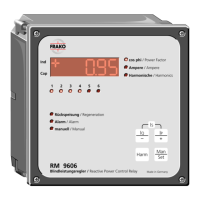
The RM 9606, RM 9612 and EMR 1100 control relays have the
capability of determining the ratio between the r.m.s. current and
the fundamental current in the capacitor. If this ratio exceeds a
value set at the control relay for at least one minute, on account of
system harmonics and the consequent amplication they produce
due to resonance, all the capacitor stages are switched out. An
alarm signal is also given when this happens.
With unchoked systems we recommend setting this ratio or factor
at a value of 1.3 (factory setting), whereas with choked systems
it must be set at its maximum value of 3.0 (and therefore not ac-
tive)!
Commissioning
Before the AC supply voltage is applied to the system, a visual
check should be carried out by a qualied technician to verify that
no equipment or connections have worked loose during transport.
If this has happened, however, the components and connections
concerned must be correctly tightened again. Please verify that
the connections to the current transformer are made at terminals
S 1 and S 2 (current transformers are not included in the standard
scope of supply).
Powering up
When the AC supply voltage is applied to the control relay, it auto-
matically carries out the connection detection procedure. Horizon-
tal lines appear in the digital display. After switching in all capacitor
stages several times, the measured power factor appears in the
display. This is preceded by a + sign to indicate inductive condi-
tions (the procedure takes some 5 - 10 minutes).
The capacitor stages required are switched in within a few se-
conds, and their corresponding LEDs light up on the control relay.
When inductive loads are switched off, the control relay within a
few seconds switches out a sufcient number of stages until the
set power factor has been reached again.
The operating manual supplied with the control relay describe in
detail how to reprogram the set power factor or other parameters
if required.
If the control relay does not react as described here, please sys-
tematically check through the individual points given in Troubles-
hooting.
Switching in capacitor stages manually
Press the Man/Set key for about three seconds. The Manual
LED then begins to ash, indicating that the instrument has been
switched over to manual operation. A capacitor stage can then be
selected by means of the + or - keys. After a delay of about ten
seconds the selected stage is switched in, or if that stage was al-
ready switched in, it is switched out. Defective or unidentied ca-
pacitor stages are signalled as follows in manual mode:
The number of the selected stage ashes.
Please do not forget to press the Man/Set key again to revert to
automatic control!
Switching off the voltage
If the voltage is to be removed from the power factor correction
system, switch the control relay over to manual mode and then
switch out all the capacitor stages. This enables the main fuses
to be removed or the fuse switch-disconnecter to be switched off
under no-load conditions.
Operation and maintenance
Power factor correction systems operate automatically and for a
long time without any maintenance. Carrying out a regular ins-
pection at least once a year can, however, prevent reactive power
penalty charges suddenly being incurred or the correction system
being damaged by an undetected fault.
Alarm signal
All FRAKO reactive power control relays are provided with a built-
in alarm contact (terminals a and b), which can be connected to
an alarm system. If the set power factor is not achieved, a signal
is given and the Alarm LED on the instrument itself lights up conti-
nuously. The operating manual for the control relay contains more
information on the types of alarm and the programming of their set
points.
Fuses
Low voltage, high breaking capacity fuses undergo an ageing pro-
cess when carrying the high switched currents associated with
capacitors. They should therefore be inspected at least once per
year. We recommend replacing the fuse links after ten years at
the latest.
Contactors
Contactors specially designed to switch capacitors in and out are
always used in FRAKO systems. Please therefore ensure when
replacing contactors that only the capacitor-switching type is t-
ted.
The contacts of capacitor switching contactors have a particular-
ly demanding duty. They are tested for 80,000 switching cycles
and must be completely replaced once this number has been re-
ached. If the power factor correction system has a control relay
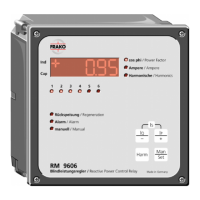
with a switching cycle counter (such as the RM 9606, EMR 1100 S
or EMR 1100), a separate message is given for each stage after
80,000 switching cycles (factory setting which can, however, be
reprogrammed) to inform the operator that contactor replacement
is due.


 To Next Page