FRANKIA OPERATING MANUAL96 FRANKIA OPERATING MANUAL 97
• If necessary, especially at night, attach the insulating mats to the side and front windows.
• Check the state of charge of the body battery.
• Close all water drains, taps and the boiler drain valve.
• Close gas shutoff valves
• Check the function of the heaters and the water system before starting the journey.
• Also open cupboards and storage spaces for initial full ventilation. This prevents the formation of mould.
• It should be taken into account that the driver‘s cab, due to its technical nature, should not be insulated
as much as the living structure.
• It is advisable to take snow chains and starting aids with you.
• Pay attention to the different handling of the motorhome in snow and ice.
• Read the chapter “WINTER” in the operating instructions of the basic vehicle manufacturer carefully.
8.2 Living in winter
• Do not route the external connector power cable along the floor to prevent it from freezing.
• Use alcohol-based door lock deicers to defrost frozen locks. Do not thaw the frozen lock with heated
objects or an open flame.
• The acrylic glass panes of the body must not be treated with deicing sprays or ice scrapers!
• Thaw frozen drain slides with deicing spray.
• Remove snow loads from the vehicle roof.
• Always keep the supply and exhaust air openings of the heating, boiler and refrigerator free of snow and ice.
• Keep the roof vent free of snow and ice.
• To park the vehicle, select first gear or reverse gear - motorhomes with automatic gearboxes: Set the
selector lever to “P”; with Sprintshift gearboxes in stage “A” or “R”.
• Secure the motorhome against rolling away using wheel chocks.
• Keep the solar panel free of snow and ice.
• Avoid extensive cooking in winter - strong condensation
• Leave the heating in operation permanently.
• Set the cab ventilation to internal circulation. This prevents the warm air from escaping through the
ventilation ducts.
• If it gets too warm: ventilate more often.
• Put additional heater into operation if necessary.
• Hang wet clothes in the shower cubicle.
8.3 Decommissioning
Your motorhome does not need any special care if you do not use it for a long time. To avoid smells and mould as well
as frost damage to the sanitary system, we would like to give you some recommendations:
• Wash the outside of the motorhome. Spray off the
wings and underbody.
• Empty the fresh and waste water tanks as well as the
toilet tank. Empty all pipes completely. To do so,
switch off the fuse of the water pump and open all
taps and the shower head (in the middle position).
Open the drain plug in the bottom of the fresh water
tank. Open both bottom valves in the hose line. (Lever
in vertical position). These are located between the
water tanks (Access via the floor cover).
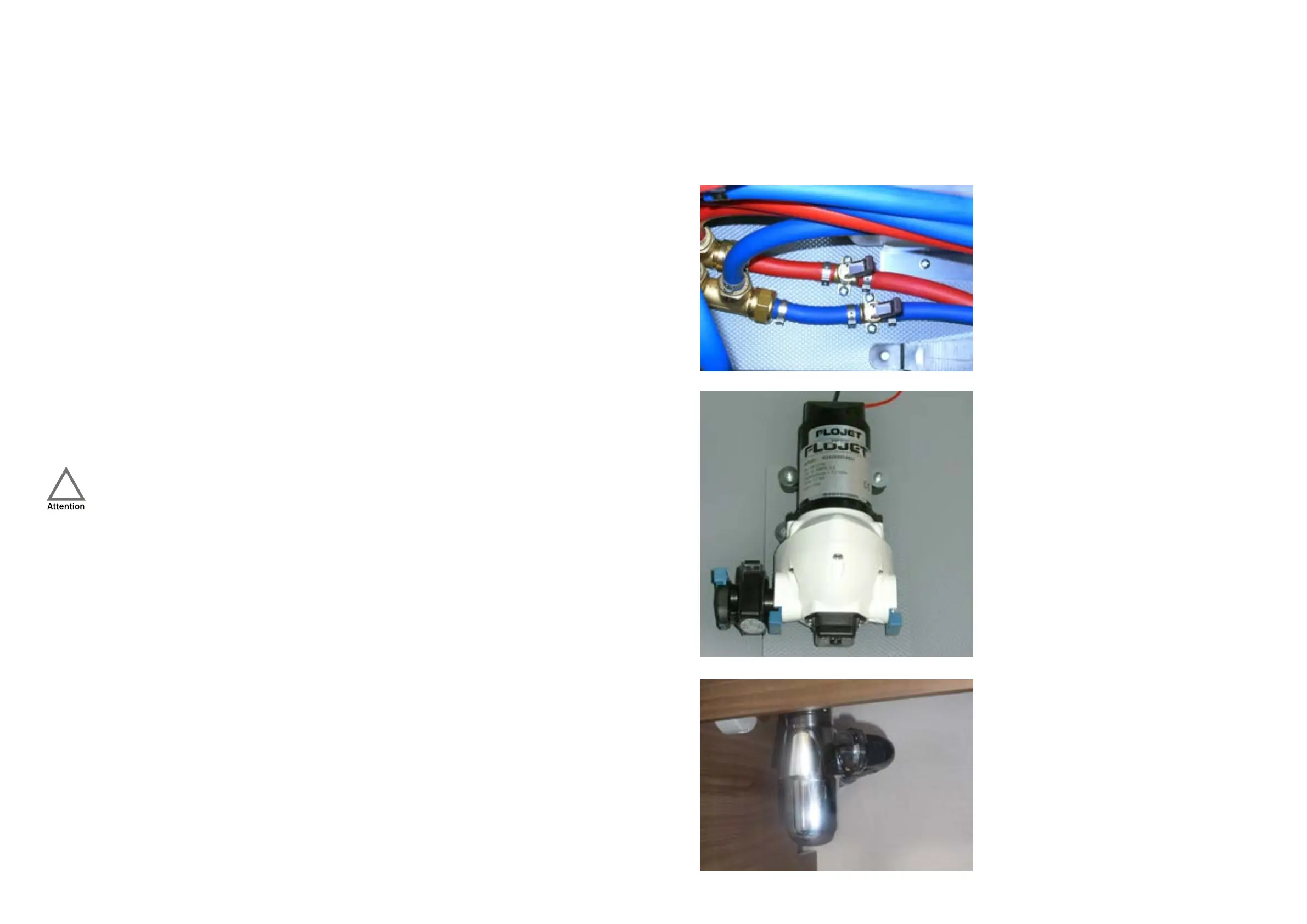
• To prevent the water pump from freezing, it can be
dismantled. The pump can be removed from the
water circuit for the winter by means of the quick-
release fasteners (photo on the right). A small bowl
is to be placed underneath to collect the remaining
water.
• Unscrew and empty the siphon in the bathroom
under the sink. Then reassemble the siphon.
• Rinse and empty the waste water tank and waste
holding tank (option). Leave the filler cap of the
fresh and waste water tank open so that the tanks
can dry. In this way, odour formation can be avoided.
• Remove the fresh water hose reel.
• Empty the boiler. To do so, open the frost protection
valve.
• Allow the pump to run dry briefly to drain the water
pump completely.
• If the water tank is empty, flush the toilet several
times to empty the pipe.
• Rinse the waste water tank and, if existing, the
outside shower and city water connection with a
water jet. Leave the drain tap of the waste water
tank open.
• Blow through the fresh water hose to push out residu-
al water in the hose or disassemble the fresh water
hosereel.


 To Next Page