FRANKIA OPERATING MANUAL10 FRANKIA OPERATING MANUAL 11
tons tons
Top speed
inside city limits
outside city limits
Motorway
50 km/h
100 km/h; with trailer 80 km/h
Recommended speed
130 km/h
50 km/h
80 km/h; with trailer 60 km/h
100 km/h
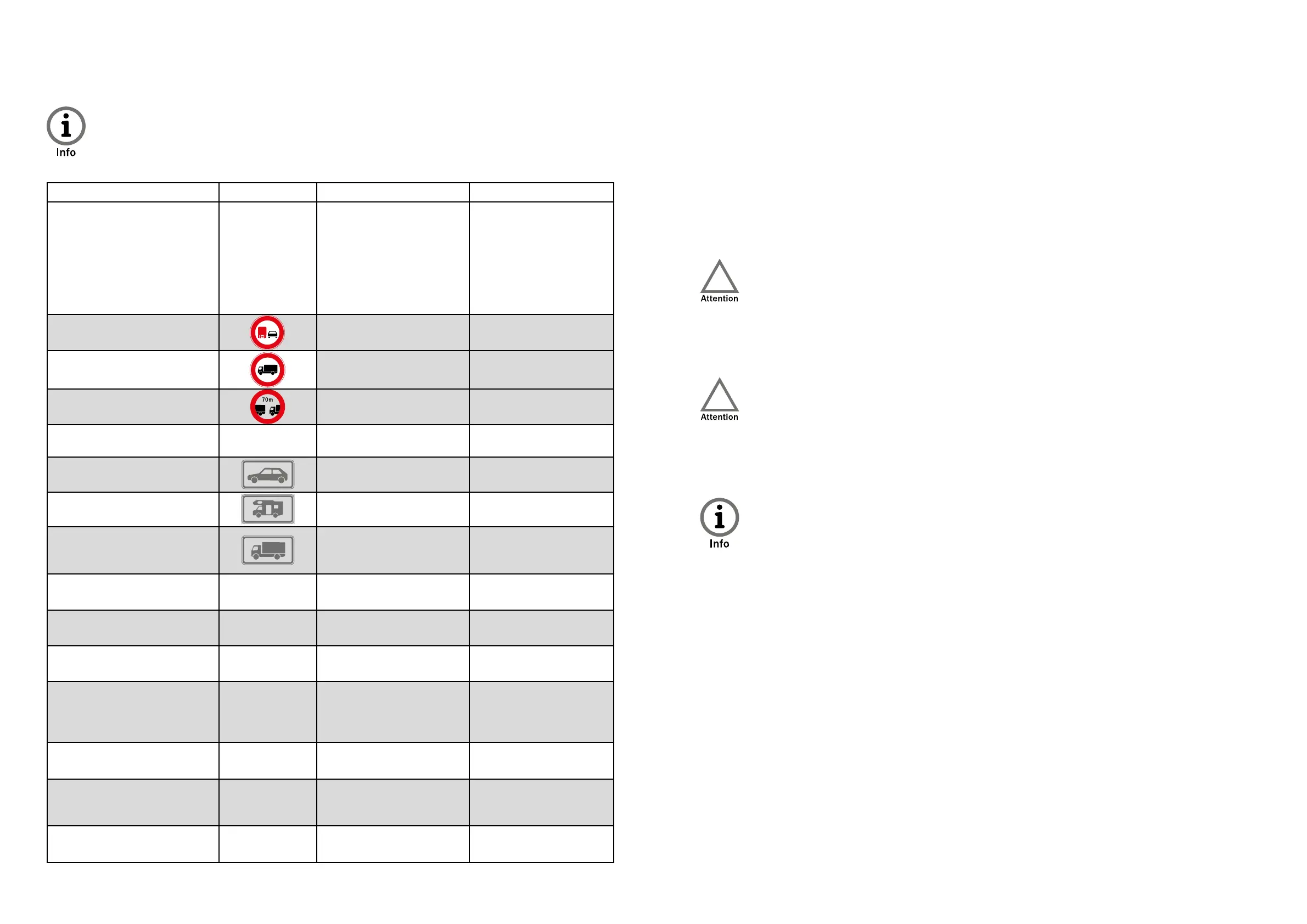
No overtaking for motor vehicles
over 3.5 tons (including trailer)
not affected applicable
Traffic prohibition for motor vehicles
over 3.5 tons
not affected applicable
Prohibition of driving without a mini-
mum distance
not affected applicable if vehicle in front is
heavier than 3.5 tons
Parking on pavements Parking not permitted Parking not permitted
Additional sign:
only cars
not affected not affected
Additional sign:
only motorhomes
applicable applicable
Additional sign: only Motor vehicles
with more than 3.5 tons authorised
total weight
not applicable applicable
Stopping vehicles in the dark
inside city limits
not affected own light source or warning
board
outside city limits
own light source:
(Side light)
own light source:
(Side light)
Parking and stopping of vehicles in
the public traffic area
as before. Not on pavements
with parking space marking
as before. Not on pavements
with parking space marking
This has to be carried along First aid kit, Warning triangle,
High-visibility vest
First aid kit, Warning triangle,
Warning light, High-visibility
vest
TÜV inspection after months 24 months
(first at 36)
24 months
(after 6 years 12 months)
Emissions test after months 24 months 24 months (after 6 y. 12
mon.)
Testing the LPG system
according to G 607 after months
24 months 24 months
Below are a few pointers regarding street signs in Germany. We do not guarantee the completeness
and content here.
Source: ADAC, Last updated: 08/2019
1.4 Parking
Shift into gear (put the gearbox in position “P” for the automatic transmission) and apply the handbrake , or for electrical
handbrakes pull the lever. It is necessary that the motorhome is as level as possible to ensure the unimpeded drainage
of dirty water from the shower and sink. Levelling wedges are practical for this.
If your motorhome is equipped with an awning, always secure it with additional tension to the ground when in use.
Awnings raised by gusts of wind often cause costly damage to the vehicle. If the electric drive fails, the awning must be
operated manually (the crank is located in the rear storage compartment).
The awning must be fully retracted before starting the engine (driving)!
Your motorhome is equipped with rear supports, never use them for a possible wheel change.
For motorhomes with rear axle air suspension:
The motorhome must be lowered completely using the rear axle air suspension before the rear supports
are used. If this procedure is not followed, the supports and the motorhome floor can be damaged.
For more detailed information on operating the air suspension, please refer to the manufacturer‘s opera-
ting instructions.
Here are some practical tips:
• When you have lowered the rear supports, place the hand crank on the steering wheel as a reminder in
the cab. In this way you will avoid an erroneous start with the supports lowered.
• In midsummer, if possible, park the motorhome in such a way that the ventilation slots of the refrigera-
tor are not exposed to the blazing sun, so that your refrigerator will work better.
• When parking on public roads within closed towns, red/white “night parking signs” must be attached
to the motorhome in the dark (for vehicles over 3.5 t).
• When leaving a stopover place, make sure that you do not leave any damage or rubbish: Discretion and
environmental awareness are the most important characteristics of motorhome users.


 To Next Page