ASSEMBLING THE ENGINE
36 37
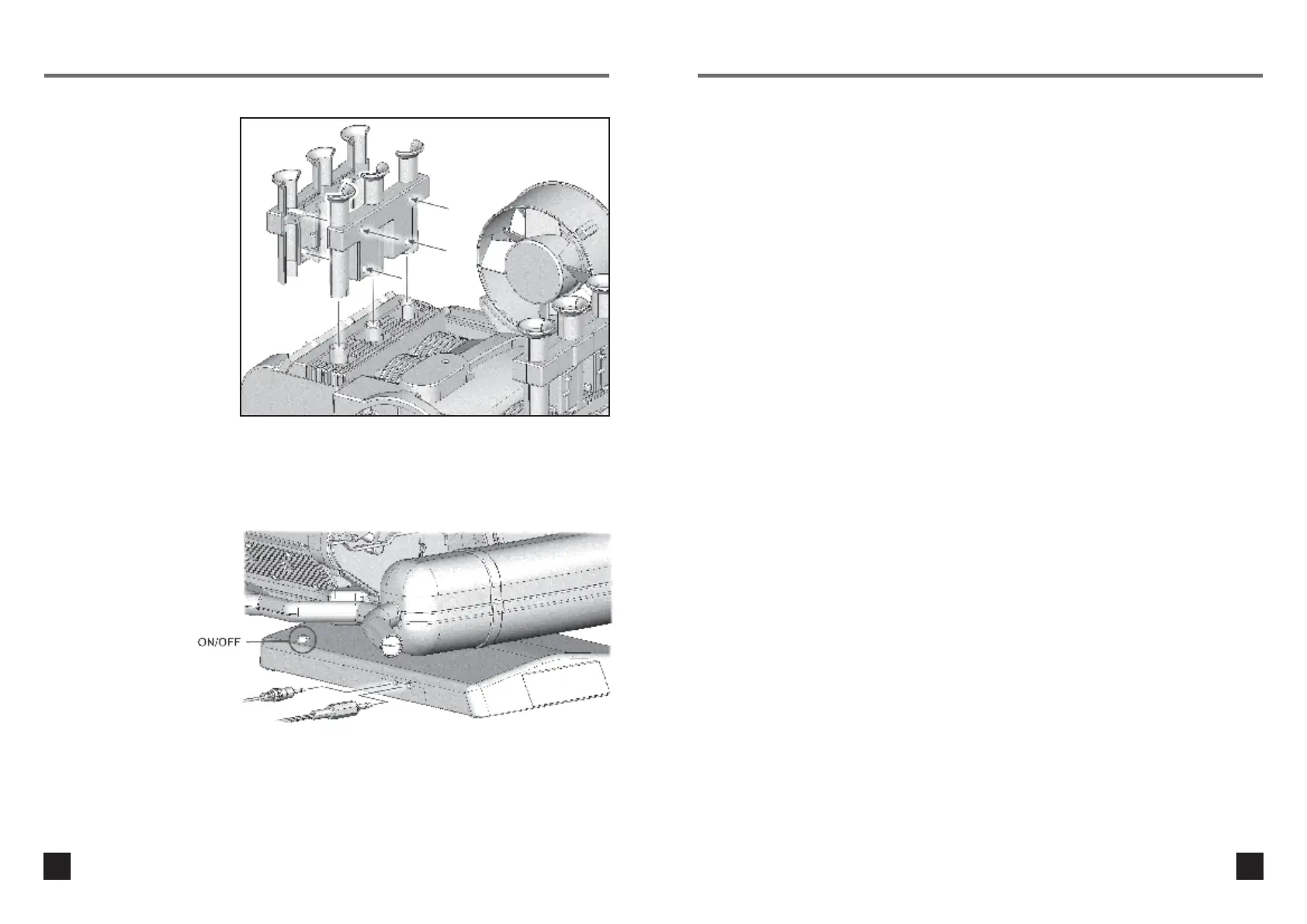
Step 40. Carburettors
Each set of carburettors is in
two halves (15 & 16). Fit each
pair together and secure with
four screws. Place each in
position over the three inlet
pipes on the top of the cylinder
heads.
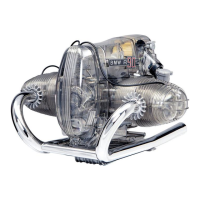
Step 41. Operation
Insert the two electrical plugs into the base -
they are two different sizes, and will only fit one
way.
Press the on/off button on the
base to begin operating the
engine. It will continue to run
for 30 seconds and then stop
automatically. Press the on/off
button while the engine
is running to stop it
before the end of the
30 second cycle. Pressing
the button again will start
another 30 second cycle.
HOW AN ENGINE WORKS
Basic Principles
To explain how a full-size car engine works, we’ll use a simplified version of a real engine -
our model engine in fact. You can switch on your finished model as you read this
explanation and it will help you to understand how a real engine works.
An engine crankshaft is described as such because it is a ‘cranked’ shaft – the shaft has
offset sections, to which the six piston/connecting rod assemblies are connected. In the
model, as the crankshaft turns (driven by the electric motor), the cranked sections move
around the centreline of the crankshaft, and convert the rotation to the reciprocating (up
and down) movement of the pistons. In a real engine, it is the movement of the pistons
(driven by the burning of fuel in the cylinders) that causes the crankshaft to rotate.
The engine’s crankshaft drives the transmission, which includes various different
components connected together whose job it is to drive the car’s wheels, making the
car move.
Now let’s look at how the engine works in more detail. We’ll look at just one cylinder of the
engine. A cylinder is the hollow cylinder inside the engine in which one piston moves up and
down. The piston has seals, called piston rings, around its edge, which aren’t shown on our
model and these seals stop gases passing round the sides of the piston. Our model has
six cylinders.
When you turn the engine to start the car, the starter (a powerful electric motor, powered by
the car’s battery) turns the crankshaft, moving the pistons up and down.
As a piston moves down from its highest position inside the cylinder (called ‘Top Dead
Centre’ or ‘TDC’), a mixture of fuel and air is sucked into the space inside the cylinder
above the piston. This is called the intake stroke.
The starter continues to turn the crankshaft and, as the piston moves back up towards the
top of its cylinder, the fuel/air mixture is compressed (squashed) in the space above the
piston. This is called the compression stroke.
As the piston reaches its highest point, a spark plug creates a spark above the piston and
this spark ignites the fuel/air mixture, causing a small controlled explosion above the piston.
The explosion pushes the piston downwards and this is called the power stroke.
Once the piston has reached its lowest point, it starts to move back up its cylinder, pushing
the burnt gases out through the top of the cylinder. This is called the exhaust stroke.
So, the engine has four strokes; intake, compression, power and exhaust, or ‘suck’,
‘squeeze’, ‘bang’ and ‘blow’ to make it simpler. These four strokes make up the
4-stoke cycle.
The fuel/air mixture flows into the space above the piston, called the combustion chamber.
The mixture flows in through a small hole which is opened and closed by the inlet valve.
The burnt gas flows out of the cylinder through another hole which is opened and closed by
the exhaust valve. The valves are normally held closed by springs, but as the engine turns the
valves are pushed open in the correct order by the rocker arms, which are moved by the
camshaft. The rocker arm pushes the valve down against its spring and, as the rocker moves
up, the spring pushes the valve closed.


 To Next Page