The car that was to become the Porsche 911 was first unveiled at
the 1963 Frankfurt motor show, intended as a larger, more
comfortable, successor to the legendary 356. As well as a new
chassis and suspension, a completely new, six cylinder, overhead
cam boxer engine was designed (called the Type 901), to replace
the four cylinder, overhead valve unit used in the 356. Design of
the new engine was led by Hans Mezger, a German automotive
engine who became a key part of Porsche’s development
programme for 35 years.
The primary reason for using the new 6-cylinder engine was to
utilise the inherent smoothness offered by the boxer configuration.
Because it consisted of three pairs of pistons moving backwards
and forwards in opposite directions, with each pair spaced at 120
degrees of crankshaft rotation, the design minimised first and
second order vibrations (vibrations that occur once and twice per
engine revolution). In addition, the short length of the engine, low
centre of gravity, and effectiveness of air cooling made it ideal for
the rear-engine 911.
To meet the high bending stresses at very high revolutions, the
forged crankshaft was supported with eight main bearings.
The crankcase was split vertically, and like all of the major
components, was made from aluminium (even the cooling fins of
the cylinders were aluminium, with cast iron sleeves inside them).
Each row of three cylinders had an overhead camshaft, these
being driven by a duplex chain running around intermediate gears
on a layshaft (itself gear driven from the crankshaft). Accurate
valve timing and smooth operation were achieved by using a
hydraulic cam chain tensioning wheel and rubber guide ramps.
The valves were arranged in a V-shape, which allowed the use of a
hemispherical combustion chamber with a small, smooth and
heat-absorbing surface. Initial versions of the engine used Solex
overflow-type carburettors, and although these had the benefit of
being relatively insensitive to forces caused by hard cornering,
problems with these, including a flat spot at low engine speeds,
led to them being changed for Weber carburettors in 1966.
INTRODUCTION
4 5
An 11 bladed axial fan,
with the alternator inside it,
was mounted on top of the
engine to improve cooling
by helping to ensure the
air was more evenly
distributed to both sets of
cylinders.
In its original form (Type
901/01), the engine had a
capacity of 1,991 cubic
centimetres, with a
cylinder bore of 80 mm
and a stroke of 66 mm.
Power output was 130 hp (96 kW) at 6,100 rpm. Subsequent
developments led to the 901/02, 901/03 and other versions,
each having different specifications depending on the intended
use (sports, touring etc). The Carrera six engine (Type 906) was
developed simultaneously to the Type 901, the main differences
being the use of twin spark plugs per cylinder,
higher-compression pistons, and the use of lighter weight
(magnesium and titanium) components. A major change came
in 1970, with the capacity of the engine being increased to
2,200 cubic centimetres (2.2 litres) by increasing the bore to 84
mm. The original engine configuration was still being used until
1972, when it was superseded by the even larger 2,341 cubic
centimetre engine.
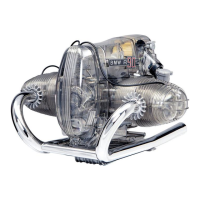
The model in this kit is intended as representation of the Type
901 engine used in the early 911. Although it lacks the fine
details of the real engine, it includes a realistic crankshaft, a
working cooling fan, and accurate valve and ignition timing.
Even the distributor works correctly, being driven from the
crankshaft using bevel gears, with its red colour closely
matched to the real thing.
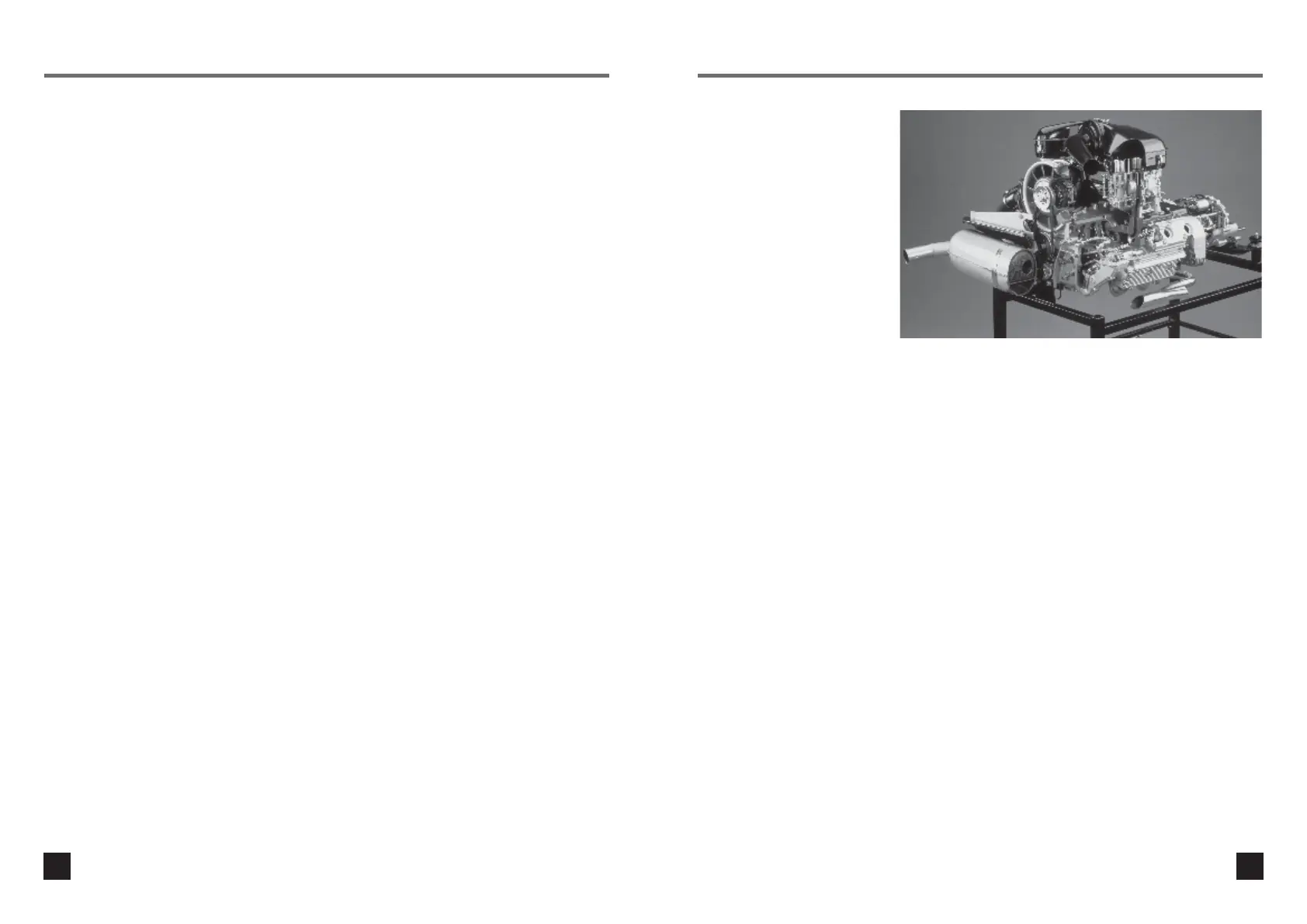
An early Porsche 911 engine, with cut-away sections to show the internal
components. The engine shown is part of the Porsche museum collection
in Stuttgart.


 To Next Page