EasyManua.ls Logo

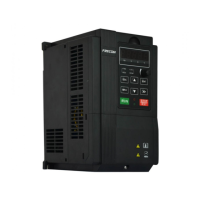
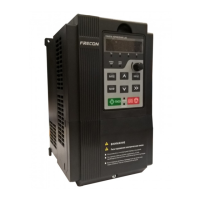
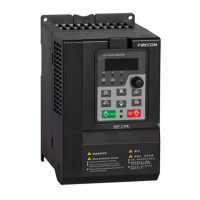
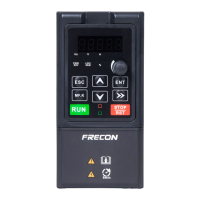
Frecon FR500-4T-2.2GB - User Manual

Default Icon
171 pages
Print Icon
To Next Page IconTo Next Page
Loading...
FR500A&FR510A Series Vector Control Inverter
- 1 -
Preface
Thank you for choosing FRECON developed and produced FR500A&FR510A series
vector control inverter.
FR500A&FR510A series vector control inverter is mainly positioned as a high-end market for
OEM customers and the specific requirements of fan and pump load applicationsits flexible design,
both embedded SVC and VF control in one, can be widely used for speed control accuracy, torque
response speed, low-frequency output characteristics and other situations with higher requirements.
This user manual supplies a detailed description of FR500A &FR510A series vector control
inverter includes product characterization, structural features, parameter setting, operation and
commissioning, inspection maintenance and other contents. Be sure to carefully read through the
safety precautions before use, and use this product on the premise that personnel and equipment
safety is ensured.
IMPORTANT NOTES
To illustrate the details of the productspictures in this manual based on products with outer
casing or safety cover being removed. When using this product, please be sure to well install
outer casing or covering by the rules, and operating in accordance with the manual contents.
The illustrations this manual for illustration only and may vary with different products you have
ordered.
The company is committed to continuous improvement of products, product features will
continue to upgrade, the information provided is subject to change without notice.
If you are using have questions, please contact our regional agents or our customer service
center. Customer Service Tel 0755 -33067999.
The company's other products please visit our website. http://www.frecon.com.cn

Table of Contents

Questions and Answers

Summary

Chapter 1 Safety Precautions

1.1 Safety Considerations

Details critical safety aspects for inverter installation, wiring, and operation phases.

1.2 Precautions

Lists specific precautions for motor insulation, thermal protection, vibrations, and operational conditions.

Chapter 2 Product Information

2.2 Information of Product Model

Provides a detailed table of product models and their technical specifications.

2.3 Technical Features

Details the inverter's technical capabilities, including power, control, and basic functions.

2.5 Configuration, Mounting Dimensions and Weight

Provides details on the inverter's configuration, physical dimensions, and weight.

Chapter 3 Installation and Wiring

3.1 Installation Environment

Specifies the recommended environmental conditions for inverter installation, including temperature and vibration.

3.2 Installation Direction, Space and Cooling

Details installation orientation, required clearances, and cooling considerations for proper operation.

3.6 Configuration of Peripheral Devices

Shows standard configurations for peripheral devices used with the inverter.

3.6.1 Selection of Peripheral Devices

Provides guidelines for selecting appropriate peripheral devices like circuit breakers and contactors.

3.7 Wiring way

Describes the general wiring principles and diagrams for inverter connections, including signal separation.

3.8 Terminal Configuration

Details the main circuit terminal configurations for various power ratings.

3.8.2 Control circuit terminals

Details the control circuit terminals and their functions, including analog and digital inputs/outputs.

EMI Solutions

Discusses methods to mitigate electromagnetic interference (EMI) from the drive.

Grounding

Explains recommended grounding practices for optimal system performance and safety.

Chapter 4 Operation and display

Viewing and Modifying Function Codes

Details how to navigate and change parameter settings using the three-level menu structure.

Motor Auto-tuning

Describes the process and importance of motor auto-tuning for optimal performance.

Chapter 5 List of Parameter

Standard Function Parameters

Lists and describes the standard function parameters available in the inverter, categorized by group.

Group F01 Frequency command

F01.00 Frequency source selection

Selects the source for frequency commands (keypad, analog, communication, PLC).

F01.01 Master frequency source selection

Defines the master source for frequency commands, allowing multiple input options.

F01.03 Auxiliary frequency command source

Selects the source for auxiliary frequency commands, complementing the master source.

Group F02 Start;Stop Control

F02.00 Run command

Sets the source for the run command (keypad, terminals, communication).

F02.04 Start mode

Configures the inverter's start mode, including direct start and speed tracking.

Group F03 Accel;Decel Parameters

F03.00 Accel time 1

Sets the first acceleration time from 0 Hz to maximum frequency.

Group F04 Digital Input

Group F05 Digital Output

Group F06 Analog and Pulse Input

Group F07 Analog and Pulse Output

Group F08 Parameters of Motor 1

Motor 1 type selection

Selects the type of Motor 1 (asynchronous, synchronous, single-phase).

Group F09 V;f Control Parameters of Motor 1

V;f curve setting

Configures the V/f curve for Motor 1, defining voltage-frequency relationship.

Group F10 Vector Control Parameters of Motor 1

Speed;torque control

Selects between speed control and torque control modes for Motor 1.

Group F11 Protection Parameters

Current limit control

Controls the current limiting behavior of the inverter, with multiple modes.

Overvoltage stall control

Manages overvoltage stall protection behavior, with different modes for deceleration.

Overload alarm threshold

Sets the threshold for triggering overload alarms based on current or temperature.

Group F12: Multi-Reference and Simple PLC Function

Group F13 Process PID

PID setting

Selects the source for PID control settings (digital, keypad, analog, communication).

Group F15 Communication Parameters

Group F20 Vector Control Parameters of Motor 2

Speed;torque control

Selects speed or torque control for Motor 2, supporting vector control modes.

Group F21 Position Control

Selection of Position Control Mode

Selects the mode for position control operations (Non-position, Zero Servo, Spindle Orientation).

Group U01 Fault Record

Code of the latest fault

Shows the code of the most recent fault that occurred, indicating the fault type.

Chapter 6 Specification of Parameters

F00.00 Setting of user password

Configures a user password for accessing the inverter's menu and parameters.

F00.08 Motor 1 control mode

Selects the control mode (V/f, Vector Control) for Motor 1.

F00.13 Carrier frequency

Sets the PWM carrier frequency for the inverter, affecting noise and efficiency.

Chapter 7 Maintenance and Troubleshooting

Err01 Accel overcurrent

Details possible causes and solutions for acceleration overcurrent faults.

Err05 Decel overvoltage

Lists causes and solutions for deceleration overvoltage faults.

Err29 Instantaneous overcurrent

Explains causes and solutions for instantaneous overcurrent faults.

Chapter 8 Maintenance and Inspection

8.1 Inspection

Outlines the daily and periodic inspection procedures for the inverter and its components.

Appendix A: Modbus Communication Protocol

Appendix B: Braking Resistor

Recommended braking resistor power rating and resistance

Provides a table of recommended braking resistors based on inverter model for load conditions.

Frecon FR500-4T-2.2GB Specifications

General IconGeneral
Rated Power2.2 kW
Input Voltage380V±15%
Output Voltage380V
Output Power2.2 kW
Weight4.5 kg
Frequency50Hz/60Hz

Related product manuals