Chapter 10 Electrical System
2. B a t t e r y
SM/IGM'2GM'$GM (D) *3HM
2. B a t t e r y
2-1 C o n s t r u c t i o n
The battery utilizes chemical action to convert chemical
energy to electrical energy. This engine uses a lead acid
battery which stores a fixed amount of power that can be
used when required. After use, the battery can be
recharged and used again.
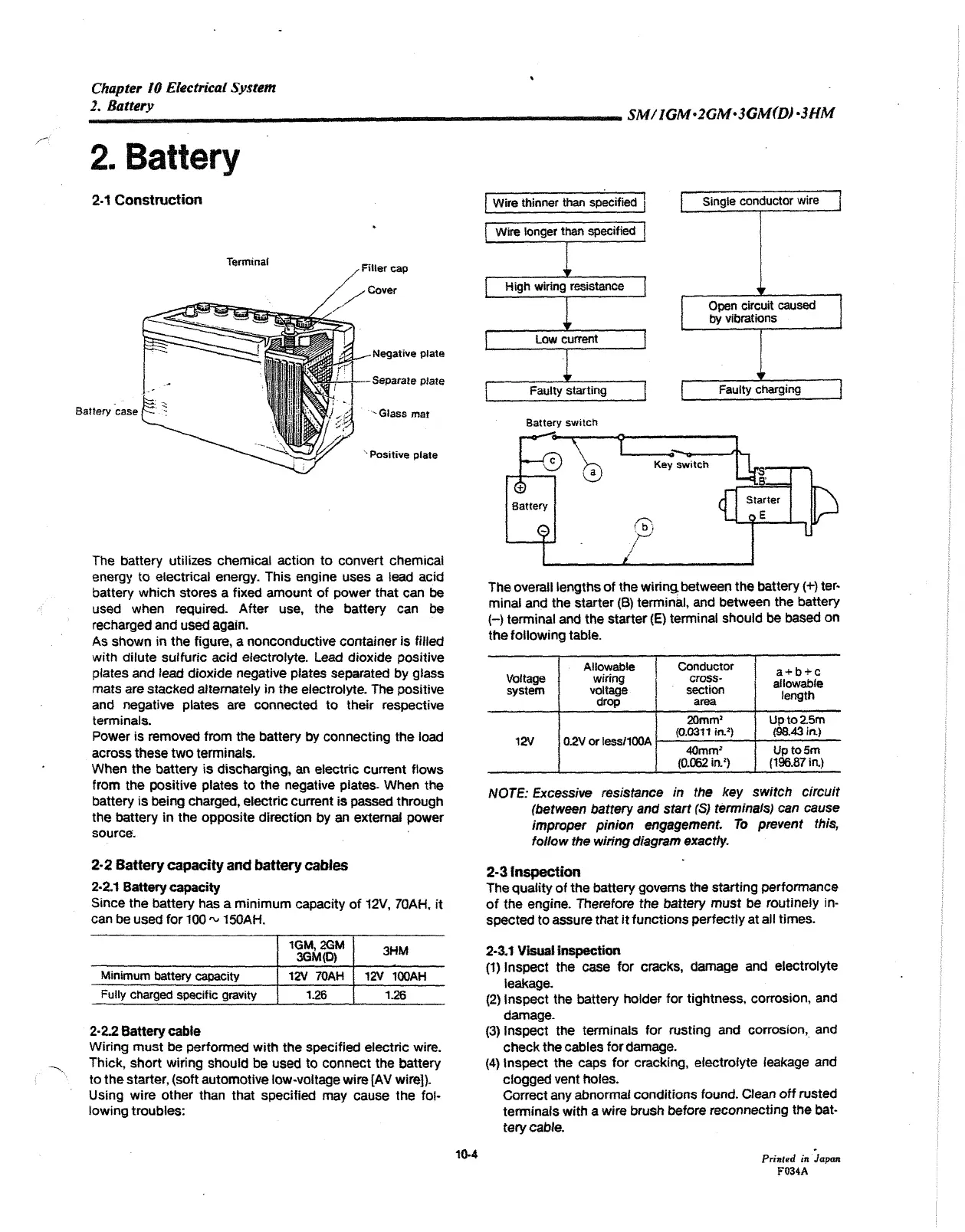
As shown in the figure, a nonconductive container is filled
with dilute sulfuric acid electrolyte. Lead dioxide positive
plates and lead dioxide negative plates separated by glass
mats are stacked alternately in the electrolyte. The positive
and negative plates are connected to their respective
terminals.
Power is removed from the battery by connecting the load
across these two terminals.
When the battery is discharging, an electric current flows
from the positive plates to the negative plates- When the
battery is being charged, electric current is passed through
the battery in the opposite direction by an external power
source.
2-2 Ba t t ery c a p a c it y an d ba tt e ry c a b l e s
2-2.1 Battery capacity
Since the battery has a minimum capacity of 12V, 70AH, it
can be used for 100 ~ 150AH.
1GM, 2GM
3GM(D)
3HM
Minimum battery capacity 12V 70AH 12V 100AH
Fully charged specific gravity
1.26 1.26
2-2.2 B a t t e r y c a b l e
Wiring must be performed with the specified electric wire.
Thick, short wiring should be used to connect the battery
to the starter, (soft automotive low-voltage wire [AV wire]}.
Using wire other than that specified may cause the fol
lowing troubles:
Wire thinner than specified j
Single conductor wire
Wire longer than specified
____________
i
___________
High wiring resistance
1
f
1
r
Open circuit caused
by vibrations
Low current
i
.
Faulty starting |
Faulty charging
Battery switch
The overall lengths of the wiring between the battery (+) ter
minal and the starter (B) terminal, and between the battery
(-) terminal and the starter (E) terminal should be based on
the following table.
Voltage
system
Allowable
wiring
voltage
drop
Conductor
cross-
section
area
a + b + c
allowable
length
12V
0.2V o r le ss/I OOA
20mm1
(0.0311 in.1)
Up to 2.5m
(98.43 i n)
40mm1
(0.062 in.1)
Up to 5m
(196.87 ia )
NOTE: Excessive resistance in the key switch circuit
(b e t w e e n b a t t e r y a n d s t a r t (S) t e r m i n a l s ) c a n c a u s e
improper pinion engagement. To prevent this,
follow the wiring diagram exactly.
2-3 i n s p e c t i o n
The quality of the battery governs the starting performance
of the engine. Therefore the battery must be routinely in
spected to assure that it functions perfectly at all times.
2-3,1 Visual inspection
(1) Inspect the case for cracks, damage and electrolyte
leakage.
(2) Inspect the battery holder for tightness, corrosion, and
damage.
(3) Inspect the terminals for rusting and corrosion, and
check the cables for damage.
(4) Inspect the caps for cracking, electrolyte leakage and
clogged vent holes.
Correct any abnormal conditions found. Clean off r u s t e d
terminals with a wire brush before reconnecting the bat
tery cable.
10-4
Printed in Japan
F034A



 To Next Page