11
Compressor
There are two types of compressors used on
dehumidifiers:
1. Permanent Split Capacitor compressor (Rotary)
2. Split Phase compressor (Reciprocating)
Permanent Split Capacitor (PSC) Compressor
This compressor has a Start and Run winding with a
capacitor wired in series with the Start winding. When
power is applied, the capacitor assists in bringing the
compressor motor to optimum speed.
Split Phase Compressor
This compressor has a Start and Run winding. On models
equipped with a current activated relay, the relay is wired
in series with the Run winding. When power is applied to
the Run winding, The high starting current pulls the relay
armature up, closing contacts to complete the circuit to
the Start winding. The motor starts and accelerates to a
point where the current is reduced enough to allow the
relay to drop out and disconnect the circuit to the Start
winding. This point occurs at about 80% of full speed.
The motor continues to accelerate to full speed on the
Run winding alone. On models with PTC relay, current is
applied to both windings at the same time. This starts the
compressor. As current flows through the relay to the Start
winding, the relay will increase in resistance . Within a
fraction of a second, the resistance will climb high enough
for the Start winding to drop out.
CAUTION: Replacement compressors are charged
with oil at the factory. Care should be exercized when
replacing a compressor to avoid spilling any oil.
To Test Compressor Motor
WARNING: WHENEVER TESTING A
COMPRESSOR, EXTREME CAUTION SHOULD
BE USED TO PREVENT DAMAGING THE
TERMINALS. A COMPRESSOR WITH A
DAMAGED TERMINAL OR A GROUNDED
WINDING CAN EXPEL A TERMINAL FROM ITS
INSULATED HOUSING WHEN THE
COMPRESSOR IS ENERGIZED. IF THIS
HAPPENS, A MIXTURE OF REFRIGERANT AND
OIL WILL BE RELEASED THAT CAN BE IGNITED
BY AN EXTERNAL HEAT SOURCE (OPEN
FLAME, HEATER, ETC.). ALSO, IF THERE IS AIR
IN THE SYSTEM WHEN THIS HAPPENS, A
SPARK AT THE COMPRESSOR SHELL COULD
IGNITE THE REFRIGERANT AND OIL MIXTURE.
NOTE: If compressor has a permanent split
capacitor (PSC) motor, running capacitor should be
tested first.
1. Disconnect dehumidifier from electrical supply.
2. Remove leads from compressor terminals.
3. Check for grounded windings by testing continuity
from each terminal to any copper tubing connected
directly to compressor. If continuity is indicated,
motor windings are grounded and compressor will
have to be replaced.
4. Check for open windings by checking continuity
from Start-to-Run terminals. If no continuity is
found, a winding is open and compressor must be
replaced.
Possible Causes of Compressor Overloading or
Overheating
1. Shorted winding. Recheck Start and Run windings.
2. Low voltage. With dehumidifier disconnected,
check voltage at electrical outlet. Voltage should be
of 115 VAC,+/- 10%.
3. Plug in dehumidifier and check voltage. If voltage is
not within +/- 10% of 115 VAC, compressor break
down or overheating may occur. Excessive voltage
drop during start-up or while running may be cause
of motor overload opening.
4. Defective run capacitor (if supplied). If compressor
will not start (or starts slowly), or compressor runs
but draws high current, test capacitor.
5. Dirty evaporator and/or condenser.
6. Insufficient air passing over condenser.
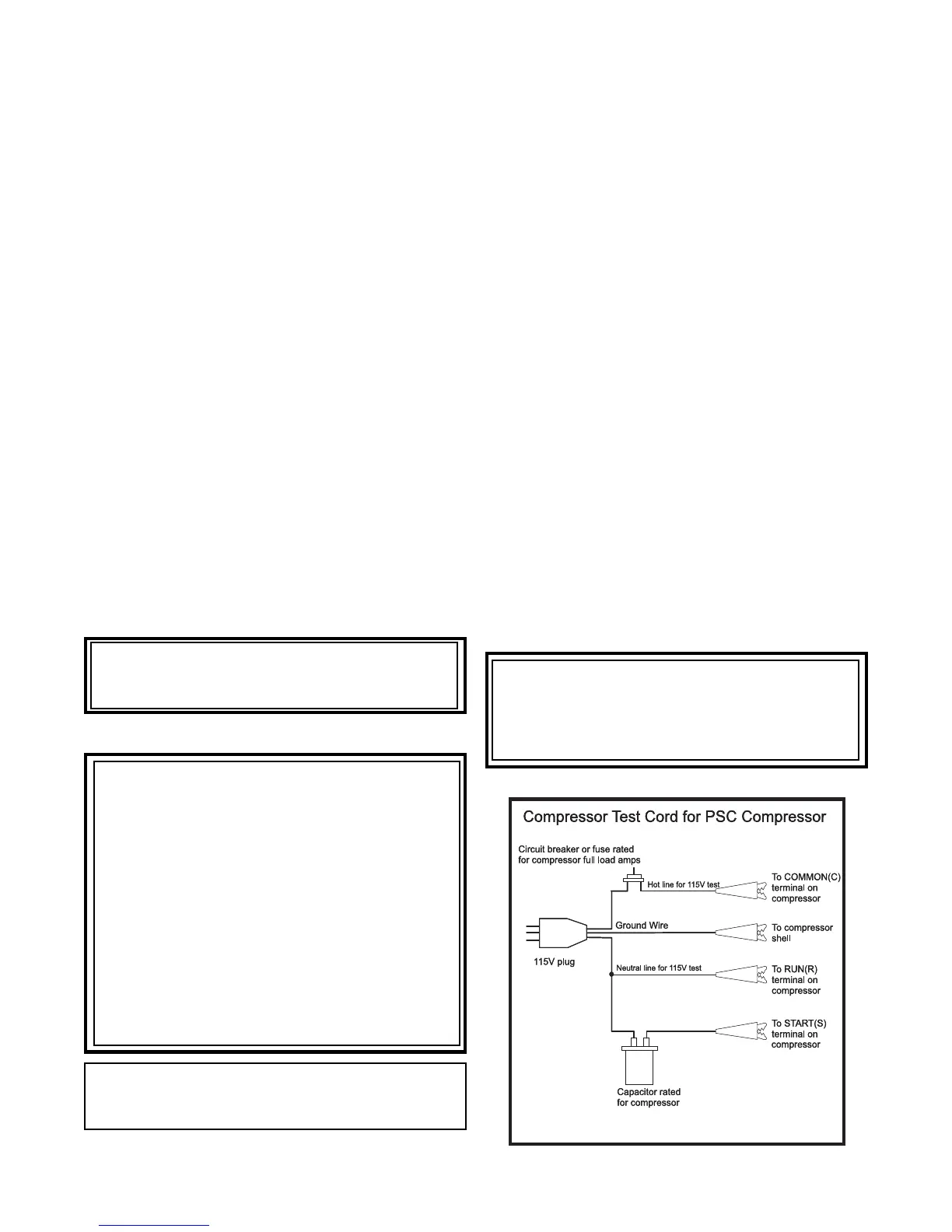
The compressor can also be operated on a test cord when
connected as illustrated below.
CAUTION: If compressor is a permanent split
capacitor type, use only a known good
electrolytic capacitor, rated for compressor
being tested. This running capacitor must be in
circuit while compressor is running.
Compressor Test Cord for PSC Compressor



 To Next Page