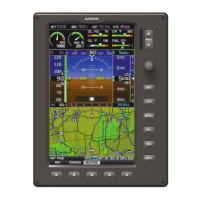
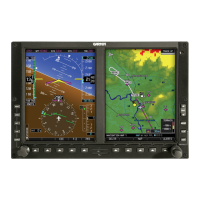
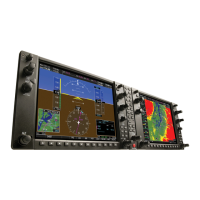
The Garmin G500/G600 PFD/MFD System is an integrated avionics solution designed to provide both a Primary Flight Display (PFD) and a Multi-Function Display (MFD) within the pilot's primary field of view. This system is installed in aircraft as an Instructions for Continued Airworthiness (ICA) in accordance with Federal Aviation Regulation (FAR) Part 23.1529 and Part 23 Appendix G, under an Approved Model List (AML) Supplemental Type Certificate (STC).
Function Description:
The G500/G600 system combines several Garmin Line Replaceable Units (LRUs) to deliver comprehensive flight information. Its core components include:
- GDU 620 Display Unit: This serves as the central interface, providing both PFD and MFD displays and front panel controls for all system operations and configurations.
- GRS 77 Attitude Heading Reference System (AHRS): Provides critical attitude and heading information, utilizing an Earth magnetic field model that requires updates every five years as part of the Aviation Database.
- GDC 74() Air Data Computer (ADC): Calculates and displays air data parameters.
- GMU 44 Magnetometer: Measures the Earth's magnetic field for heading reference.
- GTP 59 Outside Air Temperature (OAT) Probe: Measures ambient air temperature.
- Optional GAD 43/43e Adapter: Facilitates integration with analog navigation receivers and other aircraft systems.
- Optional Mid-Continent Instruments Attitude Indicator (models 4300-4() or 4200-() with MD420): Provides a standby attitude reference, often with an integrated battery pack for independent operation.
The system is powered by the aircraft's electrical bus, typically controlled by circuit breakers for each LRU. In dual installations, LRU circuit breakers are suffixed with numbers (e.g., PFD 1, PFD 2), and if optionally powered from multiple breakers, with letters (e.g., PFD 1A, PFD 1B).
Usage Features:
The GDU 620 features intuitive controls for navigation and data entry. Knobs on the lower left and right corners are used for selecting and entering data on each screen. Soft keys along the bottom of the display are context-sensitive, with their functions indicated by on-screen text. Dedicated ENT, CLR, and MENU keys are available on the MFD side.
- PFD Knob: Adjusts values for modes selected by PFD bezel keys (e.g., Heading, Course, Altitude, Vertical Speed, Barometric Setting). Pressing the knob reverts to the default value.
- Small (Inner) MFD Knob: Selects specific pages within a page group and toggles the selection cursor ON/OFF for data entry. When the cursor is ON, it selects individual characters or values.
- Large (Outer) MFD Knob: Selects MFD page groups. When the cursor is ON, it highlights available fields.
Upon power-up, the system performs a self-test and displays a database confirmation page. Invalid or expired databases are indicated in yellow. The AHRS typically aligns within one minute, displaying attitude on the PFD. System alerts are accessible via an "ALERTS" softkey.
Configuration Mode is accessed by inserting an Installer Unlock Card into the GDU 620's SD card slot, applying power while holding the ENT key, and releasing it when "INITIALIZING SYSTEM" appears.
Maintenance Features:
The G500/G600 system is designed with robust self-monitoring capabilities. All LRUs detect internal failures, executing thorough self-tests upon power application and continuously running built-in tests. Detected errors are annunciated on the GDU 620 display.
- Periodic Maintenance (Annual): A visual inspection of all G500/G600 system LRUs and wiring harnesses is required every 12 calendar months to ensure installation integrity. This includes checking:
- Security of attachment for all units, brackets, and supporting structures.
- Legibility of switches, knobs, and buttons.
- Wiring for chafing or wear at terminations.
- Signs of corrosion.
- Aluminum foil tape (if used in non-metallic aircraft) for integrity.
- Transient Voltage Suppressors (TVS) Testing (Every 24 Calendar Months): For non-metallic aircraft, TVS components (located at GDU 620, GRS 77, GDC 74, GAD 43, and standby indicators/power bus) must be tested every 24 calendar months.
- Electrical Bonding Test (Every 2000 Flight Hours or 10 Years, whichever comes first): LRU electrical bonding must be tested. Measured resistance should not exceed specified values (e.g., 40 mΩ for GDU 620 to instrument panel, 20 mΩ for GRS 77 to aircraft ground plane). GMU 44 and GTP 59 do not require bond checks due to isolation requirements.
- GRS 77 AHRS Magnetic Model Update: The Earth magnetic field model used by the GRS 77 needs updating every five years as part of the Aviation Database.
- GDC 74() Air Data Computer Testing: Must be tested according to 14 CFR §§ 91.411 and 91.413, and 14 CFR §§ 43 Appendix E, including pitot-static checkout procedures.
- Mid-Continent Instruments Standby Attitude Indicator Battery Pack Testing: If installed, the battery pack must be tested manually or using a dedicated charger/tester (P/N 36029). Manual testing involves disconnecting the battery, ensuring it's charged, connecting it to a 90-ohm load for 60 minutes, and verifying the voltage remains above 15.0 volts. Batteries below this threshold must be replaced. Discharged batteries should be recharged promptly and maintained with a float charge for maximum life.
- TBM 700(850) RVSM Periodic Maintenance (G600 Only): Requires maintenance of all RVSM equipment, encoding altimeter checks, and inspection of RVSM critical areas as specified in the Socata Maintenance Manual. Air data systems and autopilot altitude hold performance must also be checked within 24 months.
- Lightning Strike Inspection: After a suspected lightning strike, specific inspections are required, including checking the GTP 59 OAT probe for damage, replacing TVS components in non-metallic aircraft, inspecting OAT bond straps in tube and fabric aircraft, inspecting magnetometer installations in wingtips, and inspecting overbraid to weather radar interfaces.
- GDU 620 Dual Power Bus Diodes Functional Check: If optional dual power bus diodes are installed, a functional check of diode isolation is required.
- Troubleshooting and Replacement: In case of system failure, troubleshooting information is available in the G500/G600 AML STC Installation Manual. If LRUs are removed and reinstalled, a power-up self-test must be successfully completed without failure messages. Any component replacement must be with the same model and part number or a defined equivalent. GAD 43e calibration is required if the GAD 43e or analog navigation receiver is replaced.
Technical Specifications (General):
- Dwg. Number: 190-00601-00 Rev. L
- Manufacturer: Garmin International, Inc., 1200 E. 151st Street, Olathe, Kansas 66062 USA
- Overhaul Period: The system does not require overhaul at a specific time period; its health is continuously monitored by self-tests and built-in tests. LRUs are replaced on condition.
- Special Tools: A milliohm meter is required for electrical bonding testing. No special tools are needed for system checkout.
Documentation and Support:
This ICA is controlled by the Garmin document control system. Revisions require submission to the ACO or ODA for acceptance and approval. The latest revision is available on the Garmin website (www.garmin.com), and significant revisions are announced via Garmin Service Bulletins. Garmin customer assistance is available via phone or email for questions regarding the equipment and its installation. The aircraft operator is obligated to include the maintenance information from this document in the aircraft's maintenance manual and/or scheduled maintenance program.

 Need help?
 General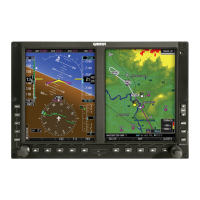

 To Next Page