62
Geberit Drainage Systems
The following symbols and abbreviations are used to
indicate the composition of the flow substances:
% Percentages refer to mass proportions in %.
VL Aqueous solution, mass proportion <= 10%.
L Aqueous solution, mass proportion > 10%.
GL Aqueous solution saturated at 20°C.
TR Chemical is at least technically pure.
H Normal commercial composition.
S Traces < 0.1%.
G Usual mass proportion of any saturated
solution or dilution.
Data is based on immersion tests without mechanical load
and reflects current levels of knowledge. No claims under
guarantee may be made on the basis of this information.
Chemical resistance
Appendix: Chemical Resistance
The following data is required for a declaration
of chemical resistance:
• Corrosion medium, composition (chemical
description), DIN safety data sheet.
• Temperature.
• Proportion (concentration).
• Information on reaction time, frequency, flow quantity.
• Other flow media.
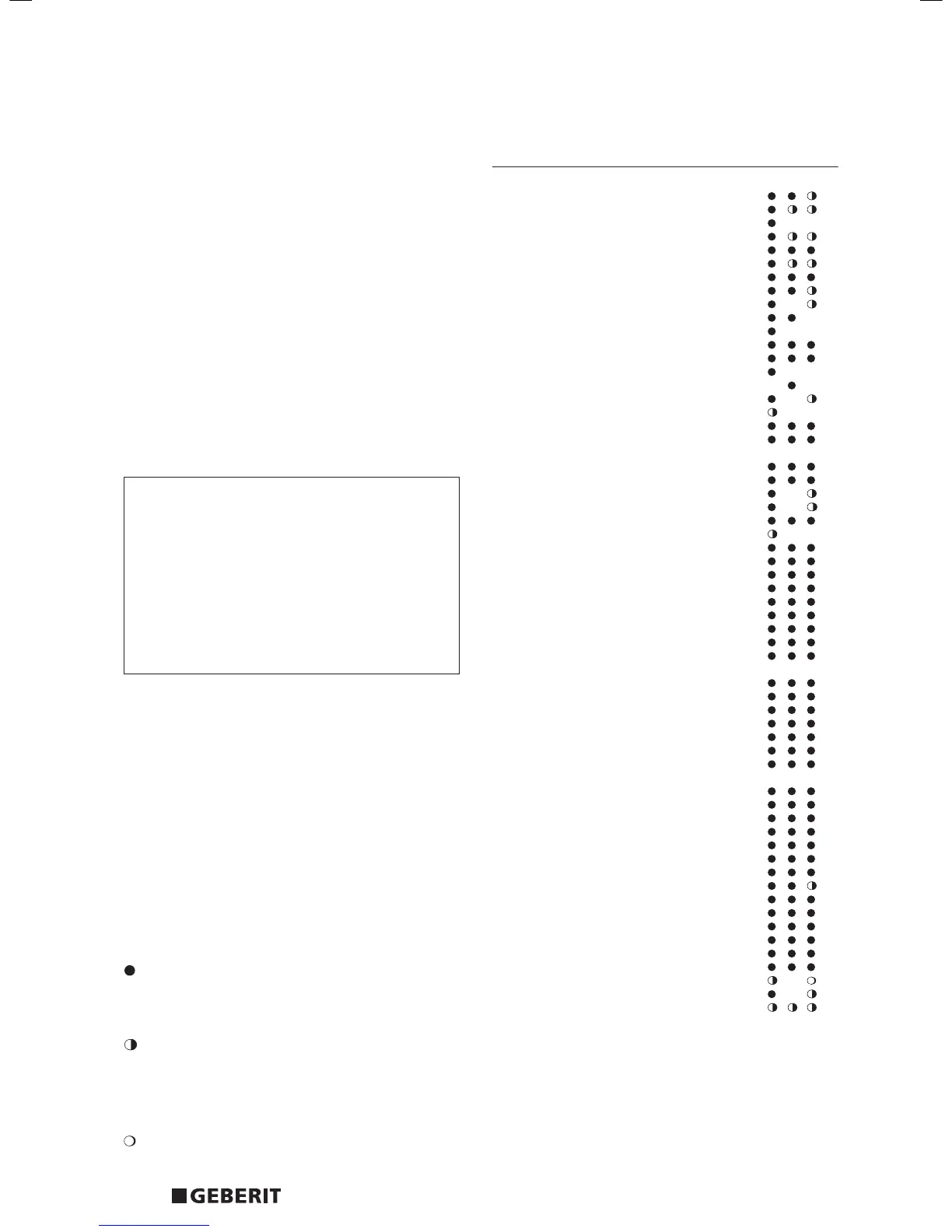
Acetic aldehyde 40
Acetic aldehyde TR
Acetic aldehyde+acetic acid 90:10
Acetanhydride (acetic anhydride) TR
Acetamide TR
Acetanhydride TR
Acetic acid 70
Acetic acid 100
Acetic acid butyl ester
Acetic ether (ethylacetate) 100
Aceto-acetic acid
Acetone VL
Acetone TR
Acetophenone TR
Acetylene
Acronal dispersions H
Acronal solutions H
Acrylonitrile TR
Acrylic acid-emulsions
Acrylic acid ethylester 100
Activine (chloramine 1%)
Adipinic acid GL
Adipinis acid ester
Allyl acetate
Allyl alcohol 96
Allyl chloride
Alum (potassium aluminium sulphate) any
Aluminium chloride VL
Aluminium chloride GL
Aluminium chloride, solid
Aluminium fluoride GL
Aluminium hydroxide
Aluminium metaphosphate
Aluminium sulphate any
Aluminium sulphate, solid
Amidosulphates
(amido-sulphonic acid salts) any
Amido-sulphonicacid any
Amino acids
Ammonia, gaseous 100
Ammonia, liquid 100
Ammonia solution (ammonium hydroxide) any
Ammonium acetate any
Ammonium carbonate
and bicarbonate of ammonium GL
Ammonium carbonate any
Ammonium chloride (sal-ammoniac) any
Ammonium dihydrogen phosphate GL
Ammonium fluoride L
Ammonium hydrosulphide any
Ammonium metaphosphate
Ammonium nitrate any
Ammonium phosphate any
Ammonium sulphate any
Amonium sulphide any
Ammonium thiocyanate
Amyl acetate TR
Amyl alcohol TR
Amyl chloride 100
Amyl phthalate
Anilin (phenylamine) GL
Geberit HDPE
thrFlow ough substance
Proport. Performance at
% 20˚C 40˚C 60˚C
Explanation
When the pipe wall material comes into contact with
substances flowing through the pipe, different processes
can take place, such as the absorption of liquid (swelling),
the extraction of soluble elements in the material
(shrinkage) or chemical reactions (hydrolysis, oxidation
etc), that can sometimes cause the properties of the pipe
or pipeline parts to change.
The performance of pipes and pipeline parts when in
contact with effluent substances can be classed as follows:
NB: Does not cover systems incorporating EPDM seal rings.
Resistant
The pipe wall material is generally regarded
as being suitable.
Limited resistance
The suitability of the pipe wall material must be
checked in each individual case and, if necessary,
further tests should be carried out.
Not resistant
The pipe wall material is general
ly regarded
as being unsuitable.


 To Next Page