Many studies are possible with MENS as its stimulation is not discernible by the patient. Lerner and
Kirsch conducted experiments on 40 patients with chronic low back pain in which patients were
randomly allocated to a MENS treatment group and a placebo group that was hooked up to dummy
MENS units that provided no electrostimulation.
Stimulation was conducted three times a week for eight weeks. Results showed pain reduction of an
average 75% in the MENS treatment group and only 6% in the placebo group. A number of studies
have also found that MENS promotes the healing of wounds and ulcers.
Gault and Gatens reported a positive effect of MENS in 106 patients with ischemia skin ulcers. In
their study, the group treated with MENS using an intensity of 200 μA - 800 μA current recovered
approximately twice as fast as the non-treated control group. It has also been reported by a number
of clinicians that the healing of bone fractures is greatly facilitated by low-level electrical current.
The above-mentioned results demonstrate that MENS is markedly effective in treating acute and
chronic pain, promotes regeneration of damaged tissues, and heals wounds, cicatrix, and bone
fractures. (Gault WR, Gatens PF Jr : Use of low intensity direct current in management of ischemic
skin ulcers. Phys Ther 56~265, 1976.)
Functional mechanism of the MENS currents, “Injury current” and the MENS functions
The functional mechanism of MENS is complicated and has to be fully analyzed yet. Although a
variety of conflicting theories exists, sufficient research findings have been accumulated that the
following conclusion seem justified.
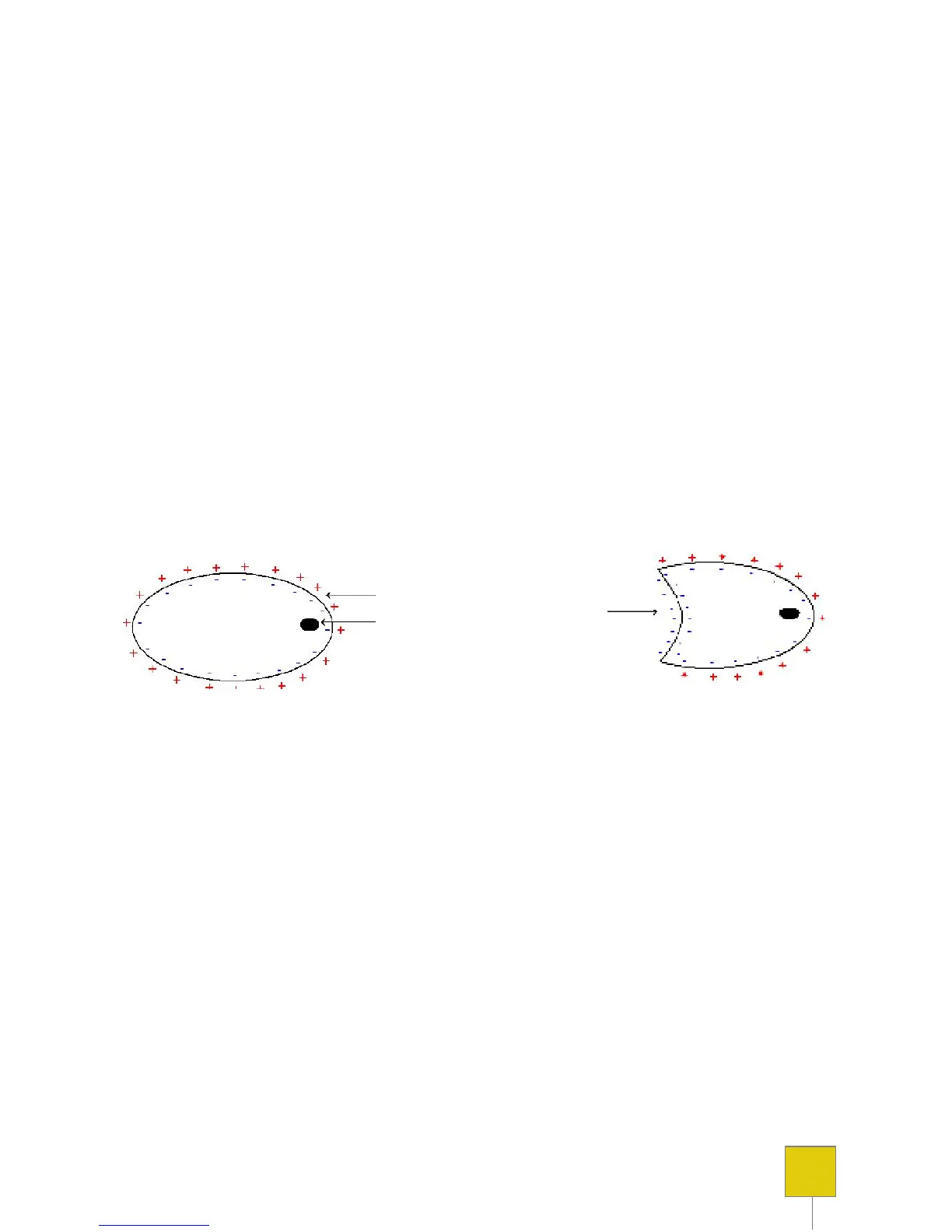
Image 3
It has been clear for over a century that an electrical potential of about -5OmV is present in the cell
membrane. This potential is known as the resting membrane potential.
The outer surface carries a positive charge, while the inner surface has a negative charge [Img.3].
When a cell is damaged, the potential of the injured part becomes negative, and the electric current
flows from the normal area to the injured area
This phenomenon was accurately measured by Matteucci (1938) and Bois-Reymond (1843), this
current is commonly known as "injury current”. Injury current is generated not only when
individual cells are injured but also when the tissue is damaged. The intensity of the injury current
ranges from 10 μA to 30 μA, as demonstrated by experiments. In other words, injury current is a
microcurrent. Injury current is considered to promote the recovery of damaged cells and tissues in
the living body. Stimulation by this current is thought to generate ATP and to synthesize protein for
the restoration of damaged tissue. Therefore, it can be affirmed that artificially generated
microcurrent would complement and further promote the natural functions of the injury current.
Phases and duration of Mens therapy
MENS therapy is ordinarily executed in the following two phases. Phase 1 is mainly intended to
reduce pain, while phase 2 is designed to solve the trauma and to repair the damaged tissue.



 To Next Page