
 Need help?
Do you have a question about the GMI D1030S and is the answer not in the manual?
Describes the D1030 unit, its channels, and configuration options.
Details electrical, mechanical, and environmental specifications for the device.
Lists directives and standards the unit conforms to.
Specifies operating and storage temperature and humidity limits.
Covers ATEX, IECEx, FM, UL, and other safety certifications and classifications.
Lists various certifications and conformity standards like DMT, IECEx, IMQ, UL, FM, EAC.
Highlights key features like SIL 2 compliance, input/output types, and certifications.
Presents failure rates (FIT), diagnostic coverage (DC), and PFDavg for the D1030D model.
Lists failure rates (FIT), diagnostic coverage (DC), and PFDavg for the D1030S model.
Describes how the unit accepts inputs and repeats status to safe areas using LEDs.
Covers mounting, electrical connections, wiring, and environmental protection requirements.
Details the initial checks and power-up sequence for the device.
Explains DIP switch settings for input/output relationship, fault detection, and operating mode.
Details DIP switch settings and summary tables for the D1030S model.
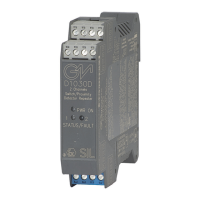
The D1030S - D1030D is a DIN Rail unit designed as a Switch/Proximity Detector Repeater, offering either one or two independent channels for controlling Safe Area loads from switches or proximity detectors located in Hazardous Areas.
The D1030D, a dual-channel model, features two independent input channels that actuate corresponding output relays. Each input channel can be independently configured via DIP switches for two actuation modes: Normally Open (NO) input/Normally Energized (NE) relay or Normally Open (NO) input/Normally De-energized (ND) relay. The unit also offers configurable fault detection for contact or proximity sensor and connection line short or open circuits. When fault detection is enabled, a fault will de-energize the corresponding output relay and illuminate the fault LED. If disabled, the output relay will simply repeat the input line's open or closed status as configured.
The D1030S, a single-channel model, has one input channel and two output relays, offering two configurable operating modes. In Mode A, the input channel actuates both output relays in parallel, providing a DPDT (Double Pole Double Throw) type of output. Relay actuation for each output can be independently configured as either NO input/NE relay or NO input/ND relay. In Mode B, output relay A is actuated based on the input channel, with its actuation configurable as in Mode A. Output relay B functions as a fault output; in the event of an input fault, relay B actuates, and the fault LED illuminates, while relay A continues to repeat the input line status. Output relay B's actuation can be configured as either No input fault/Energized relay (de-energizes on fault) or No input fault/De-energized relay (energizes on fault).
The D1030 series provides 3-port isolation (input/output/supply) and is fully compliant with CE marking requirements for EMC.
The D1030 series offers in-field programmability through DIP switches, allowing users to configure NO/NC input for contact/proximitor, NE/ND relay operation, and fault detection enable/disable. This flexibility allows the device to adapt to various application requirements.
The unit is equipped with signalling LEDs for clear status indication: a green LED for power supply, yellow LEDs for output status, and red LEDs for line faults. This visual feedback aids in quick troubleshooting and operational monitoring.
The D1030 series is designed for high reliability, utilizing SMD components, and offers high density with two channels per unit in the D1030D model. Simplified installation is achieved through the use of standard DIN Rail mounting and plug-in terminal blocks. The device supports a maximum voltage of 250 Vrms (Um) for instruments associated with the barrier.
For installations requiring fault detection with voltage-free electrical contacts, it is recommended to use a 1 kΩ series resistor and a 10 kΩ parallel resistor near the switch at the end of the line. This setup helps the fault detection circuit differentiate between contact close/open and line open/short circuit faults.
The D1030 series is designed for ease of maintenance. A proof test procedure is outlined to reveal dangerous faults that are not detected by the device's internal diagnostics. This involves a series of steps: bypassing the Safety PLC to prevent false trips, varying input sensor/contact states to verify relay output changes and safe state correspondence, disconnecting input wiring to check for de-energized relay output, shorting input connections to verify de-energized relay output (with corresponding red alarm LED illumination), restoring the loop to full operation, and removing the bypass from the safety-related PLC. This comprehensive test is expected to reveal approximately 99% of potential dangerous undetected failures.
For cleaning, the enclosure of the D1030 should only be cleaned with a damp or antistatic cloth to avoid electrostatic hazards. Penetration of cleaning liquid should be avoided to prevent damage to the unit.
The unit is not user-repairable and must be returned to the manufacturer or an authorized representative for any repairs. Unauthorized modifications are strictly prohibited to maintain intrinsic safety and operational integrity.
 General
| Type | Digital I/O Module |
|---|---|
| Digital Inputs | 16 |
| Digital Outputs | 16 |
| Input Voltage | 24 V DC |
| Output Type | Transistor |
| Output Voltage | 24 V DC |
| Communication Interface | RS-485 |
| Protocols | Modbus RTU |
| Isolation | 1500 V AC |
| Protection Class | IP20 |

 To Next Page