4
The information on the rating plate is in compliance with the FTC & DOE rating for single phase units. The three phase
units in this series are not covered under the DOE certified program. The efficiency ratings of these units are a product
of thermal efficiency determined under continuous operating conditions independent of any installed system.
EPA Regulations
IMPORTANT: THE UNITED STATES ENVIRONMENTAL PROTECTION AGENCY (EPA) HAS ISSUED VARIOUS REGULATIONS
REGARDING THE INTRODUCTION AND DISPOSAL OF REFRIGERANTS IN THIS UNIT. FAILURE TO FOLLOW THESE
REGULATIONS MAY HARM THE ENVIRONMENT AND CAN LEAD TO THE IMPOSITION OF SUBSTANTIAL FINES. BECAUSE
REGULATIONS MAY VARY DUE TO PASSAGE OF NEW LAWS, WE SUGGEST A CERTIFIED TECHNICIAN PERFORM ANY WORK
DONE ON THIS UNIT. SHOULD YOU HAVE ANY QUESTIONS PLEASE CONTACT THE LOCAL OFFICE OF THE EPA.
National Codes
This product is designed and manufactured to permit installation in accordance with National Codes. It is the installer’s
responsibility to install the product in accordance with National Codes and/or prevailing local codes and regulations.
MAJOR COMPONENTS
General
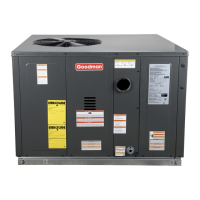
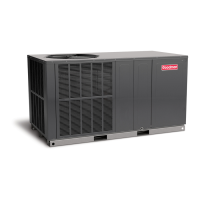
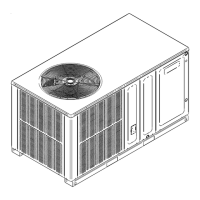
The unit includes a hermetically sealed refrigerating system (consisting of a compressor, condenser coil, evaporator coil
with flowrator), an indoor blower, a condenser fan and all necessary internal electrical wiring. The heat pump also
includes a reversing valve, solenoid, defrost thermostat and control and loss of charge protection. The system is factory-
evacuated, charged and performance tested. Refrigerant amount and type are indicated on rating plate.
INSTALLATION
Pre-Installation Checkpoints
Before attempting any installation, the following points should be considered:
• Structural strength of supporting members
• Clearances and provision for servicing
• Power supply and wiring
• Air duct connections
• Drain facilities and connections
• Location may be on any four sides of a home, manufactured or modular, to minimize noise
Clearance
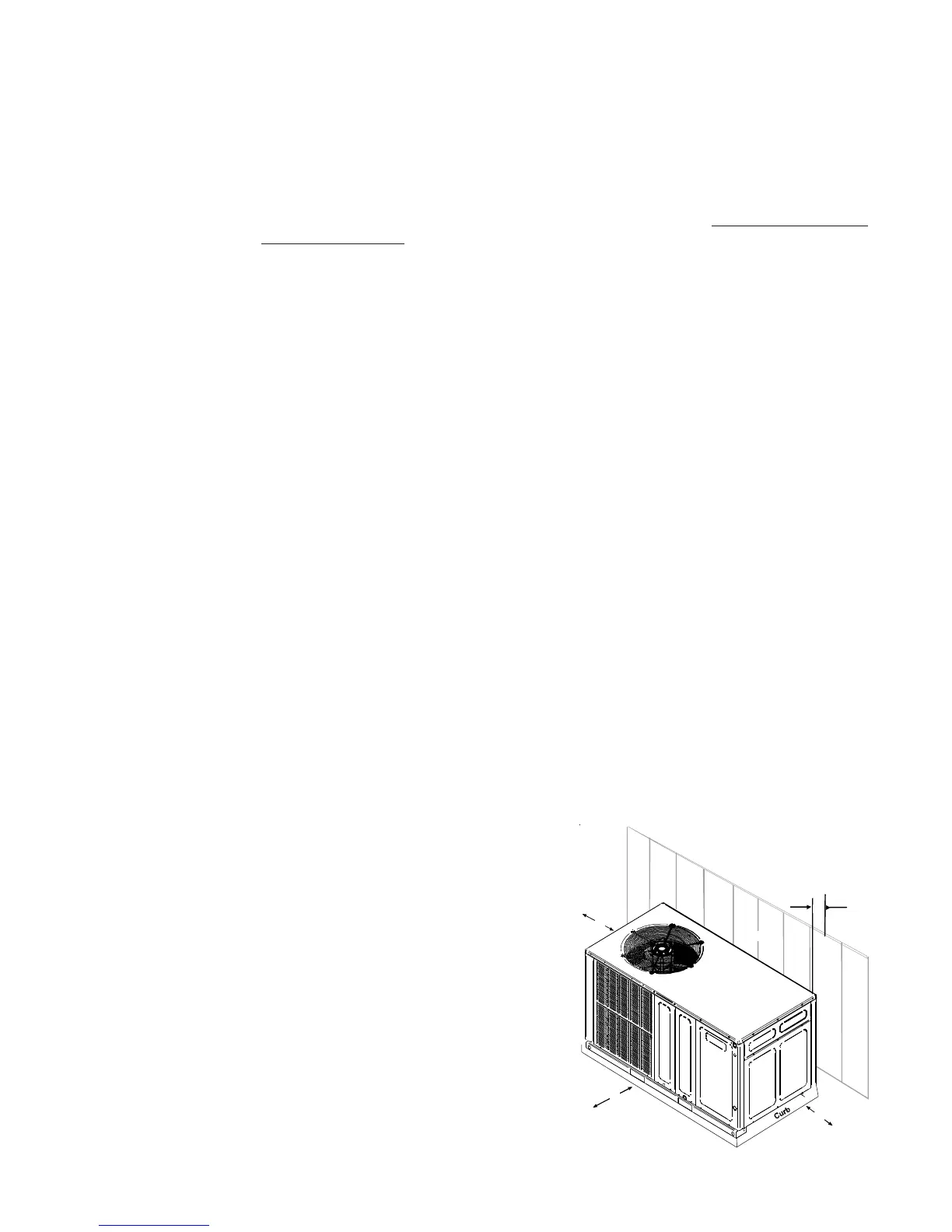
The unit is designed to be located outside the building with unobstructed condenser air inlet and discharge. Additionally,
the unit must be situated to permit access for service and installation. Condenser air enters from three sides. Air
discharges upward from the top of the unit. Refrigerant gauge connections are made on the right side of the unit as you
face the compressor compartment. Electrical connections can be made either on the right or left sides of the unit. The
best and most common application is for the unit to be located 10” from wall (4” minimum) with the connection side
facing the wall. This “close to the wall” application minimizes exposed wiring.
Close to the wall application assures free, unobstructed air to the other two sides. In more confined application spaces,
such as corners provide a minimum 10” clearance on all air inlet sides. Allow 18” minimum for service access to the
compressor compartment and controls. The top of the unit should be completely unobstructed. If units are to be located
under an overhang, there should be a minimum of 36” clearance and provisions made to deflect the warm discharge air
out from the overhang.
Location
Consider the affect of outdoor fan noise on conditioned space and any adjacent
occupied space. It is recommended that the unit be placed so that condenser air
discharge does not blow toward windows less than 25 feet away.
The unit should be set on a solid, level foundation - preferably a concrete slab at
least 4 inches thick. The slab should be above ground level and surrounded by a
graveled area for good drainage. Any slab used as a unit’s foundation should not
adjoin the building as it is possible that sound and vibration may be transmitted
to the structure. For rooftop installation, steel or treated wood beams should be
used as unit support for load distribution.
Heat pumps require special location consideration in areas of heavy snow
accumulation and/or areas with prolonged continuous subfreezing temperatures.
Heat pump unit bases have holes under the outdoor coil to permit drainage of
defrost water accumulation. The unit must be situated to permit free unobstructed
drainage of the defrost water and ice. A minimum 2" clearance under the outdoor
coil is required in the milder climates.
Outside Slab Installation (Figure 1)
1. The unit must be mounted on a solid, level foundation.
2. Select a location that will minimize the length of the supply and return ducts.
36"
36"
10"
UNIT
WALL
36"
FIGURE 1



 To Next Page