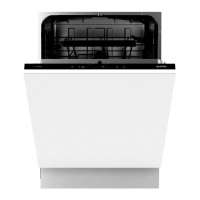
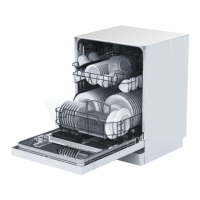
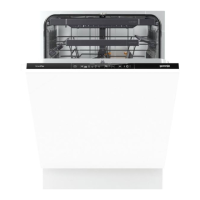
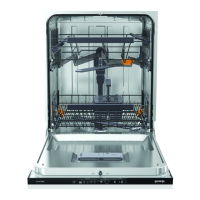
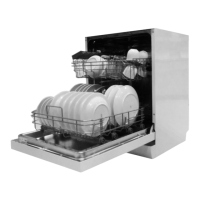
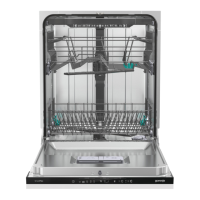
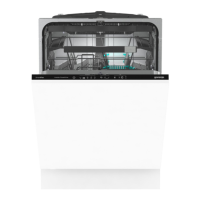
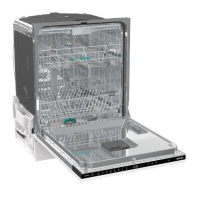
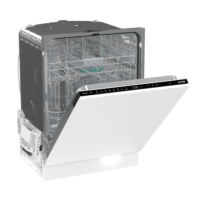
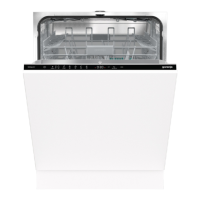
This document provides operating instructions for the Gorenje GV65160XXLCUS dishwasher, covering its functions, usage, and maintenance.
Function Description
The Gorenje GV65160XXLCUS is a dishwasher designed to clean dishes efficiently. It features multiple wash programs and extra options to suit various cleaning needs and soil levels. The dishwasher includes a built-in water softener to ensure optimal wash results, especially in areas with hard water, by reducing mineral content and preventing white coatings on dishes. It also has an overflow protection function that automatically pumps out water and turns off the supply if the water level exceeds normal, enhancing safety.
The control panel includes a main power switch, a program selector, and buttons for various wash programs like Auto wash, Intensive wash, Normal wash, Quick wash, and Rinse. Additional options such as SpeedWash, Extra dry, Half load, and Delayed start are available to customize the wash cycle. A display shows the current program status and time, while indicators for rinse aid and salt alert the user when these need topping up.
Usage Features
Before First Use:
Before using the dishwasher for the first time, it's crucial to check and set the water hardness. This involves contacting your local water utility to determine the hardness in your area and then adjusting the dishwasher's water softener setting accordingly. The manual provides a table to guide this adjustment based on German (°dH) or French (°fH) water hardness scales. If the water hardness exceeds 6°dH (9°fH), salt must be added to the salt compartment. The salt compartment lid is unscrewed, water is poured in first, followed by up to 2 lb (1.0 kg) of large grain or special dishwasher salt. Any excess salt should be wiped away before firmly screwing on the lid. A dishwashing program should be started immediately after adding salt to prevent rust stains.
The rinse aid dosage also needs to be set. Rinse aid improves drying results and helps achieve clear, spotless dishes. The rinse aid compartment is opened, filled to the 'max' level, and any spills are wiped before closing the lid.
Loading the Dishwasher:
For optimal results and energy saving, dishes should be scraped of large food particles but not rinsed under running water. The dishwasher should be fully loaded before starting a program. Fragile items, handmade items, crystal/glassware, silver, copper, tin, aluminum, wood, and plastic items should be checked for "dishwasher safe" markings. All dirty surfaces should face in and down, and dishes should not be placed on top of each other. Hollow items like cups should be angled to allow water to run off. Small items should be placed in the cutlery basket to prevent them from falling through the main baskets. The spray arms should be checked to ensure they can rotate freely.
The dishwasher has an upper, lower, and cutlery basket. Glasses, cups, bowls, side plates, and saucers go in the upper basket, face down. Large plates, serving dishes, pots, and cutlery (in the cutlery basket) go in the lower basket. The upper basket can be raised or lowered to three different positions to accommodate larger items, ensuring both sides are set to the same height. Cutlery should be placed with handles down, except for knives, and spread out to prevent stacking.
Adding Detergent:
Detergent is added to the dry detergent compartment, which has separate sections for prewash and main wash. The amount of detergent depends on water hardness, and instructions on the detergent packaging should be followed. For powder or liquid detergent, a small amount goes into the prewash compartment. Dishwasher tablets can be used, but they are not recommended for short programs (less than 75 minutes). All-in-one detergents can be activated via the settings menu, which disables rinse aid dispensing and reduces the amount of salt needed, though the salt compartment still needs to be filled.
Starting a Program:
To start the dishwasher, first load the dishes and add detergent. Select the desired program using the program selector. Additional options like SpeedWash, Extra dry, Half load, or Delayed start can be chosen. The display shows the program duration. Press the main power switch to start the program. If a delayed start is selected, the dishwasher will begin at the set time.
Stopping or Changing a Program:
To change a program after it has started, open the door, press and hold the main power switch until the display turns off, then select a new program and close the door. If the door is opened during a program, it will pause. To resume, close the door within five seconds. If the door is open for more than two minutes, the program will be canceled.
After the Program Finishes:
The dishwasher switches off automatically. To minimize leaks, it's recommended to turn off the water supply valve if leaving home for an extended period. For best drying results, allow dishes to cool in the dishwasher before unloading, starting with the lower basket to prevent water drops from the upper basket.
Maintenance Features
Topping Up Rinse Aid and Salt:
The dishwasher's display will show indicators when rinse aid or salt needs topping up. For rinse aid, open the compartment lid, fill to the 'max' level, wipe spills, and close firmly. For salt, unscrew the salt compartment lid, fill with large grain or special dishwasher salt (after adding water the first time), wipe excess salt, and tighten the lid. A wash program should be run immediately after adding salt to prevent rust stains.
Cleaning Filters:
The dishwasher has coarse and fine filters that need regular cleaning. The coarse filter traps larger food particles and should be emptied when necessary by lifting it by its handle. The fine filter collects debris and should also be cleaned periodically. To clean the fine filter, turn its handle counterclockwise, lift it straight up, and remove the coarse filter. Reinstall in reverse order, ensuring the edges seal properly and the handle is locked in place, pointing straight out from the dishwasher.
Cleaning Spray Arms:
The spray arms can become blocked by debris. Remove any blockages from the holes and bearings using a needle or similar item. The lower spray arm can be released by pulling it straight up. The upper spray arm is removed by pulling out the upper basket and unscrewing the spray arm bearings counterclockwise. Ensure they are fitted firmly back in place after cleaning.
Cleaning the Dishwasher Tub and Door:
The stainless steel dishwasher tub is kept clean through normal use. If limescale deposits build up due to hard water, run the Intensive wash program with two tablespoons of citric acid in the detergent compartment (without dishes). The door and door seal should be cleaned regularly with a slightly damp cloth.
Unblocking the Drain Pump:
If water remains in the dishwasher after a program, the drain pump may be blocked. To clear it, turn off the machine, unplug it, remove the coarse and fine filters, and scoop out any water. Remove the colored stop in the bottom drain to inspect the pump. Turn the pump wheel by hand to remove any items. Reinstall the drain pump stop and filters, then plug the machine back in. If a whirring sound persists, the overflow protection may be triggered, requiring the water supply to be shut off, the unit unplugged, and customer care contacted.
Display Panel Maintenance:
Keep the display panel buttons clean and free from grease. Wipe them with a dry or slightly damp cloth, avoiding cleaners that could scratch the surface. Turn off the dishwasher before cleaning the buttons to prevent unintentional activation.


 To Next Page
 General