307-738 9
Startup
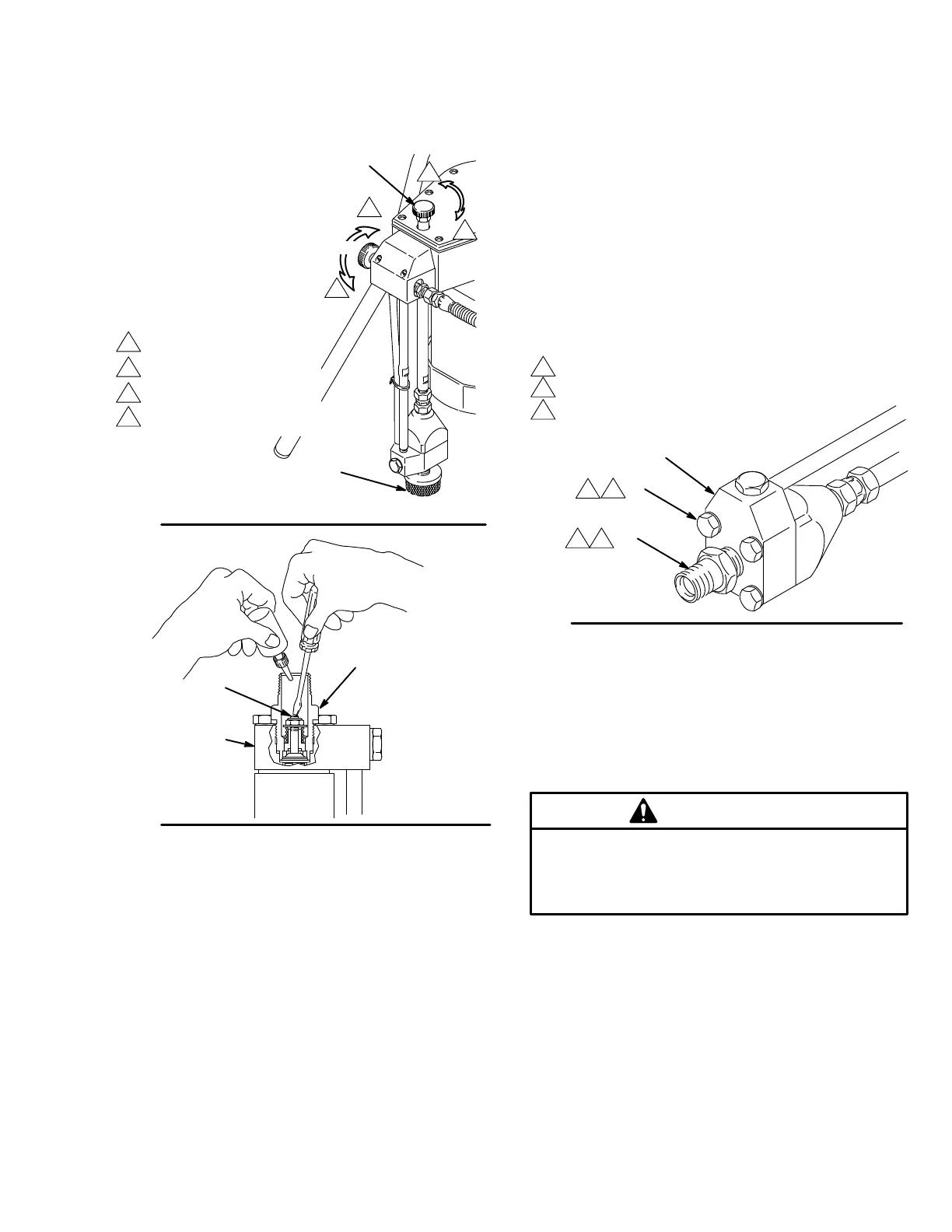
6. Turn the bypass valve (66) clockwise (finger tight)
to
close it; this allows the pump to build up pressure.
Fig.
3
Fig. 4
27
66
4
Decrease
pressure
(counterclockwise).
Increase pressure (clockwise).
Open (counterclockwise).
Close (clockwise).
22
26
A
7. Release the trigger safety lever and trigger the gun
onto
a piece of paper to check the spray pattern. Ad
-
just
the pressure setting to obtain the best atomiza
-
tion and spray pattern.
Always use the lowest
pressure necessary .
Excessive pressure cause
premature
tip wear and pump wear
.
NOTE: If
you cannot obtain a good spray pattern or ade
-
quate
atomization, your paint may be too thick. Thin the
paint
according to the manufacturer
’
s recommendations
until
you can get good atomization.
8. Whenever
you stop spraying, even for a moment,
al
-
ways
set
the trigger safety lever to prevent acciden
-
tally
trigger the gun.
9. Whenever you stop spraying for more than a mo-
ment, or if you must leave the sprayer unattended,
shut
it of
f and follow the
Pressure Relief Procedure
on
page 8.
NOTE: The
sprayer will not restart
if it was left pressur
-
ized
after shutting it off. Relieve pressure, then start
the
sprayer.
Fig. 5
Lubricate
the threads.
T
orque to 19–23 N.m.
T
orque to 36–41 N.m.
22
26
25
10.
After
the first 3 to 5 hours of operation
torque the
four
screws (25) on the bottom of the paint pump (22)
to
19–23 N.m. See Fig. 5.
11.
Also torque
the inlet valve (26) to 36–41 N.m.
CAUTION
Failure
to properly tighten the inlet valve and
screws
at
the intervals indicated will result in oil leaking from
the hydraulic system into the paint, and can cause
costly
damage to the sprayer
.
12.
Repeat
these torques
after another
3 to 5 hours of
operation,
and then after each 25 hours of operation
(about
weekly).
startup procedure continued on page 10



 To Next Page