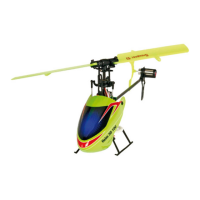
The Graupner Heim 3D 100 is a high-quality remote-controlled helicopter model, part of the GRAUPNER/SJ RFH series. This model is designed for air operation and is suitable for users aged 14 and above. It comes either with a remote control or can be connected to a remote control from the HoTT series. To prepare the model for flight, users primarily need to connect the remote control components and install the battery.
Function Description:
The Heim 3D 100 is a functional remote control helicopter designed for flight. Its operation involves a transmitter (remote control) and the helicopter itself, which includes a flybarless unit, receiver, controller, and gyro. The model is controlled through various settings on the transmitter, including stick modes, swashplate adjustments, and tail rotor sensitivity. The "binding" process ensures that the helicopter communicates with a single transmitter, a step that needs to be performed once for a new helicopter/transmitter combination. The helicopter's LED indicator provides feedback on the binding status: quick flashing for 5 seconds followed by continuous shining indicates a proper link, while slow flashing after 5 seconds means rebinding is required. The model is designed for stable hovering and flight, with adjustable sensitivity settings to fine-tune its response to pilot commands. It also features a "Throttle Hold" function for safety.
Important Technical Specifications:
- Length: 260 mm
- Total height (approx.): 75 mm
- Total weight (approx.): 37 g
- Rotor diameter: 205 mm
- Tail rotor diameter: 37 mm
- Battery specifications: 3.7V 180 mAh 15 C LiPo battery
- Flight time: 4-5 minutes (under no wind conditions)
- Transmitter: MZ-12 (included in some versions, otherwise obtainable separately)
- Transmitter batteries: 4 AA (included in some versions, otherwise obtainable separately)
- Charger: Two 500 mA 5V XC-1S2 (included)
- Receiver setup menu features: Model type selection (Plane, Heli), Alarm voltage (2.5-24.0V, default 3.0V), Alarm temperature (50-80°C, default 70°C), Cycle time (10ms for digital servos, 20ms for analogue servos), Language selection (English, French, German, Italian, Spanish).
Usage Features:
The Heim 3D 100 requires careful setup and programming of the transmitter before its first flight. The manual provides detailed instructions for programming the MZ-12 transmitter, including selecting a model memory, setting the stick mode, naming the model, and configuring swashplate and tail rotor settings.
- Transmitter Programming: Users need to set gas and pitch values correctly to ensure proper helicopter reaction. The "model mem." menu allows selection of a free memory location. The "Transmitter settings" menu is used to select the stick mode. The "Model Type" menu allows selection of "Akro 3D" and assignment of switches for flight phases.
- Swashplate Settings: The swashplate should be aligned at right angles to the main rotor axis. The "SWP sensitivity" setting (1-10, MIN or K5-K16) allows adjustment of the helicopter's response to commands. High sensitivity can lead to overstabilization and oscillation, while low sensitivity can make the helicopter unstable.
- Tail Rotor Setting: Similar to the swashplate, "Tail sensitiv." (1-10, MIN or K5-K16) controls the tail rotor's response. If the tail swings up, this value should be reduced.
- Binding: For versions without a pre-bound remote control, the binding process involves turning on the transmitter, then the helicopter, and observing the LED. If the LED flashes slowly after 5 seconds, rebinding is necessary, following instructions in the remote control manual.
- Pre-flight Checklist: Before each flight, all parts must be checked for proper installation and damage. The rotors must be able to rotate freely.
- Flight Sequence: Always turn on the transmitter first, then the helicopter. To power down, turn off the helicopter first, then the transmitter. This sequence prevents unintended control by other transmitters or interference.
- Flight Conditions: Avoid operating the helicopter in strong winds or areas with air blowers, as this can cause loss of control.
- Landing: The helicopter's handling becomes unstable as the battery charge depletes, indicating it's time to land and recharge the battery.
Maintenance Features:
- Cleaning: The model should be cleaned after each use. Any water that enters RC components must be drained, and the components should be dried. Only appropriate, lint-free cleansers should be used for cleaning the model and transmitter; chemical cleaners, solvents, gasoline, or ethyl alcohol are not recommended.
- Lubrication: The driveshaft and outer shaft bearings of the rotors should be lubricated after operation with a small drop of oil that does not pollute water (e.g., order No. 206).
- Battery Care:
- Always charge the battery under supervision on a nonflammable surface.
- Never place the battery on or near hot objects to prevent explosion hazards.
- Store the battery in a dry location and avoid hitting it with hard objects.
- Do not disassemble the battery.
- Never let the charge of a lithium polymer battery drop below 3 V per cell.
- If the battery swells during charging or flight, immediately stop charging/flight.
- Transport and store the battery between 5°C and 49°C. Avoid storing it in a hot car or under direct sunlight, as this can damage the battery and cause fire.
- Only use chargers specifically designed for lithium polymer batteries to prevent fire or property damage.
- Disposal: The product, its instructions, and packaging indicate that it should not be disposed of as common household waste. It must be sent to a recycling collection point for electrical and electronic equipment. Batteries (including rechargeable ones) must be removed and disposed of separately at an appropriate collection point.

 Need help?


 To Next Page
 General