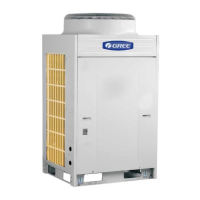
This document is an Installation and Operation Manual for a GREE GMV D.C. Inverter air conditioning unit, specifically covering models GMV-Pd100W/NaB-K, GMVL-Pd100W/NaB-K, GMV-Pd120W/NaB-K, GMVL-Pd120W/NaB-K, GMV-Pd140W/NaB-K, GMVL-Pd140W/NaB-K, GMV-Pd160W/NaB-K, and GMVL-Pd160W/NaB-K.
The device is a multi-split air conditioning system designed for both cooling and heating (Heat Pump Type) or cooling only (Cooling Only Type), utilizing a D.C. Inverter compressor for efficient operation. It is capable of connecting one outdoor unit to up to 16 indoor units, offering flexibility in system integration. The indoor units can be of various types, including cassette, wall-mounted, ducted, low hydrostatic pressure ultra-thin, and floor standing types, allowing for diverse installation scenarios and aesthetic preferences.
Function Description:
The GMV D.C. Inverter system provides climate control for indoor spaces. In cooling operation, low-temperature, low-pressure refrigerant gas from the indoor unit heat exchangers is absorbed and compressed by the outdoor unit's compressor into high-temperature, high-pressure gas. This gas then discharges into the outdoor unit's heat exchanger, where it exchanges heat with the outdoor air and transforms into refrigerant liquid. The liquid flows through a Y-type manifold to all indoor units, passes a throttling component to decrease pressure and temperature, and then enters the indoor unit heat exchangers to absorb heat from the room air, changing back into low-temperature, low-pressure gas. This cycle continuously repeats to achieve cooling. For heating operation (heat pump models), a 4-way reversing valve alters the refrigerant flow, causing the indoor unit heat exchanger to radiate heat into the room (with auxiliary electric heating if present) and absorb heat from the outdoor unit's heat exchanger, thereby providing warmth. The system ensures that when any indoor unit receives an operation order, the outdoor unit starts, and when all indoor units stop, the outdoor unit also stops.
Important Technical Specifications:
The manual provides specific technical data for the listed models:
- Cooling Capacity (kW): Ranges from 10 kW (GMV(L)-Pd100W/NaB-K) to 16 kW (GMV(L)-Pd160W/NaB-K).
- Heating Capacity (kW): Ranges from 11 kW (GMV(L)-Pd100W/NaB-K) to 17.6 kW (GMV(L)-Pd160W/NaB-K) for heat pump models. Cooling-only units (GMVL Type) do not have a rated heating capacity.
- Noise (dB(A)): 58 dB(A) for 100W, 120W, 140W models, and 60 dB(A) for 160W models.
- Compressor Type: Inverter*1 for all listed models.
- Refrigerant: R410A, with a filling amount of 7.5 kg for all models. Additional refrigerant may be required based on pipe length.
- Power Supply: 220-240V ~ 50Hz.
- Power Input (kW):
- Cooling: 2.86 kW (100W) to 4.98 kW (160W).
- Heating: 2.6 kW (100W) to 4.85 kW (160W).
- Rated Current (A):
- Cooling: 14.2 A (100W) to 23.2 A (160W).
- Heating: 13.2 A (100W) to 21.9 A (160W).
- Dimensions (mm) (Width×Depth×Height): 950×340×1250 mm for all models.
- Water Proof Level: IP24.
- Weather Type: T1.
- Pipe Connections:
- Gas Pipe (mm): φ15.9 for 100W, 120W, 140W models; φ19.05 for 160W models.
- Liquid Pipe (mm): φ9.52 for all models.
- Connection Method: Flare Connection.
- Rated Working Conditions:
- Cooling: Indoor 27°C DB / 19°C WB; Outdoor 35°C DB / 24°C WB.
- Heating: Indoor 20°C DB / 15°C WB; Outdoor 7°C DB / 6°C WB.
- Operating Temperature Range:
- Cooling: Outdoor 10°C ~ 48°C.
- Heating: Outdoor -20°C ~ 27°C.
- Maximum Indoor Units: One outdoor unit can drive up to 16 indoor units.
- Indoor Unit Capacity Code Sum: The sum of indoor unit capacity codes can be 50%-135% of the outdoor unit capacity code number.
- Allowable Pipe Lengths:
- Total length (actual): 150m.
- Length of farthest fitting pipe (actual): 70m.
- Length of farthest fitting pipe (equivalent): 80m.
- Equivalent length from 1st manifold to farthest fitting pipe: 25m.
- Allowable Drop Heights:
- Between outdoor and indoor unit (outdoor unit upper): 30m.
- Between outdoor and indoor unit (outdoor unit lower): 25m.
- Between indoor units: 10m.
Usage Features:
- Smooth Start: The main power switch should be turned "ON" 8 hours before the initial start-up for smooth operation.
- Fan Operation after Stop: After receiving a STOP signal, the indoor unit fan continues to operate for 20-70 seconds to utilize residual cold/hot air and prepare for the next use.
- Mode Conflict Detection: If an indoor unit's run mode conflicts with the outdoor unit's, a fault indicator will blink, and the indoor unit will stop. Users must switch the indoor unit's mode to resolve the conflict. Cooling mode does not conflict with dehumidify mode, nor fan mode with other modes.
- DIP Switch Configuration: Indoor units and wired controllers use DIP switches (4-bit or 8-bit) to set address and capacity codes. The wired controller's address must match its corresponding indoor unit.
- Refrigerant Filling: The outdoor unit is pre-filled with R410A. Additional refrigerant is calculated based on the liquid pipe length and diameter. No additional refrigerant is needed if the total liquid pipe length is within 50m.
- Test Run Procedure: After installation, a professional test run is required. This involves powering on units, turning on controllers, and observing automatic start-up of indoor fans and compressors. Immediate shutdown is necessary if abnormal noise occurs.
Maintenance Features:
- Pre-Operational Season Inspection (Beginning of Operational Season):
- Check for blockages at air inlets/outlets of both indoor and outdoor units.
- Verify reliable grounding.
- Check and replace remote controller batteries if needed.
- Inspect outdoor unit installation for stability.
- Ensure the main power switch is "ON" 8 hours before starting after a long shutoff.
- Post-Operational Season Maintenance (End of Operational Season):
- Clean the filter and housing of the outdoor unit.
- Shut off the main power supply.
- Remove dust and foreign articles from the outdoor unit.
- General Cleaning: Before cleaning, the unit must be stopped, and the main power supply shut off. Do not wet the unit or use hot water above 45°C, volatile liquids (thinner, gasoline). Use a soft dry cloth or a cloth wetted with neutral cleanser.
- Troubleshooting: The manual includes a comprehensive troubleshooting guide with error codes (E1-Fd) displayed on wired controllers and LED indicators on outdoor unit mainboards. These codes correspond to various issues such as high/low pressure protection, temperature sensor errors, communication errors, and compressor malfunctions, guiding professionals in diagnosis.

 Need help?
 General

 To Next Page

