Mini-X Installation, Setup & User Manual GRT Avionics
Revision A9 80
Fuel Flow
The accuracy of the Fuel Remaining Estimate (Totalizer) derived from the fuel flow sensor is a
valuable function for any pilot who uses their airplane for cross-country flights. It is also essential
when you’ll be using most of the airplane’s fuel capacity. Additionally, it provides the rate of fuel
burn, which is displayed and used in other EFIS calculations. These calculations are used to provide
efficiency measurements that are useful for adjusting the cruise power setting when maximum
economy, maximum range or time/fuel burn tradeoffs are of interest.
NOTE: The totalizer and range data require pilot entry of the fuel onboard whenever fuel is
added to the airplane, as described below. The totalizer shows an estimate of the TOTAL fuel on
board, but NOT individual fuel tank levels in airplanes with multiple tanks.
Fuel Flow must be calibrated for full accuracy. This is simply a matter of keeping track of how much
fuel is consumed according to the totalizer compared with the actual fuel used and adjusting the
“FloCal” entry. For information on how to install and calibrate a fuel flow sender, please refer to the
documentation appropriate for your fuel flow sender on the GRT EIS Documentation web page.
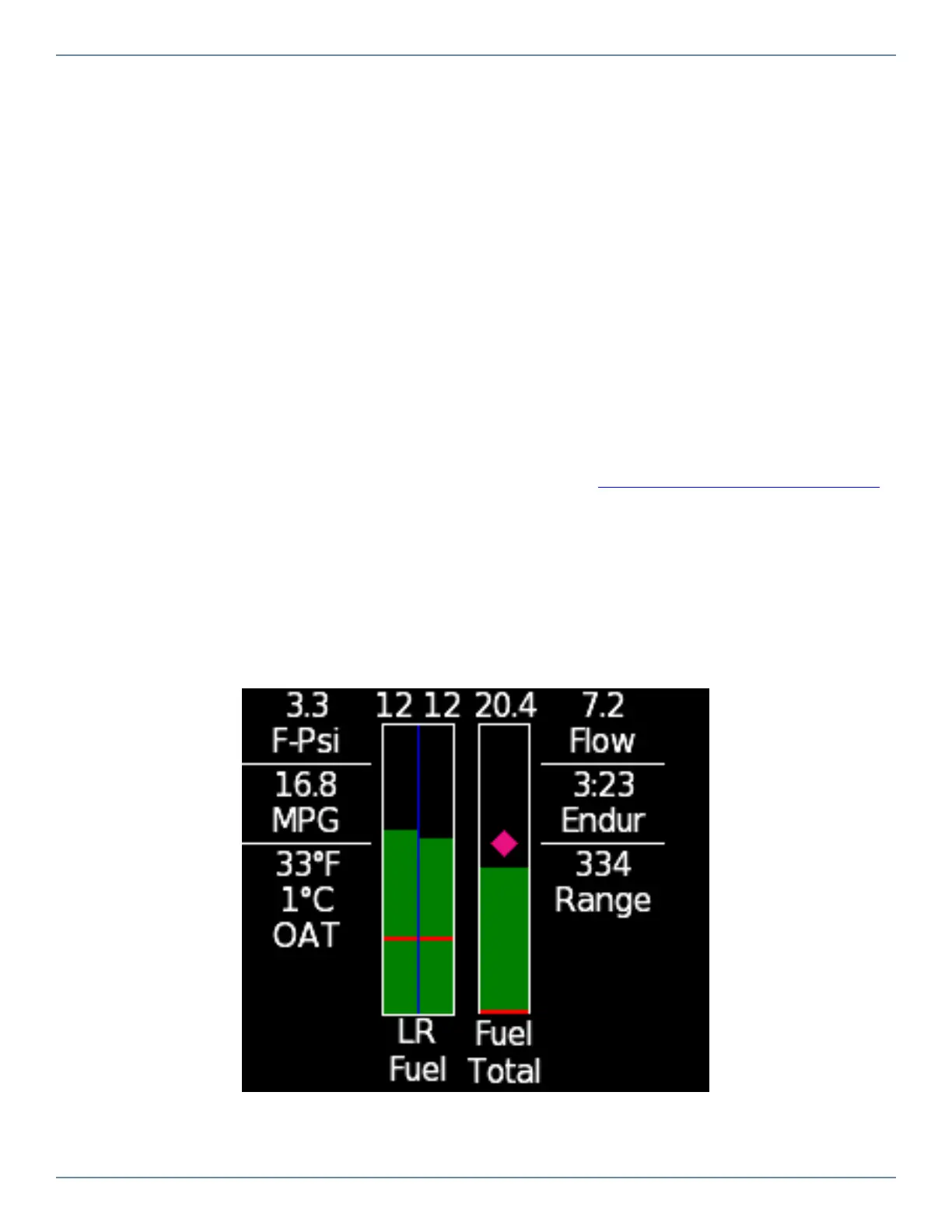
The upper left corner of all engine pages includes a fuel data block. As shown below, Left and Right
fuel levels (up to three may be shown) are displayed next to the fuel totalizer bar graph. The sum
of the fuel level sensing is displayed as a magenta diamond on the fuel totalizer. Red lines indicate
limits. Other commonly referenced fuel data is also shown here. MPG provides over the ground
efficiency information.


 To Next Page