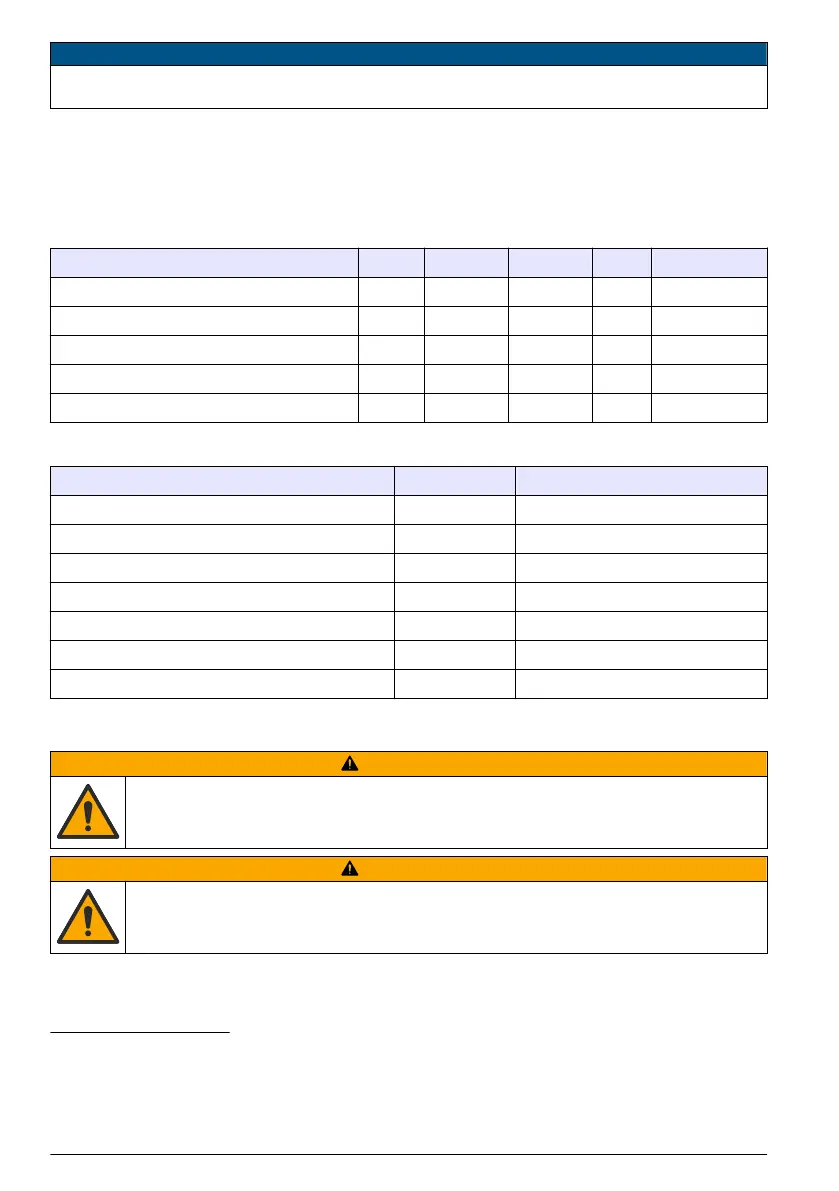
N O T I C E
Do not disassemble the instrument for maintenance. If the internal components must be cleaned or repaired,
contact the manufacturer.
6.1 Maintenance schedule
Table 3 shows the recommended schedule of maintenance tasks. Facility requirements and
operating conditions may increase the frequency of some tasks. Table 4 shows the average service
life of wearing parts for standard operating conditions and default (factory) settings.
Table 3 Maintenance schedule
Task 1 week 3 months 6 months 1 year As necessary
Visual inspection X
Clean the measuring path on page 18 X
Validate the probe calibration on page 21 X
10
Replace the wiper blade on page 19 X
10,11
Manufacturer service inspection X
12
Table 4 Wearing parts consumption
Wearing part Quantity Average service life
Wiper blades (set of 5 pieces) 1 > 1 year
10,11
Wiper motor 1 7 years
11
Wiper shaft with seals 1 2 years
11
Housing seals
13
1 2 years
Flashlamp 1 10 years
Measuring window 2 5 years
10
Filter set 1 5 years
6.2 Clean the measuring path
C A U T I O N
Chemical exposure hazard. Obey laboratory safety procedures and wear all of the personal protective
equipment appropriate to the chemicals that are handled. Refer to the current safety data sheets
(MSDS/SDS) for safety protocols.
C A U T I O N
Chemical exposure hazard. Dispose of chemicals and wastes in accordance with local, regional and
national regulations.
10
Based on non-abrasive water conditions
11
Based on the default settings
12
A minimum of one inspection per year is required. For the best performance and uptime, the
manufacturer recommends 2 inspections per year.
13
Replace each time the probe is opened.
18 English


 To Next Page