*#1
Owner’s Manual
22
Vx
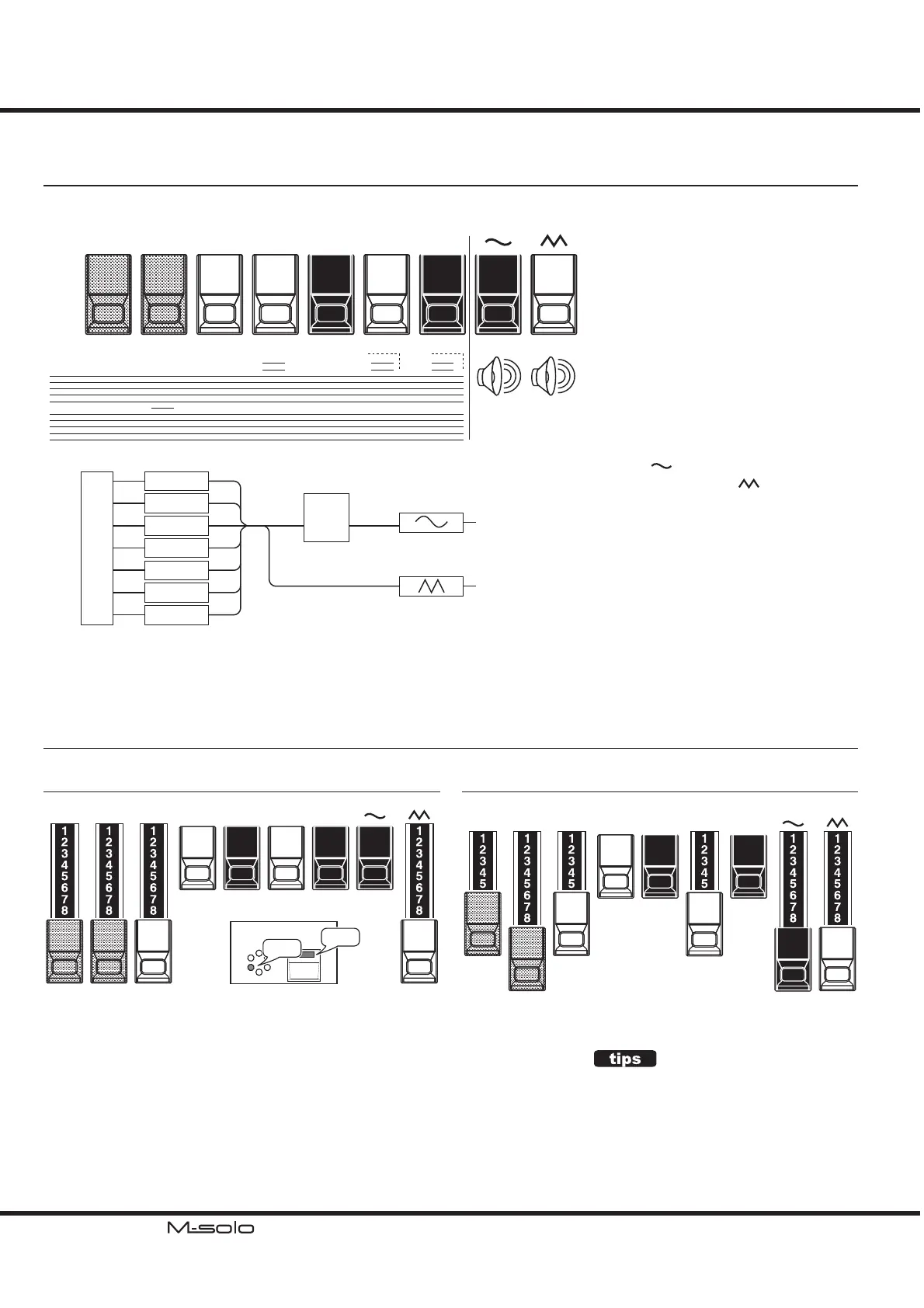
WHAT IS “Vx”?
e Vx comes from a British Transistor Organ.
SETTING EXAMPLE
INSTRUMENT TYPES - continued
Oscillators
16´
8´
4´
2´
II
III
IV
Filter
to output
8´
16´ 4´ 2´
II
III
IV
"
X
X
X
XXX
X
X
X
X
X
X
X
at Middle “C”
e type of British combo organ repli-
cated by the “Vx” ORGAN Type had
Drawbar-type controls, but they func-
tioned di erently from Hammond Har-
monic Drawbars. e rst four Draw-
bars control individual pitches, while
the next three are “Mixture” Drawbars
which cause multiple pitches to sound.
“II,” “III” and “IV” refer to the number
of pitches represented by that Drawbar.
e last two Drawbars control the type
of tone produced by the first seven
Drawbars.
e “
” Drawbar causes mellow tones
to sound while the “ ” Drawbar caus-
es brighter and more harmonically com-
plex tones to sound.
NOTE: The first seven Drawbars WILL NOT
sound unless one or both of the right
two Drawbars are also “out.” These
two Drawbars regulate the overall
volume as well as timbre of the to-
tal Drawbar registration, and can be
used separately or together.
8´
16´ 4´ 2´
II
III
IV
VIB&CHO
V-2
ON
Let’s Go, Crazy
8´
16´ 4´ 2´
II
III
IV
Light My Fire
TRANSISTOR ORGANS
As transistors gradually replaced vacuum
tubes in electronic circuits it became possible
to produce light-weight combo organs. These
have been used extensively in rock and popular
music since the early 60’s. The type of circuitry
is different from maker to maker or model by
model. We have replicated 3 representative
types here.


 To Next Page