Page 15<&(%$*4.8"4,7%H'*#$"&8#I%/7*,#*%4,77%JKLLLKLMMKNOPO1Item 56825
?@<6AQD@CEA6E@ER6 S@?CR%T6GUCEVT6GUCEV%ACW? ?6AFW
'XW\&\FOH'XUDWLRQRI8VH
@Z&"9%9,5,3*%$&%$.*%T*79*(%+>%8&$%)*79"83%2&(%
5&(*%$.,8%$.*%/(*#4("+*9%9'$>%4>47*%$"5*1 The Duty
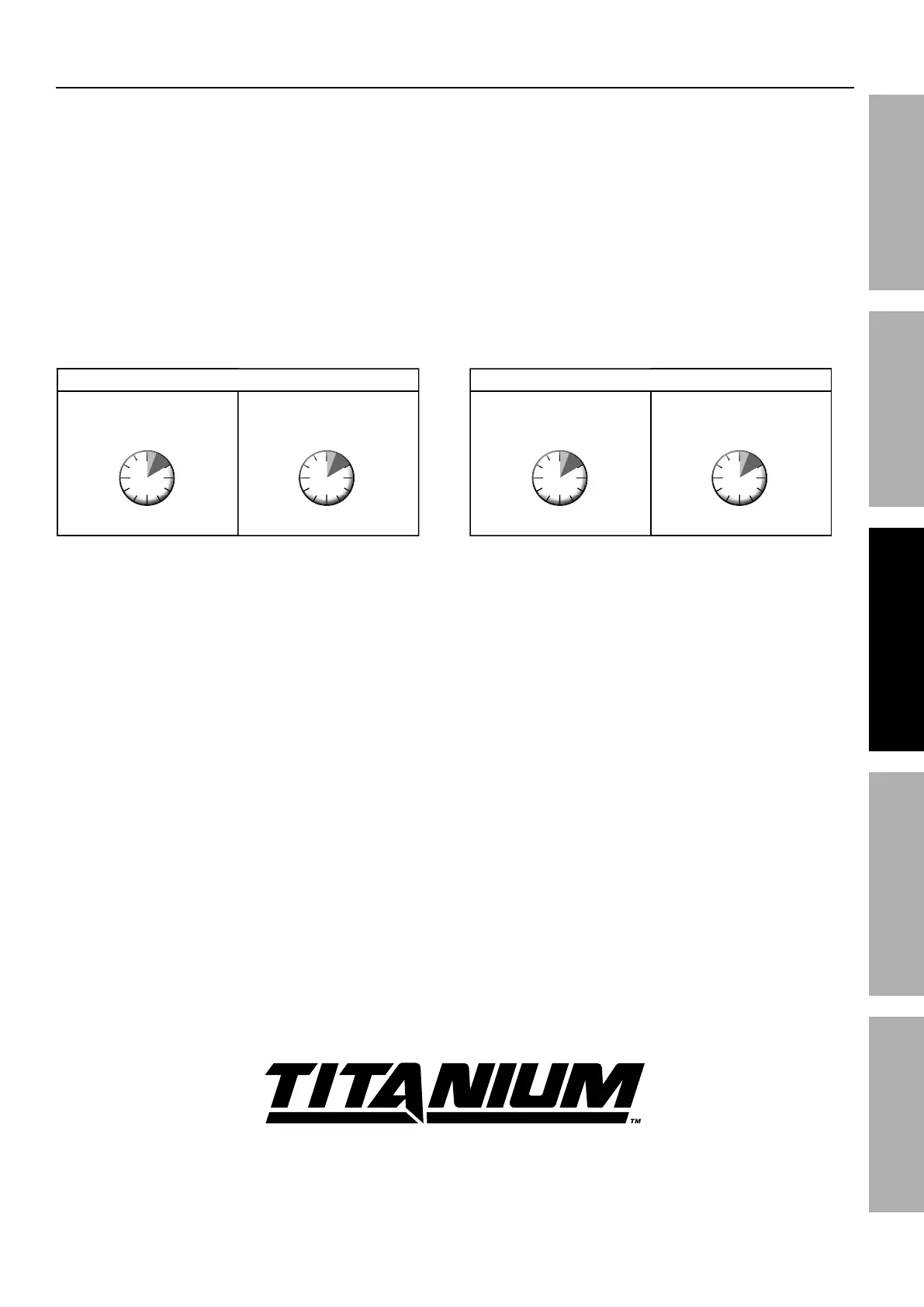
Cycle defines the number of minutes, within a 10 minute
period, during which a given welding process can
produce a particular welding current without overheating.
For example, a 30% duty cycle at 165 A welding
current must be allowed to rest for at least 7 minutes
after every 3 minutes of continuous welding.
Failure to carefully observe duty cycle limitations
can easily over-stress a welder’s power generation
system contributing to premature welder failure.
This welder has an internal thermal protection
system to help prevent this sort of over-stress.
When the Welder overheats, it automatically shuts
down and the Overload Indicator lights. The
welder automatically returns to service after cooling
off. Rest the Tig Torch or Electrode Holder on an
electrically non-conductive, heat-proof surface, such
as a concrete slab, well clear of the ground clamp.
@77&)%$.*%T*79*(%$&%4&&7%)"$.%$.*%W&)*(%?)"$4.%&8I%
#&%$.,$%$.*%"8$*(8,7%<,8%)"77%.*7/%4&&7%$.*%)*79*(1
When the Overload Indicator is no longer lit and the
Welder can be used again, use shorter welding periods
and longer rest periods to prevent needless wear.
9$&
8VHDW$
<&(%J^%R&8$"8'&'#%D"8'$*#
&RQWLQXRXV8VHDW$
b
D"8'$*#%
T*79"83
L
D"8'$*#%
;*#$"83
9$&
8VHDW$
<&(%J^%R&8$"8'&'#%D"8'$*#
&RQWLQXRXV8VHDW$
bKJ0b
D"8'$*#%
T*79"83
OKJ0b%
D"8'$*#%
;*#$"83
?$"4Y%;,$*9%U'$>%R>47*#
9$&
8VHDW$
<&(%J^%R&8$"8'&'#%D"8'$*#
&RQWLQXRXV8VHDW$
b
D"8'$*#%
T*79"83
L
D"8'$*#%
;*#$"83
9$&
8VHDW$
<&(%J^%R&8$"8'&'#%D"8'$*#
&RQWLQXRXV8VHDW$
bKJ0b
D"8'$*#%
T*79"83
OKJ0b%
D"8'$*#%
;*#$"83
ACV%;,$*9%U'$>%R>47*#


 To Next Page