EasyManua.ls Logo

Harman Kardon 730 - User Manual

Harman Kardon 730
10 pages
Print Icon
To Next Page IconTo Next Page
Loading...
harman/kardon
730
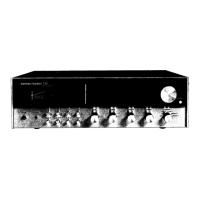
twin powered receiver
owner's
manual

Other manuals for Harman Kardon 730

Question and Answer IconNeed help?

Do you have a question about the Harman Kardon 730 and is the answer not in the manual?

Summary

Introduction to the Harman;Kardon 730 Receiver

Connecting the 730 Receiver and Speaker Systems

Preparing for Speaker Connections

Discusses selecting appropriate speaker wire gauge and type for best audio quality and preparing it.

Connecting Speaker Systems to the 730

Speaker System Connections

Details on connecting SPEAKER SYSTEM 1 and SPEAKER SYSTEM 2, emphasizing wire polarity and phasing.

Connecting Turntables and Automatic Changers

Turntable and Record Player Connections

Instructions for connecting record playing units to PHONO 1 and PHONO 2 inputs, and power connection.

FM and AM Antenna Connections

FM Antenna Setup

Guidance on connecting FM antennas, including folded dipole, outdoor systems, and matching transformers.

AM Antenna Setup

Information on connecting the ferrite loopstick AM antenna and long wire antennas for improved reception.

Connecting Tape Equipment

Tape Recorder Connections

Instructions for connecting tape decks for recording and playback using TAPE 1 and TAPE 2 receptacles.

Connecting Other Audio Equipment

Auxiliary Input and Accessory Connections

Details on connecting auxiliary inputs (AUX 1, AUX 2) and equipment between pre-amplifier and power amplifier.

Operating the Harman;Kardon 730

Playing Records

Step-by-step guide for playing records using FUNCTION, VOLUME, BALANCE, and SPKRS-1 controls.

Speaker Phasing Check

Procedure for checking and correcting speaker phasing using the MONO button and listening tests.

Receiving FM Broadcasts

FM Tuning and Controls

Guide to using FUNCTION, VOLUME, BALANCE, FM MUTING, and Tuning controls for FM reception.

Muting Adjustment

Explanation of the MUTE ADJ control for setting the FM interstation noise threshold.

Understanding Other Controls

Front Panel Controls Explained

Details on TREBLE, BASS, CONTOUR, TAPE MON, MONO, HI CUT, LO CUT, and PHONES controls.

Circuit Protection and Fuse

Information on SPEAKER PROTECTOR circuit breakers and the importance of using the correct replacement AC fuse.

Technical Specifications

Overview

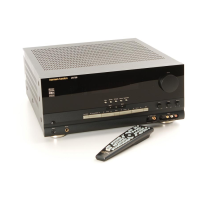
The Harman/Kardon 730 is a twin-powered receiver designed for high-fidelity audio reproduction, emphasizing uncompromised sound quality and user-friendly operation. It serves as the central component of a stereo system, integrating a tuner, preamplifier, and power amplifier into a single unit.

Function Description

The 730 receiver is capable of processing and amplifying audio signals from various sources, including turntables, tape decks, and auxiliary devices, as well as receiving FM and AM radio broadcasts. Its "twin-powered" design signifies separate power supplies for each channel, aiming to deliver cleaner, more dynamic sound by minimizing inter-channel interference and maximizing power delivery.

The receiver features inputs for two record-playing units (PHONO 1 and PHONO 2), allowing users to connect multiple turntables or automatic changers. It also provides two pairs of auxiliary inputs (AUX 1 and AUX 2) for connecting other "high-level" output equipment, such as special tuners (long wave, marine, aircraft, or citizen's bands) or the audio section of a television receiver.

For tape recording and playback, the 730 offers comprehensive facilities. It supports two tape recorders (TAPE MON-1 and TAPE MON-2), enabling users to connect open-reel, cassette, or eight-track cartridge equipment. The tape monitor functions allow for true off-tape monitoring, where users can listen to the recorded signal as it is being laid down on the tape, provided their tape deck supports this feature. Even if a tape deck only offers playback, it can still be connected to the tape monitor receptacles. Additionally, the tape monitor inputs can be used for connecting signal processing devices.

The FM tuner section is designed for enhanced reception, with provisions for both a "T"-shaped, folded dipole antenna (included) and external outdoor antenna systems (300 ohm or 75 ohm lead-in). The AM tuner section utilizes a ferrite loopstick antenna for good reception in many areas, and also includes a connection for a "long wire" AM antenna for extended range.

The power amplifier section is protected by two circuit breakers (SPEAKER PROTECTOR) that safeguard the amplifier circuitry from external short circuits or excessive current draw. An AC power fuse further protects the entire receiver from excessive current from the AC power line.

Usage Features

The front panel of the 730 features a logical arrangement of controls for intuitive operation. Key controls include:

  • POWER: A push-button switch to turn the unit on and off, indicated by a red power light.
  • VOLUME: A rotary control to adjust the overall loudness of the playback.
  • BALANCE: A rotary control to shift loudness between the left and right speakers, allowing for compensation of room acoustics or speaker placement.
  • FUNCTION: A rotary switch to select the desired input source (PHONO 1, PHONO 2, AUX 1, AUX 2, FM, AM).
  • SPKRS-1 / SPKRS-2: Push-button switches to engage or disengage speaker systems connected to SPEAKER SYSTEM 1 and SPEAKER SYSTEM 2, respectively.
  • TREBLE: A rotary control to adjust the high-frequency content of the program material on both channels simultaneously.
  • BASS: A rotary control with the same effect as the TREBLE control, but for low frequencies.
  • CONTOUR: A push-button switch that works in conjunction with the VOLUME control to increase bass energy at low volume settings, with its effect progressively decreasing as the volume level is increased.
  • TAPE MON-1 / TAPE MON-2: Push-button switches to select programs from the connected tape recorders or signal processing devices. These do not affect the signal appearing at the TAPE OUTPUT receptacles, ensuring that the recording process of the selected source remains undisturbed.
  • MONO: A push-button switch to change any program from stereophonic to monophonic format. It also processes any single-channel source through both speakers and disables the red STEREO beacon light.
  • HI CUT: A push-button filter to reduce high-frequency content, useful for mitigating tape hiss, record scratches, and other program material noise.
  • LO CUT: A push-button filter to reduce low-frequency content, effective against turntable rumble or other low-frequency problems.
  • PHONES: A front-panel receptacle for headphones, allowing private listening without automatically defeating the speaker systems.
  • TUNING: A rotary knob to move the dial pointer across the FM and AM frequency scales.
  • FM MUTING: A push-button switch to eliminate interstation noise (hiss) when tuning between FM stations.
  • MONO (FM): When an FM stereo station is tuned, pressing this switch allows for monophonic reception, useful for weak stereo stations accompanied by excessive noise.

The illuminated dial pointer and scale, along with the FM MAX QUIET meter, assist in accurate tuning. The FM MAX QUIET meter indicates the relative quality of the FM signal, deflecting further to the left as signal quality improves. A red STEREO beacon lights up when a stereo FM broadcast is received. A third "logging" scale with arbitrary numbers (0-100) simplifies memorizing favorite station frequencies.

Maintenance Features

  • Ventilation: The 730 generates heat, and adequate ventilation is crucial for preventing internal temperatures from rising too high. If placed on an open shelf, 1-2 inches of free space above the receiver is recommended. For enclosed spaces, 2-4 inches of free space above and to either side is advised. Custom cabinet installations require air flow, either through large cutouts or small holes, both above and below the receiver (not in the 730 housing). It is critical to ensure free air flow through the bottom of the receiver; therefore, the unit should never be operated on a rug or cushion that could obstruct the bottom vents.
  • Speaker Connections: Proper speaker wiring is essential for optimal performance and to prevent damage. The manual recommends 18-gauge stranded two-conductor "lamp" or "zip" cord for lengths up to 50 feet, with thicker 16-gauge wire for longer runs. Careful attention to "phasing" (connecting the coded side of the wire consistently to the same terminal on both the receiver and speakers) is emphasized to ensure a clear, centered stereo image. The speaker terminals are designed for bare wire connections, which should be tight and free of loose strands to prevent short circuits.
  • AC Outlets: The receiver includes a SWITCHED AC OUTLET on the rear panel, which is "live" only when the 730 is operating. This allows a tape deck or other accessory equipment to be powered on and off with the receiver's POWER switch. An UNSWITCHED AC OUTLET is also provided, which is "live" as long as the 730 is connected to a live AC outlet, regardless of the receiver's power status.
  • Circuit Protection: The SPEAKER PROTECTOR circuit breakers are resettable by firmly pressing and immediately releasing the button. The AC power fuse is user-replaceable, but it is critical to use precisely the same type as specified on the rear panel (4A/250V) to avoid serious damage to the circuitry.
  • Cleaning: Dust and smudges on the dial glass can be removed with a diluted liquid glass cleaner and a soft cloth or damp paper towel. Strong solvent-type cleaners or ammonia should be avoided as they may remove lettering or cloud the glass.
  • Grounding: The 730 provides a GND terminal for connecting the ground wire from a turntable, which helps reduce hum. However, in some turntable/cartridge combinations, disconnecting the ground wire might actually produce less hum, so users are advised to experiment.
  • Muting Adjustment: The MUTE ADJ control on the rear panel allows users to adjust the signal threshold at which FM muting takes place. This control is factory-set but can be readjusted to suit specific reception conditions.
  • Preamp/Power Amp Separation: The 730 allows for the preamplifier and power amplifier sections to be separated by disconnecting the patch cords from the MAIN AMP IN and PREAMP OUT jacks. This feature enables the connection of accessory equipment between these two stages. If no accessory equipment is used, these patch cords MUST remain installed for the receiver to function.

Harman Kardon 730 Specifications

General IconGeneral
Power Output40 watts per channel into 8Ω (stereo)
Signal to Noise Ratio75dB (MM), 90dB (line)
Tuning RangeFM, MW
Damping Factor30
Input Sensitivity2.5mV (MM), 150mV (line)
Signal to Noise Ratio (line)90dB
Speaker Impedance4Ω to 16Ω
Total Harmonic Distortion0.1%

Related product manuals