33
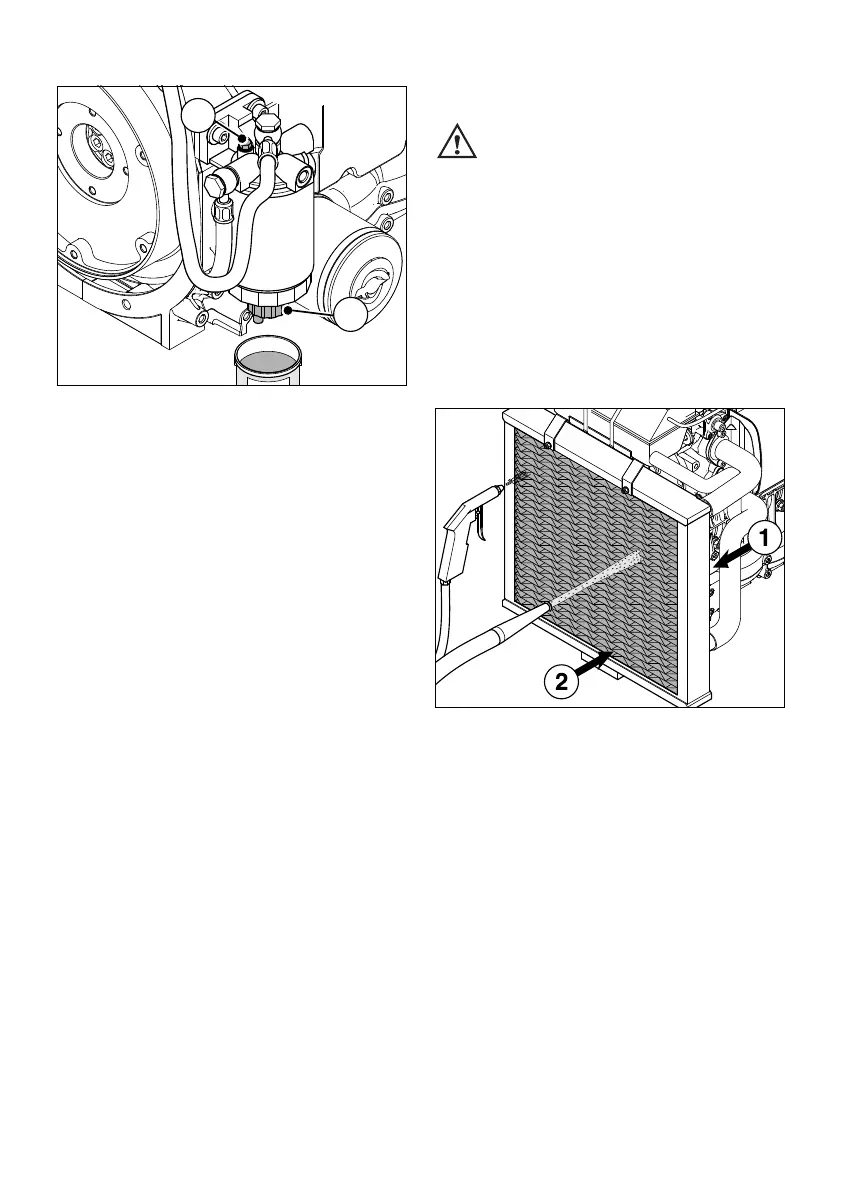
– Release the drain plug 1 and collect the liquid
in a transparent vessel.
If the drain plug is not easily accessible, an ex-
tension piece of hose can be slipped on the
plug.
– If an insufficient amount of liquid leaves the
tank, release additionally plug 2.
As water is heavier than diesel fuel, first the
water, then the fuel will escape. This is indicated
by the clearly visible separating line.
– If finally only fuel leaves through the port, the
drain plug 1 can be closed again.
– Subsequently, re-tighten plug 2.
Note:
If starting appears difficult, bleed the injection
system (Chapter 4.1.3).
5.3.3. Clean the radiator fins
For cleaning, the engine must be at a
standstill and have cooled down.
Important !
The delicate radiator fins must never be cleaned
using tools, such as a screw-driver or a spatula.
Deformed radiator fins or radiator leakage may
reduce the radiator performance.
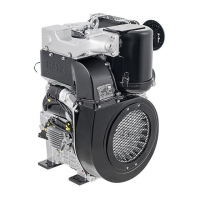
– Place a vessel below the radiator to collect any
contamination.
Dry contamination
34
– Blow-clean radiator fins – depending on the
degree of soiling – either using compressed
air or rinse them using a water jet (first from
item 1, then from item 2).
Do not use a high-pressure jet.
Damp or oily contamination
– Spray-coat the whole area with an appropriate
cleaning solution according to the manufactur-
er’s specification, and subsequently clean by
means of a water jet. Do not use a high-pres-
sure jet.
Note:
Do not use gasoline or acidic cleaning agents.
– Determine the cause of oiling and eliminate
leakage.


 To Next Page