– 23 –
1
2
3
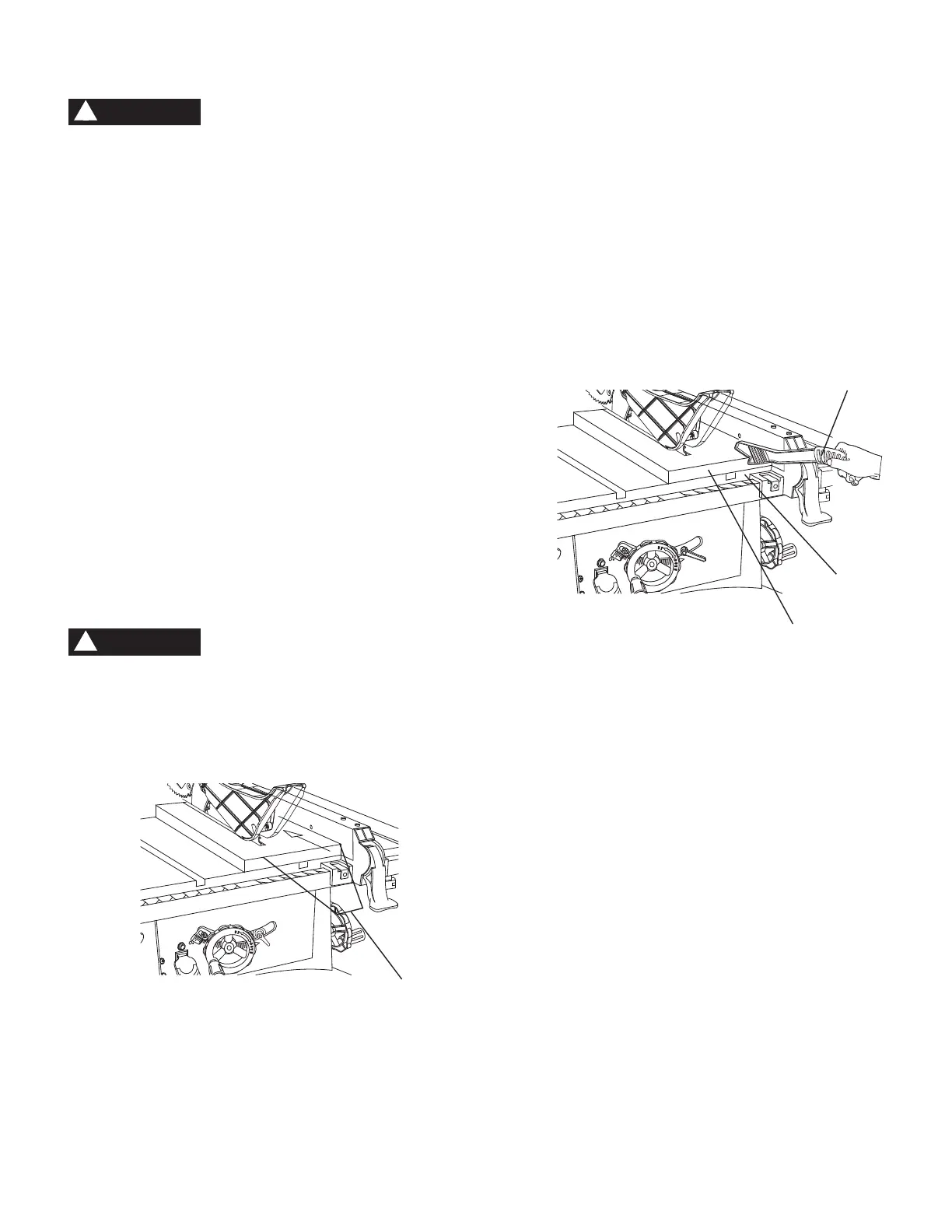
RIPPING (Fig. II, JJ)
To prevent serious injury :
● Never use a mitre gauge when ripping.
● Do not allow familiarity or frequent use of
your table saw to cause careless mistakes.
Remember that even a careless fraction of a
second is enough to cause a severe injury.
● Keep both hands away from the blade and clear
from the path of the blade.
● The workpiece must have a straight edge
against the fence and must not be warped,
twisted, or bowed when ripping.
1. Remove the mitre gauge, and hang it on the mitre
guage storage loacted on the right side of stand.
2. Secure the rip fence to the table.
3. Raise the blade so it is about 1/8 in. (3.2 mm) higher
than the top of the workpiece.
4. Place the workpiece flat on the table and against the
fence. Keep the workpiece away from the blade.
5. Turn the saw ON and wait for the blade to come to
full speed.
6. Slowly feed the workpiece into the blade by pushing
forward only on the workpiece section (1) that will
pass between the blade and the fence.
AVOID KICKBACK by pushing forward on the
section of the workpiece that passes between the
blade and the fence.
NOTE : When the workpiece is 2 in. to 6 in. wide use
the push stick to feed the work. When the workpiece
is narrower than 2 in. the push stick cannot be used
because the guard will interfere. Use the auxiliary fence
as indicated on page 25.
WARNING
!
WARNING
!
1
Fig. II
7. Keep your thumbs off the table top. When both of
your thumbs touch the front edge of the table (2),
finish the cut with a push stick. Make a push stick
using the pattern on page 29.
8. The push stick (3) should always be used when the
ripped workpiece is 2 in. to 6 in. wide. (Fig. JJ)
9. Continue pushing the workpiece with the push stick
(3) until it passes the blade guard and clears the
rear of the table.
10. Never pull the piece back when the blade is turning.
Turn the switch OFF. When the blade completely
stops raise the anti-kickback pawls on each side of
the splitter and slide the workpiece out.
BEVEL RIPPING
This cut is the same as ripping except the blade bevel
angle is set to an angle other than 0°.
RIPPING SMALL PIECES
To avoid injury from the blade contact, never make cuts
narrower than 1/2 in. (12.7 mm) wide.
1. It is unsafe to rip small pieces. Instead, rip a larger
piece to obtain the size of the desired piece.
2. When a small width is to be ripped and your hand
cannot be safely press between the blade and the
rip fence, use one or more push sticks to move the
workpiece. Always use a push stick during ripping
operations.
CROSSCUTTING (Fig. KK)
To prevent serious injury :
● Do not allow familiarity or frequent use of your table
saw to cause careless mistakes. Remember that
even a careless fraction of a second is enough to
cause a severe injury.
● Keep both hands away from the blade and the path
of the blade.
Fig. JJ


 To Next Page