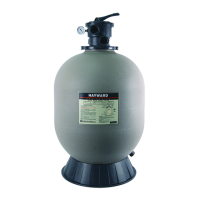
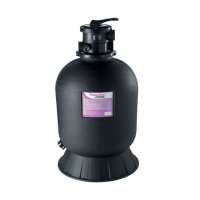
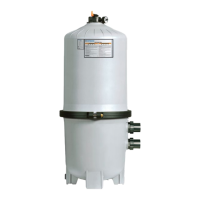
HCF Cartridge Filter
Model: HCF7030C
2
Table of Contents
1. Important Safety Instructions
2. General
2.1 Installation
3. Characteristics and Dimensions
3.1 Before Starting the Pump
4. Operation
4.1 Filtering
4.2 Maintaining Your Filter
4.3 Removing Cartridges
5. Filter Re-Assembly Instructions
5.1 Re-Installing Cartridges
5.2 Clean Seal Ring and Seal Surface
5.3 Body and Clamp Re-Assembly
6. Vacuuming Pool
7. Manual Air Relief Valve
7.1 Removing the Manual Air Relief Valve
7.2 Re-Installation of the Manual Air
Relief Valve
8. Winterizing
9. Service and Repairs
10. Replacement Part Drawings
and Numbers
11. Warranty
12. Product Registration
13. Warranty Card Registration
3
IMPORTANT SAFETY INSTRUCTIONS
1. Important Safety Instructions
WARNING – READ, UNDERSTAND, AND FOLLOW ALL SAFETY AND OPERATION INSTRUCTIONS.
Failure to follow safety and operation instructions can result in severe personal injury or death.
CAUTION
–
To reduce risk of injury, do not permit children to use or climb on this product. Closely
supervise children at all times. The ANSI/NSPI-4 Standard (above-ground and on-ground pools) advises that
components such as the ltration system, pumps, and heaters be positioned to prevent their being used as a
means of access to the pool by young children.
WARNING
–
COMPONENT SEPARATION HAZARD
Pool and spa water circulation systems operate under hazardous pressure during start up, normal operation, and
possibly after pump shut off. Pressure in system can cause explosive component separation of the upper lter
body if safety and operation instructions are not followed. Severe personal injury or death can result.
This product should be installed and serviced only by a qualied pool professional.
TO AVOID COMPONENT SEPARATION
• Followallsafetyandoperationinstructions.
• Donotoperatewatercirculationsystemifasystemcomponentisassembledimproperly,damaged,missing,or
not a genuine Hayward component.
• Beforeperformingmaintenanceonthewatercirculationsystem,verifyallsystemandpumpcontrolsarein
OFF position and lter manual air relief valve is in the OPEN position.
• UseONLYHaywardclampsystemcomponents:DEX2421JKITclampassembly,DEX2421J2nut/boltassembly,
andaDEX2422Z2metalreinforcedseal.
Non-Hayward components may fail in use and cause explosive separation.
• Neverrelyonhandtighteningtheclampnuttotheclampbolt.Usinga¾”socketonatorquewrench,torque
clamp nut and clamp bolt to 150 inch-lbs.
• Beforestartingsystempump,insureltermanualairreliefvalvebodyisinLOCKpositioninlterupperbody.
• Beforestartingthesystempump,verifythatallsystemvalvesaresetinapositiontoallowwaterfromthelter
to return back to the pool.
• Beforestartingthesystempump,themanualairreliefvalvemustbeintheOPENposition.
• Whenstartingpump,donotstandoverornearlter.
• Ifwaterleakageappearsintheareaoftheltertankclamp,immediatelyturnoffallsystemcirculationpumps
and electrical power. Do not return to the lter until all water ow has stopped. Reassemble the clamp system
per the instructions in this owner’s manual to stop the leak.
• Returntoltertoclosemanualairreliefvalveonlywhenasteadystreamofwater(Notairorairandwatermix)
is discharged from the manual air relief valve.
• Donotchangeltercontrolvalvepositionwhilesystempumpisrunning.
WARNING
–
EXCESS PRESSURE HAZARD
Pressure testing of the pump and lter system in excess of the 50 PSI can cause explosive separation of the
components. Component separation can result in severe personal injury or death.
This is the safety-alert symbol. When you see this symbol on your pump or in this manual, look for one
of the following signal words, and be alert to the potential for personal injury or death.
WARNING
warns about hazards that could cause serious personal injury, death or major property
damage and if ignored presents a potential hazard.
CAUTION
warns about hazards that will or can cause minor or moderate personal injury and/or
property damage and if ignored presents a potential hazard. It can also make consumers aware of actions
that are unpredictable and unsafe.
The NOTICE label indicated special instructions that are important but not related to hazards.


 To Next Page
 Loading...