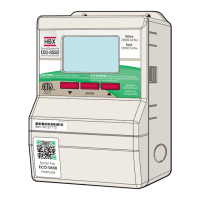
HBX CPU-1000 HVAC Controller
Version 1.38
Page 18
GLOSSARY OF TERMS
AI (Analog Input) – A control signal that varies in
magnitude, example 0-10 volts or 4-20mA. Usually
being supplied to the control source.
Aquastat – The name usually supplied to the
temperature sensing device immersed in water and
sending on/off control signals to its control source.
Closed Loop – This typically describes the control
strategy employed in a regulated system. Closed loop
controls always have feedback sensors giving signals
back to the control source allowing incremental
adjustments to be made, thus resulting in more precise
control.
Mixing Valve – A special type of valve that is
designed to temper water temperature by blending
hot water with cooler return water.
Can be 2-way, 3-way and even 4-way mixing.
Modulating Valve – A special type of
valve that has the ability to regulate or proportional
open or close dependent on the control signal supplied
to it.
Open Loop – Normally used to describe a type of
control strategy for a regulated system. Open loop
systems provide no feedback on temperature changes
and thus tend to work blind or unaware of actual
temperature conditions.
PID (Proportional, Integral, Derivative) –
This is an acronym to describe the control calculations
in automatic controls. In essence it decides when to
accelerate or decelerate a device and at the same time
measures and compensates for the rate of change and
how long it has been outside of its target range.
PWM (Pulsed Width Modulation) –
It is a control strategy that uses digital technology (1’s
and 0’s or 0 and 5 volts) to emulate an analog signal.
The longer the high value (e.g. 5 volts) is pulsed for
during a string of pulses, represents a higher analog
value.
Relay – Typically a small switching device that
aids or assists in the control of turning on/off larger
pieces of electrical equipment.
Thermistor – Is an electrical device that varies its
resistance in proportion to the temperature it is
exposed to. It is commonly used as a feedback signal
to a controller.
Thermostat – A temperature sensing device that
sends electrical signals back to a central controller to
turn on/off the heat/cooling supply.
WWSD (Warm Weather Shut Down) –
A control strategy used to turn the boiler off at times
when the temperature outside of the building exceeds
the design heat loss or heat exchange between the
internal and external walls. The strategy is designed to
provide energy savings from firing the boiler
unnecessarily and to improve the inside comfort of
uncontrolled zones.
Zone – An area, room or collection of rooms that
have independent heating and cooling control. Each
zone will usually have its own thermostat.
Zone Damper – The name usually given to the
sliding or rotating vane inside the air supply ducting or
plenum. The zone damper will either open or close to
meet the heat/cool demand.
Zone Valve – The name given to the isolation valve
that opens and closes the heat generating/cooling
source to the zone requiring temperature adjustment.



 To Next Page