17
4 CHANNEL 2
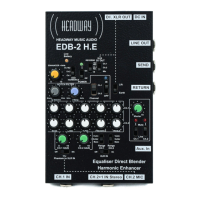
Channel 2 is suitable for a second pickup or Mic on same instrument. It
suits active and passive magnetic/piezo pickups as well as a wide
range of Mics.
The XLR input allows the use of a high quality Mic directed at the
instrument to be mixed in combination with a pickup source fed into
Channel 1. For live performances when using Mics you should use
Uni-directional Mics such as Cardiod and especially Hyper-Cardiod
Polar Patterns.
The EDB-2 was NOT primarily intended to be used for two totally
separate sources such as Guitar + Vocals since you will normally
require different settings of EQ.
Phantom Power is required to power true condenser Mics e.g. DPA
4099 or AKG C414 where no battery is used inside Mic. Exceptional
quality reproduction may be obtained in this way. Dynamic
Mics such as the Shure SM 57 are more usual in live work as they are
tougher and often easier to use than condenser types but are less
subtle and accurate for acoustic instruments and do not require
Phantom Power.
IMPORTANT: Before Switching Phantom Power ON/Off, switch
Standby ON first.
Mic Use Notes: Headway Music Audio Ltd. do NOT recommend the
use of internal Mics within instrument bodies for several reasons.
Firstly, musical instruments are voiced to be heard from the outside
whereas internal bodies usually have excessive mid and bass boom.
Secondly, Mics are meant to be used in free air where sound waves
travel mainly from front of diaphragm to rear whereas inside
instruments sound reflections and partial cancellations from standing
waves cause phase problems and prevent clarity. In addition, the
sound quality and construction/reliability of Mics offered with pickup
systems for internal use is often poor.
Finally, the placement of a Mic inside a resonant chamber producing
uneven peaks and a preponderance of low frequencies makes it
exceptionally prone to feedback.


 To Next Page