19
4.1 INPUTS & LEVEL CONTROL
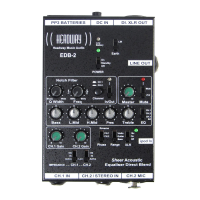
4.1.1 MIC INPUT XLR: Impedance < 2k Ohm
XLR input accepts Dynamic, Ribbon or Condenser Mics.
4.1.2 STEREO JACK INPUT
Stereo jack input feeds separate signals to both channels controlled by
their gain controls. The signal on the tip of jack (red or white wire in
stereo cable) feeds Channel 2. The signal on the ring of the jack (blue
or black wire in cable) feeds Channel 1.
See Impedance 3 Way Switch Notes on Ch.1
4.1.3 PHANTOM POWER 9V TO CHANNEL 1 JACK INPUT:
3 WAY SWITCH
This enables external powering of certain Active Pickup Systems and
Blender systems on board instruments with no battery inside
where wired to accept Phantom Power via RING (Stereo Jack Lead) or
wired to accept Phantom Power to TIP.
Active Pickup or Active Pickup/Mic Blender Systems wired for
Phantom should NOT require an Internal Battery. This may be an
advantage where maximum active system performance is required but
where battery access may be restricted, e.g. “f” Hole Instruments and
Resophonic Guitars.
CAUTION: BE SURE TO CHECK IF PHANTOM POWER IS
REQUIRED BY CHECKING THE WIRING SPEC. OF YOUR
PICKUP/MIC OR BLENDER SYSTEM WITH THE
MANUFACTURERS NOTES BEFORE TRYING THIS FACILITY.
Headway Music Audio Ltd. will NOT accept requests for information on
other manufacturers wiring or specifications.
Headway Music Audio Ltd. will not be held liable for damage to other
manufacturers pickup systems from Phantom Power.
The Ring Position suits more typical pickup systems where wired for
Phantom. Tip position is required for certain Electret Condenser Mic
systems.


 To Next Page