PART 4: DOMESTIC WATER PIPING (CONTINUED)
tion line connections. These connections must be installed in accordance with all local and national
codes or any applicable standard that prevails. The auxiliary connections are 1” on all Phoenix
Evolution models. Never use dielectric unions or galvanized steel fittings. Use only copper or brass
fittings. Teflon sealant must be used on all connections. The top port has a dip tube that draws the
hot water from the dome of the unit and the bottom port dip tube returns the water to bottom of the
unit.
PART 5: HYDRONIC PIPING
A. HYDRONIC HEATING MODULE PIPING
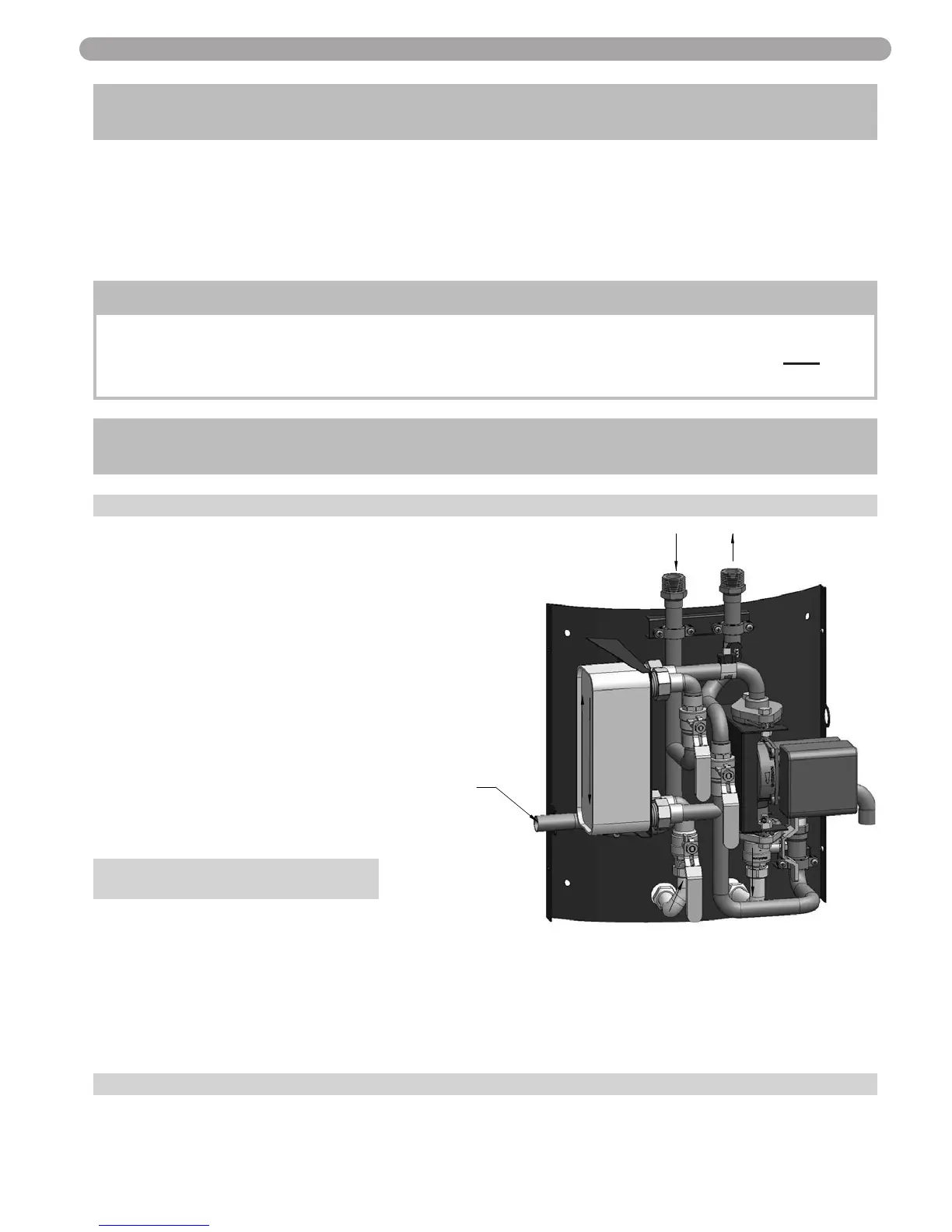
The hydronic heating module
comes pre-plumbed and connected
directly to the Phoenix Evolution
Storage Tank. The heated water
inside the tank will be circulated
through one side of the brazed plate
heat exchanger while the heating
system water flows through the
other side. The heating system pip-
ing is connected to the return and
supply pipes located on the top of
Hydronic Heating Module (See Fig.
5-1). Piping of the module to the sys-
tem is not complex and does not
require any primary or secondary
piping normally used on high effi-
ciency low mass boilers.
B. PRESSURE RELIEF VALVE
FOR THE HYDRONIC SYSTEM
The pressure relief valve supplied is
designed to relieve pressure greater
than 30 PSI. The Hydronic Heating
Module is designed to withstand
pressure up to 150 PSI. If you are changing the pressure relief valve for a higher pressure, you must
make sure that the system components are designed for the higher pressure. The relief valve must
be rated for the BTU capacity of the brazed plate heat exchanger which is a maximum of 135,000
BTU. Pipe the discharge line in copper piping to a drain. Provide 6” clearance from the floor drain.
C. HYDRONIC EXPANSION TANK AND MAKE UP WATER
Ensure that the expansion tank is sized to the system volume and the brazed plate capacity and relat-
ed piping for the Hydronic Heating Module. The capacity is ½ gallon. Most chilled water systems are
n
WARNING
Never connect auxiliary connections to any system that uses glycol or other solutions
formulated for hydronic systems. These auxiliary connections are to be used only
in a
potable water system. Failure to follow this warning could result in death or serious injury.


 To Next Page