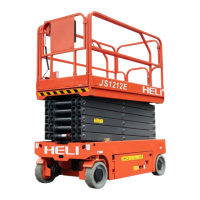
JS07N·JS07·JS08·JS12·JS14
47
Maintenance
Before replacing the hydraulic oil, the oil may
be tested by an oil distributor for specific levels
of contamination to verify that changing the oil
is necessary.
If the hydraulic oil is not replaced at the two-
year inspection, test the oil quarterly. Replace
the oil when it fails the test.
Refer to E-1 Test or Replace the Hydraulic oil.
B-12
Inspect the Hydraulic Tank Cap Vent-
ing System
This procedure should be performed every 250
hours or quarterly, whichever comes first.
A free-breathing hydraulic tank cap is essential
for good machine performance and service life.
A dirty or clogged cap may cause the machine
to perform poorly. Extremely dirty conditions
may require that the cap be inspected more of-
ten.
1. Remove the breather cap from the hy-
draulic tank.
2. Check for proper venting.
Result: Air passes through the breather ⊙
cap.
¤ Result: If air does not pass through the
cap, clean or replace the cap. Proceed to step
Note: When checking for positive tank cap
venting, air should pass freely through the
cap.
3. Using a mild solvent, carefully wash the
cap venting system. Dry using low pressure
compressed air. Repeat step 2.
4. Install the breather cap onto the hydraulic
tank.
B-13
Check the Module Tray Latch
Components
This procedure should be performed every 250
hours or quarterly, whichever comes first.
Maintaining the module tray latch components
in good condition is essential to good perfor-
mance and service life. Failure to detect worn
out latch components may result in module
trays opening unexpectedly, creating an un-
safe operating condition.
1. Inspect each module tray rotary latch and
related components for wear. Tighten any
loose fasteners.
2. Lubricate each module tray rotary latch.
Using light oil, apply a few drops to each
of the springs and to the sides of the ro-
tary latch mechanism.
B-14
Test the Down Limit Switch, Level
Sensor and Pothole Limit Switches
This procedure should be performed every
250 hours or quarterly, whichever comes first.
Maintaining the limit switches is essential to
safe operation and good machine perfor-
mance. Operating the machine with a faulty
limit switch could result in reduced machine
performance and a potentially unsafe operat-
ing condition.
Perform this procedure with the machine on a
firm, level surface that is free of obstructions.
Down limit switch
1. Remove the platform controls.
2. Raise the platform about 2.5m from the
ground.
3. Lift the safety arm, move it to the center
of the scissor arm and rotate down to a
vertical position.
4. Lower the platform onto the safety arm.
Crushing hazard.
Keep hands clear of the safety arm when low-
ering the platform.
5. Turn the key switch to the off position.
6. Tag and disconnect the platform control
box at the platform.
7. Open the battery tray, tag and disconnect
the connector from the ECU to the plat-
form control cable.


 To Next Page
 Loading...