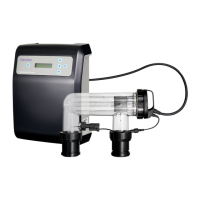
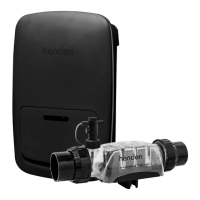
Henden Mineral and Salt Chlorinator Owners Manual
16 | HENDEN INSTALLATION & OWNERS MANUAL
WARNING Some people recommend
that you put salt directly in the skimmer
box. This is a very poor practice as it
allows very high concentrations of salt
to be passed through your filtration and
other pool equipment.
8. DAY TO DAY OPERATION
Four Prime rules must be observed if your unit is to give
the best possible service:
8.1 Stabiliser
The importance of pool stabiliser cannot be over –
emphasised. It is essential in helping retain chlorine
in your pool. Chlorine is rapidly dissipated by sunlight
and the use of stabiliser will reduce this dissipation
substantially. Without stabiliser, it may be necessary to
run the unit for up to three times as long!
Stabiliser should be added at the rate of 500 grams
for every 10,000 litres of water. Stabiliser should be
maintained at a level of 30 – 50 ppm. Before adding
more stabiliser, have your pool water analysed at your
pool shop to ensure that you do not add too much. (FOR
OUTDOOR POOLS ONLY, INDOOR DO NOT REQUIRE
STABILISER)
8.2 pH and total alkalinity
A correct pH level must be maintained to prevent
problems such as black spot, staining, cloudy water, etc.
An incorrect pH level can damage the pool. Correct pH
levels are as follows; fibreglass – 7.2 to 7.4 concrete & tiled
– 7.4 to 7.6 If you allow the pH level to rise to 8.0 or above,
the chlorine required could be as much as three times the
normal amount.
Total alkalinity should not be confused with pH, although
the two are closely related. Total alkalinity determines the
speed and ease of pH change. The ideal range is 80 – 150
ppm, or refer to your pool professional.
You should use a test kit which includes a test for total
alkalinity. Low total alkalinity can cause unstable
pH levels – i.e. An inability to keep the pH constant may
cause staining, etching and corrosion of metals. High total
alkalinity will cause constantly high pH levels.
8.3 TDS levels
Salt is the essential element by which your unit operates.
Insufficient salt will damage your cell.
RECOMMENDED TDS LEVEL RANGE: 4,000 -
6,000ppm
Salt is NOT used up in the sanitisation process or by
evaporation. It is only lost through backwashing, splash-
out, overflow or by leakage from the pool or plumbing.
Heavy rain can dilute the TDS levels in your pool;
therefore TDS levels should be checked during these
events.
Low TDS levels will destroy the coating on the anode
plates and will void all warranty.
The Henden Chlorinator has a built in warning indicator to
minimise damage resulting from insufficient TDS levels,
however, the ultimate responsibility is on the owner to
ensure adequate TDS levels are maintained all year round.
8.4 Running times
These instructions cover Henden Chlorinator for
residential use only.
If you run your sanitiser for 24 hours a day, or for
long periods, the cell life will be greatly reduced. It is
important that the correct model Henden Chlorinator has
been installed on your pool. Many models are available
from Henden to cope with small courtyard pools up
to commercial applications. (Consult your local Reece
Irrigation & Pools branch for more information).
Note: The Henden guarantee does not apply to
commercial or semi-commercial installations,
i.e. where the system runs more than an average
of 8 hours per day over the year. Guarantee on
commercial and semi-commercial installations is
12 months only on both power supply and cells.
WARNING Do not add Hydrogen
Peroxide to pool water or through
swimming pool hydraulic or sanitiser
system. Use of Hydrogen Peroxide will
void warranty on Henden products.


 To Next Page