29
Surface Roughness and Tipping
Because of the higher penetration depth the influence of surface roughness is not as
high as for the surface sensing head MOIST-R1M V2. For measurements at surfaces
with ledges or holes deeper than 5 mm average values must be generated from single
measurements. Measurements at surfaces with roughness > 10 mm must be
considered to be critical.
Take care during measurement that the sensing head isn’t tipping. The falsifications
caused by tipping aren’t as critical as for the sensing head MOIST-R1M V2.
Nevertheless tipping can also falsify the measured data.
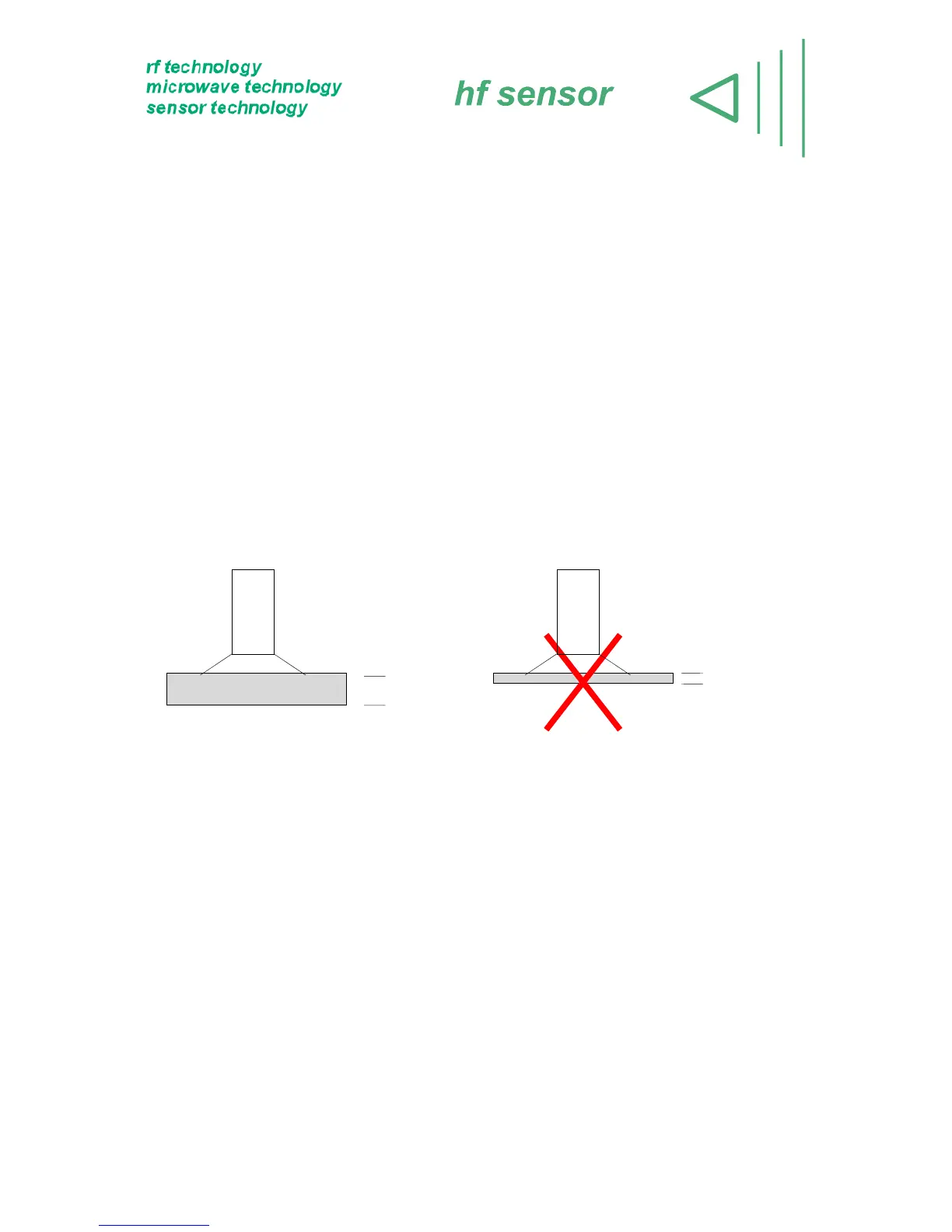
Minimum Thickness of Material
The field penetrates the material dependent on moisture and material type in the range
of 20 ... 30 cm. Therefore test objects must have a minimum thickness in this range. If
the material thickness is lower, measurement can be falsified.
If the test object - for instance a wall - is smaller than this minimum thickness, than parts
of the electromagnetic wave irradiated from the sensing head MOIST-PM V2 will be
reflected from the rear side of the test object and will superimpose with the reflexions
caused by moisture. Depending on moisture and material this effect can cause partially
strong falsification of the measured data.
> 20 ... 30 cm
< 20 cm



 To Next Page