
 Need help?
Do you have a question about the HighPoint SSD7140 and is the answer not in the manual?
Specifies necessary system hardware and operating systems for the SSD7140.
Lists the components included within the SSD7140 package.
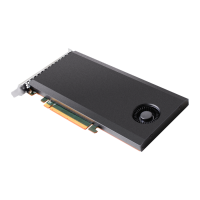
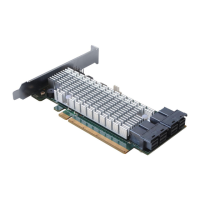
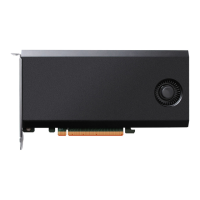
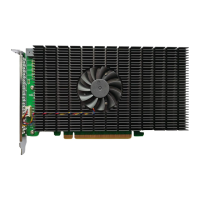
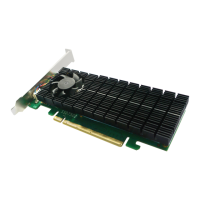
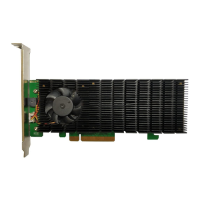
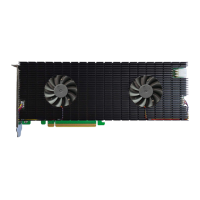
Details the physical components and front view of the SSD7140 controller.
Instructions for removing heatsink screws and managing fan cables.
Guide for removing M.2 slot screws and installing NVMe SSDs into the card.
Steps for flipping the heatsink, securing SSDs, and reconnecting fan power.
Securing the heatsink with screws and powering up the external power supply.
Explains the necessity of both PCIe bus and external PSU power for operation.
Specific note on the external power cord not being required for 2019 Macpro systems.
Links to drivers, WebGUI, installation guides, and compatibility lists.
Information on how to obtain web support and access HighPoint's official websites.
The HighPoint SSD7140 is an advanced 8x M.2 Port to PCIe 3.0x16 NVMe RAID Controller, designed to significantly enhance storage performance and capacity in compatible systems. This quick installation guide (V1.02) outlines the necessary steps for setting up and utilizing the controller, ensuring users can integrate high-speed NVMe SSDs into their workstations or servers with ease.
The SSD7140 serves as a high-performance RAID controller, enabling the use of up to eight M.2 NVMe Solid State Drives (SSDs) within a single PCIe 3.0 x16 slot. Its primary function is to aggregate the performance and capacity of multiple NVMe SSDs, presenting them to the host system as a unified storage solution. This is particularly beneficial for applications demanding extremely fast data access, such as video editing, large-scale data analytics, high-performance computing, and enterprise-level storage.
By leveraging the PCIe 3.0 x16 interface, the SSD7140 ensures maximum bandwidth utilization for the connected NVMe SSDs, overcoming the limitations of traditional SATA-based storage solutions. The controller supports various RAID configurations, allowing users to optimize for either maximum performance (e.g., RAID 0) or data redundancy and protection (e.g., RAID 1, RAID 5, RAID 10, or JBOD for individual drive access). This flexibility makes it suitable for a wide range of professional and enthusiast applications where both speed and data integrity are critical.
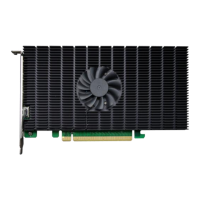
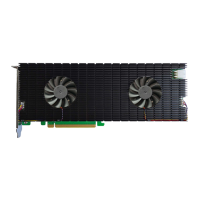
The device is designed to be compatible with a broad spectrum of operating systems, including Windows 10, Windows Server 2016, Windows Server 2019, Linux kernel 3.10 and later, and macOS 10.13 and later. This broad compatibility ensures that a diverse user base can integrate the SSD7140 into their existing infrastructure without significant compatibility hurdles. The controller card itself is a full-height, full-length PCIe card, featuring a robust heatsink and dual cooling fans to manage the thermal output of up to eight high-performance NVMe SSDs, ensuring stable operation even under sustained heavy workloads.
The SSD7140 offers several key usage features that streamline its integration and operation. The installation process is detailed and user-friendly, starting with the physical mounting of M.2 NVMe SSDs onto the controller card. This involves removing the heatsink, carefully inserting each SSD into its designated M.2 slot, and securing it with screws. The guide emphasizes the importance of proper alignment and secure fastening of each SSD to prevent detection issues or data loss.
Once the SSDs are installed, the heatsink is reattached, and the cooling fan's power cable is reconnected. A critical aspect of the SSD7140's operation is its power delivery system. The controller relies on two power sources: power supplied through the PCIe bus and additional power from the system's Power Supply Unit (PSU) via an external power cable. The manual explicitly warns that insufficient external power can lead to SSDs dropping offline or remaining undetected, potentially resulting in data loss. An exception is noted for 2019 Mac Pro systems, which may not require the external power cord. This highlights the importance of adhering to the power requirements for optimal performance and stability.
After the physical installation, the next step involves installing the necessary drivers and management software on the host system. The guide directs users to the HighPoint Technologies website for the latest drivers, WebGUI (Graphical User Interface) for management, and detailed installation guides. The WebGUI provides a comprehensive interface for configuring RAID arrays, monitoring SSD health, and managing other controller settings, offering users full control over their storage solution.
The SSD7140 is designed for systems with a free PCIe 3.0 (or 4.0) x16 slot, ensuring it can leverage the full bandwidth required for high-speed NVMe operations. The ability to support up to eight M.2 NVMe SSDs provides substantial flexibility in terms of capacity and performance scaling, allowing users to tailor their storage solution to specific needs. The controller's robust design, including its active cooling solution, is a crucial feature for maintaining the performance and longevity of the installed NVMe SSDs, especially in demanding environments where sustained high data transfer rates generate significant heat.
Maintenance for the SSD7140 primarily revolves around ensuring proper installation, power supply, and software updates. The initial installation steps serve as a foundational maintenance aspect, as correctly installing the SSDs and securing the heatsink prevents common issues such as overheating or poor electrical contact. The guide's emphasis on carefully handling the heatsink and fan power cable during SSD installation underscores the need for gentle and precise handling to avoid damage.
Regular checks of the external power supply connection are crucial, as highlighted by the warning regarding SSDs dropping offline due to insufficient power. This proactive check can prevent data loss and ensure continuous operation. Users are encouraged to regularly visit the HighPoint Technologies website for the latest drivers and firmware updates. Keeping the controller's software up-to-date is essential for maintaining optimal performance, ensuring compatibility with new operating system versions, and addressing any potential bugs or security vulnerabilities.
The WebGUI management interface plays a significant role in ongoing maintenance. Through this interface, users can monitor the health and status of individual NVMe SSDs, check RAID array integrity, and perform maintenance tasks such as rebuilding degraded arrays or replacing faulty drives. This centralized management tool simplifies the process of overseeing the storage solution and responding to any issues promptly.
While the guide does not explicitly detail physical cleaning procedures, the presence of cooling fans implies that occasional cleaning to remove dust buildup would be beneficial for maintaining optimal airflow and preventing overheating. This is a common maintenance practice for any actively cooled computer component. The robust design of the heatsink and fans suggests a focus on long-term reliability, but user vigilance in monitoring system temperatures and ensuring adequate ventilation within the host chassis will further contribute to the longevity of the SSD7140 and its installed SSDs.
In summary, the HighPoint SSD7140 is a powerful and versatile NVMe RAID controller that offers significant performance and capacity enhancements for a wide range of computing environments. Its design focuses on ease of installation, robust power delivery, and comprehensive software management, all contributing to a reliable and high-performance storage solution. Adhering to the installation guidelines and performing routine software updates and power checks will ensure the controller operates efficiently and effectively for its lifespan.
 General
| RAID levels | 0, 1 |
|---|---|
| Certification | CE, FCC, RoHS, REACH, WEEE |
| Data transfer rate | 28 Gbit/s |
| S.M.A.R.T. support | Yes |
| Number of devices supported | 8 |
| Mean time between failures (MTBF) | 920585 h |
| PCI Express slots version | 3.0 |
| Supported storage drive interfaces | M.2 |
| Mac operating systems supported | Mac OS X 10.13 High Sierra |
| Linux operating systems supported | Kernel 3.12 |
| Server operating systems supported | Windows Server 2016 |
| Windows operating systems supported | Windows 10 |
| Storage temperature (T-T) | -20 - 80 °C |
| Operating temperature (T-T) | 5 - 55 °C |
 Weight and Dimensions
| Depth | 21 mm |
|---|---|
| Width | 284.9 mm |
| Height | 110.9 mm |


 To Next Page