EasyManua.ls Logo

Hiland HLDS01-MGTHG - User Manual

Hiland HLDS01-MGTHG
23 pages
Print Icon
To Next Page IconTo Next Page
Loading...
MODEL #HLDS01-MGTHG
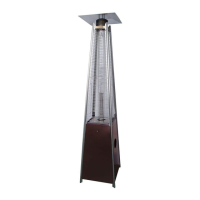
FLAME PATIO HEATER
Owner’s
Manual
1 WH19/01
Questions, problems, missing parts? Before returning to your retailer, call our customer
service department at 1-888-775-1330, 7 a.m. - 4 p.m., PST, Monday - Friday.
Serial Number
Purchase Date
Precaution!
The Powder Coating paint process has become the
most common widely used application in the outdoor
furniture category. Unfortunately powder coating is
extremely sensitive to Humidity and Moisture. A
simple process to protect your furniture, especially
flat surfaces is to apply a simple coat of good quality
car wax prior to using. If this process is done every
few months it will protect your furniture for years
to come.
INSTALLER/ASSEMBLER: Leave this
manual with consumer.
CONSUMER: Keep this manual for
future reference.
Distributor: AZ PATIO HEATERS LLC
8601 W. Washington St. Ste 200 Tolleson, AZ 85353.
ATTACH YOUR RECEIPT HERE
DANGER
If you smell gas:
1. Shut off gas to the appliance.
2. Extinguish any open flame.
3. If odor continues, keep away from the appliance
and immediately call your gas supplier or fire
department.
DANGER
CARBON MONOXIDE HAZARD
This appliance can produce carbon
monoxide which has no odor.
Using it in an enclosed space can kill
you.
Never use this appliance in an
enclosed space such as a camper,
tent, car or home.
WARNING
Do not store or use gasoline or other flammable
vapors and liquids in the vicinity of this or any other
appliance. An LP-cylinder not connected for use shall
not be stored in the vicinity of this or any other
appliance.
WARNING
Improper installation, adjustment, alteration, service
or maintenance can cause property damage, injury or
death. Read the installation, operation and
maintenance instructions thoroughly before installing
or servicing this equipment.
WARNING: For Outdoor Use Only
Question and Answer IconNeed help?

Do you have a question about the Hiland HLDS01-MGTHG and is the answer not in the manual?

Summary

Safety Information and Warnings

Understanding Safety Symbols

Explains DANGER and WARNING symbols and their implications.

Fire and Carbon Monoxide Hazards

Details risks of explosion, fire, and carbon monoxide poisoning.

Burn Hazards and Proposition 65

Covers burn risks, high surface temperatures, and Prop 65 chemical warnings.

Package and Hardware Contents

Package Contents List

Lists all parts included in the package with their quantities.

Hardware Contents List

Lists all hardware components with their actual sizes and quantities.

Preparation for Assembly

Product Check and Tool Requirements

Instructions to check parts, compare with lists, and list required tools.

Assembly Instructions

Base and Support Assembly

Assembling the base, ignitor, and connecting support structures.

Main Frame and Glass Tube Installation

Securing the frame, block belt, top plate, and installing the glass tube.

Tube Fixer, Guards, and Reflector Assembly

Installing glass tube fixer, protective guard, mesh, and reflector.

Panel Installation and Cylinder Connection

Attaching side/front panels and connecting the gas hose to the cylinder.

Operation Instructions

Performing a Leak Check

Step-by-step procedure to check for gas leaks using soapy water.

Pre-lighting and Ignition Procedures

Steps for turning on gas, pre-lighting checks, and pilot light ignition.

Main Burner Ignition and Flame Adjustment

Lighting the main burner, adjusting flame height, and identifying abnormal flames.

Restarting, Shutdown, and Operation Checklist

Procedures for relighting, safely shutting down, and pre-operation checks.

Troubleshooting Guide

Pilot and Burner Ignition Issues

Addresses problems with pilot light and main burner not igniting or having low flame.

Smoke, Odor, and Flame Quality Issues

Solutions for thick smoke, gas odors, and abnormal flame colors.

Uneven Heating and Popping Noises

Troubleshooting tips for inconsistent heat distribution and popping sounds.

Care and Maintenance

Routine Cleaning Procedures

Instructions for cleaning exterior surfaces, burner areas, and ventilation.

Storage and Transportation Guidelines

Best practices for storing the heater between uses and during transport.

Service and Repair Recommendations

Guidance on when and how to get the heater serviced by qualified personnel.

One-Year Limited Warranty

Overview

This document serves as the owner's manual for the Hiland Premium Series FLAME PATIO HEATER, model #HLDS01-MGTHG. It provides comprehensive instructions for assembly, operation, maintenance, and troubleshooting, ensuring safe and efficient use of the appliance.

Function Description

The Hiland FLAME PATIO HEATER is an outdoor combustion appliance designed to provide radiant heat for outdoor spaces. It operates using propane gas and features a visible flame within a glass tube, offering both warmth and aesthetic appeal. The heater is intended for outdoor use only and is not to be used in enclosed spaces such as campers, tents, cars, or homes due to the risk of carbon monoxide poisoning. The design incorporates a pilot light for safer startups and shutdowns, and a variable control knob allows users to adjust the heat output.

Usage Features

The heater is designed for ease of use with several key features:

  • Propane Fuel: It uses a standard 20 lb. propane cylinder (not included) with a vapor withdrawal supply system. The manual emphasizes the importance of using a cylinder with an overfilling prevention device and a connection compatible with the appliance.
  • Ignition System: The heater is equipped with an ignitor knob and requires an AA battery (1.5 V) for ignition. The lighting procedure involves turning the control knob to the "OFF" position, fully opening the LP cylinder valve, pushing in and rotating the control knob to the "PILOT" position, and then pushing and releasing the igniter button until the pilot flame is visible. For initial starts or after cylinder changes, the control knob should be held in for 2 minutes to purge air from the gas lines. If the pilot does not stay lit, a long stem lighter can be used to manually light the pilot through the glass tube while depressing the control knob.
  • Heat Adjustment: Once the pilot is lit and the control knob is turned to "HIGH," the main burner will ignite. The temperature can be lowered by pushing in the control knob and turning it counterclockwise to the "LOW" position.
  • Safety Precautions: The manual extensively details safety information, including warnings about fire, explosion, burn hazards, and carbon monoxide poisoning. It stresses the importance of adequate clearances from combustible materials (3 feet from sides, 2 feet from top), never leaving the heater unattended when hot, and keeping it out of reach of children. It also warns against storing or using flammable vapors or liquids near the appliance and emphasizes that the LP-cylinder should not be stored in the vicinity of the appliance when not connected for use.
  • Outdoor Use Only: A critical usage feature is its strict designation for outdoor use in well-ventilated spaces. The manual defines permissible partial enclosures, such as those with walls on all sides but no overhead cover, or those with an overhead cover and no more than two or three side walls, provided a significant portion of the horizontal periphery remains open.
  • Shut Down Procedure: To shut down the heater, the control knob is turned clockwise to "PILOT," which extinguishes the main burner while keeping the pilot lit. To extinguish the pilot, the control knob is depressed and turned clockwise to "OFF." Finally, the cylinder valve is turned to "OFF," and the regulator is disconnected when the heater is not in use.

Maintenance Features

Regular maintenance is crucial for the heater's longevity and safe operation:

  • Leak Check: Before each use, a leak check must be performed outdoors using a soapy water solution on all gas connections. Any bubbles indicate a leak, which must be rectified before using the heater. The manual provides detailed steps for performing and troubleshooting leaks.
  • Cleaning: Exterior surfaces should be cleaned with warm soapy water. The area around the burner and pilot assembly must be kept dry. The appliance area should be clear of combustible materials, gasoline, and other flammable vapors. Ventilation openings of the cylinder enclosure must be free from debris.
  • Hose Assembly Inspection: The entire hose assembly should be inspected at least annually for signs of excessive abrasion, cuts, or wear. Suspected areas should be leak tested, and if leaks are found, the hose must be replaced with a manufacturer-specified assembly.
  • Burner and Orifice Cleaning: Spiders and insects can nest in the burner or orifices, creating a dangerous condition. Burner holes should be cleaned with a heavy-duty pipe cleaner, and compressed air can help clear smaller particles.
  • Glass Tube and Reflector Cleaning: Carbon deposits can create a fire hazard. The reflector, reflector spacer, screen, and protective guards should be disassembled to remove the glass tube for washing and clearing.
  • Professional Inspection: The heater should be inspected before use and annually by a qualified service person. More frequent cleaning may be required depending on usage.
  • Storage: When not in use, the control knob should be turned OFF, the LP cylinder disconnected, and the heater stored upright in an area sheltered from inclement weather. Covering the heater is recommended to protect exterior surfaces and prevent build-up in air passages. For extended inactivity or transport, the LP cylinder should be moved to a secure, well-ventilated outdoor location and never exposed to direct sunlight or excessive heat.
  • Corrosion Prevention: In salt-air environments, corrosion occurs more quickly. Frequent checks for corroded areas and prompt repairs are advised. Applying high-quality automobile wax to exterior surfaces (excluding the emitter screen or domes) can help maintain the heater's appearance.

The manual also includes a detailed troubleshooting section to help users diagnose and resolve common issues such as the pilot not lighting, the burner not staying lit, low burner flame, carbon build-up, and uneven glow. It emphasizes that only a qualified service person should repair gas passages and associated components.

Hiland HLDS01-MGTHG Specifications

General IconGeneral
ModelHLDS01-MGTHG
CategoryPatio Heater
TypePropane
Heat Output48, 000 BTU
Weight38 pounds
Fuel TypePropane
ColorHammered Gray
Burner MaterialStainless Steel
MaterialSteel
Ignition TypePiezo
Fuel Tank Size20 lbs

Related product manuals