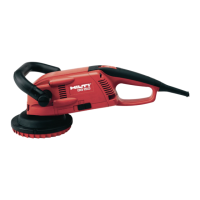
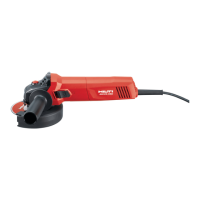
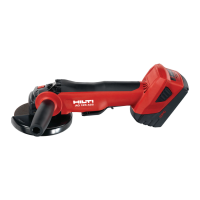
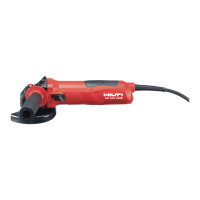
The Hilti DG 150 is an electrically-powered diamond grinding tool designed for professional use in the construction industry, specifically for grinding mineral materials. It operates exclusively in conjunction with the DPC 20 power conditioner, forming a complete system. When used with the Hilti VCD50L industrial vacuum cleaner and corresponding DG-CW 150/6" diamond cup wheels, the system is engineered to release a minimum of dust, ensuring optimum dust extraction.
Function Description:
The DG 150 is intended for dry grinding on the surface of concrete or similar mineral materials and for removing thin coatings, with a maximum thickness of 3 mm. It is crucial to use the tool only with original Hilti cup wheels and to observe all locally applicable health regulations and safety precautions. The tool is not suitable for grinding metals, wood, or other materials not listed for use, nor is it designed for use with diamond cutting discs, abrasive cutting or grinding discs, wire brushes, or other unapproved insert tools. Wet grinding is also not permissible. Materials containing asbestos must not be ground.
Important Technical Specifications:
The DG 150 operates with a nominal voltage ranging from 100 V to 240 V, depending on the DPC 20 power conditioner version. Its power input ranges from 1500 W to 2100 W, and power output from 1070 W to 1500 W. The mains frequency is 50/60 Hz.
It offers two no-load speed settings:
- Setting 1: 4700 r.p.m. (recommended for grinding soft mineral materials like paint coatings on cement rendering, offering improved dust extraction and easier guidance).
- Setting 2: 6600 r.p.m. (recommended for grinding hard mineral materials such as concrete, screed, or rock for full grinding performance).
The tool weighs 4.1 kg (DG 150) and the DPC 20 weighs between 3.4 kg and 3.8 kg, depending on the voltage version. Its dimensions are 46x25x23 cm. It features Electrical Protection Class II (double insulated) and complies with EN 55014-2 for interference immunity and EN 55014-1 for radio and television interference suppression.
Noise and vibration information (in accordance with EN 50144) includes a typical A-weighted sound power level (LWA) of 88 dB(A), a typical A-weighted emission sound pressure level (LPA) of 101 dB(A), and a typical weighted vibration at the grip of 4.0 m/s².
Other significant characteristics include a stop time after switching off of ≤ 2 seconds, thermal overload protection, and a restart safety interlock.
Usage Features:
- On/Off Switch: A push-forward switch that engages in the ON (I) position. In case of a power cut, the tool can be restarted by moving the switch to OFF (0) and then back to ON (I).
- Side Handle: Essential for safety, the side handle can be adjusted in two axes (angled for right/left-handed use and pivoted forwards/backwards) to achieve the most favorable working position. Adjustment involves switching off the tool, disconnecting the supply cord, releasing the clamping screw, positioning the handle, and then tightening the screw.
- Guard Assembly: The guard is crucial for safe operation and must always be fitted. A damaged or incomplete guard must be replaced immediately.
- Rotation: The entire guard can be rotated to position the extraction hose connector optimally. This involves switching off the tool, disconnecting the supply cord, opening the clamping lever, rotating the guard, and closing the lever.
- Height Adjustment: The guard's height can be adjusted to the work surface for optimum dust extraction, aiming for a 0-1 mm gap between the lamellar seal and the surface.
- Edge Grinding: The lower section of the guard can be rotated to expose part of the cup wheel, allowing grinding close to walls. Caution is advised when working with the guard in this partly open position due to the risk of serious injury from the rotating cup wheel.
- Diamond Cup Wheel Installation:
- Place the clamping flange on the spindle, ensuring the O-shaped recess engages securely.
- Place the cup wheel on the centering collar of the clamping flange.
- Screw on the clamping nut clockwise and tighten by hand or with a wrench against motor/gearing resistance.
- Removal involves pressing and holding the spindle lockbutton, turning the clamping nut counter-clockwise with a wrench, releasing the lockbutton, and removing the cup wheel.
- Speed Control Switch: Allows selection between two speed settings (4700 r.p.m. and 6600 r.p.m.) based on the material being ground.
- Operation: Always connect the tool to an industrial vacuum cleaner and the DPC 20 power conditioner before connecting the DPC 20 to the mains supply. Test new diamond cup wheels by running them for at least 30 seconds under no load. Apply moderate pressure and move the tool side-to-side during grinding. If the diamond cup wheel overheats or loses cutting power, interrupt grinding and allow it to cool or resharpen it with an abrasive material.
- Indicator Lamps (LED):
- DG 150: A blinking red lamp indicates tool overheating. The tool should be switched off and allowed to cool until the lamp stops blinking.
- DPC 20:
- Continuous green light: DPC 20 is ready for operation, connected to mains, and no malfunctions.
- Green blinking: May occur with 100-120 V versions under load, indicating low mains voltage and reduced DG 150 performance.
- Red blinking: Indicates DPC 20 reaction to irregularities (e.g., too high/low current, voltage, temperature). Check power output fuses if blinking persists. No indication means no power to the DPC 20, requiring checks of mains supply, cords, or the DPC 20 itself.
Maintenance Features:
- General Maintenance: Always switch off the tool and unplug the supply cord before any adjustments, cleaning, or part changes. Keep ventilation slots unobstructed and clean, ideally by blowing out dust with compressed air every four weeks. Avoid using metal objects for cleaning.
- Lamellar Seal Replacement: The guard's lamellar seal should be replaced at least every time the cup wheel is changed. Disassembly involves using a screwdriver to press the retaining ring lugs and release the seals. Assembly requires cleaning locating grooves, pressing the small seal into the guard, placing the large seal in the retaining ring, and pressing the retaining ring over the guard.
- Repairs: The tool requires no user maintenance. In case of a fault, it should be returned to a Hilti service center for repair by trained electrical specialists only. Only original Hilti spare parts should be used to avoid accidents.
- Disposal: Hilti power tools are designed for recycling. Materials should be separated for proper recycling. Hilti offers arrangements for taking back old electric tools. If disposing of the tool yourself, dismantle it without special tools, wipe oily parts clean with absorbent paper, and dispose of oil correctly, ensuring it does not enter wastewater or ground. Components like the toolbox, motor housing, fan, side handle, guard, grip, and power conditioner housing are plastic. Motor parts, internal gearing, and cup wheel mount are steel. Bearing plate, gear housing, and flange are magnesium alloy. Electric conductors are plastic and copper. Heat sink is aluminum.

 Need help?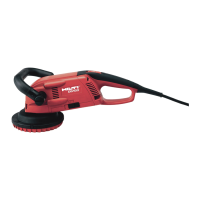

 To Next Page

 General