Need help?
Do you have a question about the Hisense 120L9 and is the answer not in the manual?
Precautions to ensure safe and correct use, avoiding dangerous situations and damage.
Crucial warnings about humidity, dust, fire risk, electrical shock, and placement.
Guidelines for connecting the device to a power source correctly.
Requirements for proper airflow to prevent overheating and damage.
Precautions for thunderstorms, long absences, and cleaning the device.
Refer all servicing to qualified personnel; no user-serviceable parts inside.
Do not look directly at the laser lens to avoid eye damage.
Keep Eye Protection setting on and avoid looking into the lens.
Avoid liquids, fire sources, blocking vents, and ensure proper environment.
Diagram and guidelines for minimum space needed for proper ventilation.
Steps for automatic image alignment using a mobile device and app.
Basic troubleshooting steps for common issues like startup delay or no picture.
Troubleshooting steps for no picture/sound, distorted images, or blurry output.
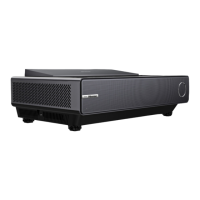
This document provides a comprehensive guide for setting up, operating, and maintaining the Hisense Laser Cinema, a device designed for home entertainment, offering a large-screen viewing experience. The Laser Cinema functions as a projector, displaying images onto a screen, and is intended for use in a home or office environment with moderate humidity and dust concentration.
The Hisense Laser Cinema is a short-throw projector that utilizes laser technology to display high-quality video and audio. It is designed to be placed on a table-top, projecting an image onto an accompanying display screen. The device supports various input sources, including HDMI, USB, and antenna connections, allowing users to connect external devices such as DVD players, set-top boxes, video cameras, and audio amplifiers. It also features network connectivity, both wired (Ethernet) and wireless (Wi-Fi), enabling access to online content and services. The Laser Cinema incorporates an eye protection sensor and a foreign object detection feature to enhance safety during operation.
Setting up the Laser Cinema involves several steps, starting with mounting the display screen, which requires referring to a specific screen installation guide. The Laser Cinema itself should be handled by two people when moved to protect the lens. Before positioning the device, all necessary cables (audio, video, Ethernet, and external device cables) should be securely connected to the ports on the back of the unit to ensure optimal picture quality. The device supports various antenna types for receiving broadcast signals, including satellite and VHF/UHF antennas. For network connectivity, users can either connect via an Ethernet cable to a router or modem, or wirelessly through a built-in Wireless LAN Adapter. It is important to ensure proper ventilation around the device by leaving at least 15 cm of space above and 20 cm on the sides to prevent overheating.
Adjusting the display image and screen is a crucial step for optimal viewing. This involves aligning the bottom of the image with the screen by rotating the device counterclockwise or clockwise if the image is lower on the left/right and higher on the right/left, respectively. If the image shifts to the left, the Laser Cinema should be moved to the right, and vice versa. The image width can be adjusted by moving the Laser Cinema closer to or farther from the screen. Fine-tuning the image involves adjusting the upper-right and upper-left corners using a wrench to rotate the front and back feet, ensuring the image is parallel with the screen. An "Auto Geometric Correction" function is available to automatically adjust the display border, or users can use "Manual Geometric Correction" for precise adjustments via a mobile device. The device also includes an "Eye Protection" setting that temporarily disables the light output if an object is too close to the projector lens.
The Laser Cinema comes with a remote control that allows users to power on/off, select input sources, access quick setup menus, navigate through content, adjust volume, mute sound, and access special functions like the electronic program guide, channel lists, and subtitles. The remote control uses AAA batteries, and proper installation is essential. For Bluetooth remote controls, pairing with the TV is required by pressing and holding a specific button for at least 3 seconds. Troubleshooting tips for the remote include checking battery installation and removing interference.
Proper maintenance is crucial for the longevity and performance of the Laser Cinema. Users should avoid touching the device when it is hot or running. The exterior should be cleaned with a damped soft cloth if dirty, but oil-based cleaners should not be used as they can damage the paint or exterior. It is important not to touch the lens with bare hands. For lens cleaning, a dust blower should be used to remove dust, and grease or fingerprints should be cleaned by a professional using optical cleaning cloth, lens wiping paper, or specialized cleaning solutions to prevent damage to the optical film and maintain image quality. The device should not be powered off directly by cutting the power supply while it is operating; instead, the power button on the remote control should be used.
Troubleshooting common issues includes checking power connections if there is no sound or picture, ensuring the remote control batteries are correctly installed, and verifying input connections for external sources. If the picture is black and white, unplugging and replugging the Laser Cinema after 60 seconds may resolve the issue. Distorted or wavy sound/picture can be caused by nearby electrical appliances, which should be moved farther away. Blurry or cut-out sound/picture when using an external antenna requires checking the antenna's direction, position, and connection. A "clicking" sound from the plastic cabinet is normal and occurs due to temperature-induced expansion and contraction. If the projector's light output is disabled and the power indicator shows a red light five times, the foreign object detection window should be checked and cleaned if covered or dirty.
 General
| Display Type | Laser TV |
|---|---|
| Screen Size | 120 inches |
| HDR Support | HDR10, HLG |
| USB Ports | 2 |
| Bluetooth | Yes |
| Refresh Rate | 60 Hz |
| Resolution | 4K Ultra HD (3840 x 2160) |
| Audio Technology | Dolby Atmos |
| HDMI Ports | 3 |
| Wi-Fi | Yes |
| Smart Features | Voice Control, Google Assistant |
| Ports | HDMI, USB, Ethernet, Optical Audio Out |


 To Next Page