9
English
Always start by fi ling half the amount of fuel, which
is to be used. Then add the whole amount of oil. Mix
(shake) the fuel mixture. Add the remaining amount
of fuel.
Mix (shake) the fuel-mix thoroughly before fi lling the
fuel tank.
Fueling
WARNING
● Always shut off the engine before refueling.
● Slowly open the fuel tank, when fi lling up
with fuel, so that possible over-pressure
disappears.
● Tighten the fuel cap carefully, after fueling.
● Always move the trimmer at least 10 ft (3 m)
from the fueling area before starting.
● Always wash any spilled fuel from clothing
immediately with soap.
● Be sure to check for any fuel leakage after
refueling.
Before fueling, clean the tank cap area carefully, to
ensure that no dirt falls into the tank. Make sure that
the fuel is well mixed by shaking the container, before
fueling.
Starting
CAUTION
Before starting, make sure the cutting
attachment does not touch anything.
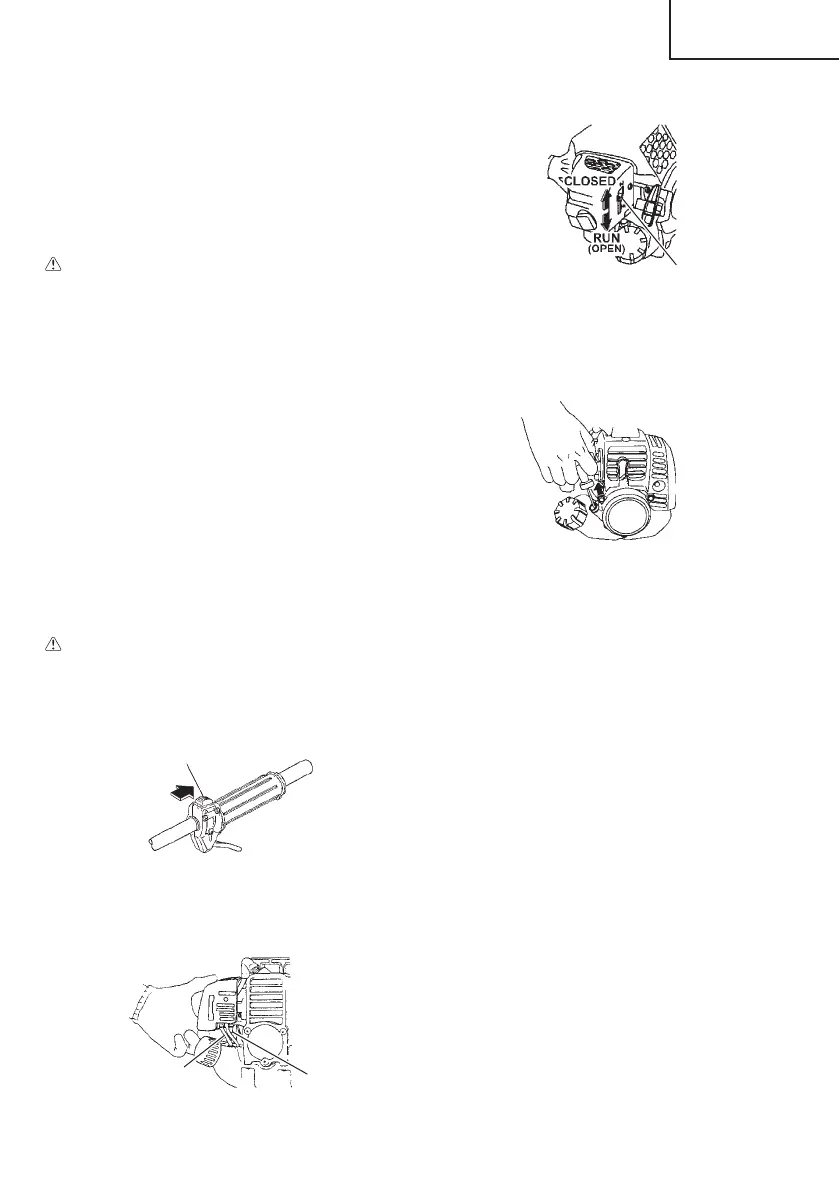
1. Set ignition switch (15) to ON position. (Fig. 11)
15
ON
Fig. 11
* Push priming bulb (16) several times so that fuel
fl ows through return pipe (17). (Fig. 12)
17
16
Fig. 12
2.
Set choke lever (18) to CLOSED position. (Fig. 13)
18
Fig. 13
3. Pull recoil starter briskly, taking care to keep the
handle in your grasp and not allowing it to snap
back. (Fig. 14)
Fig. 14
4. When you hear the engine want to start, return
choke lever to RUN position (open). Then pull
recoil starter briskly again.
NOTE
If engine does not start, repeat procedures from
2 to 5.
5. Then allow the engine about 2–3 minutes to warm
up before subjecting it to any load.
Cutting (Fig. 15, 16, 17)
○ When cutting, operate engine at over 6,500 min
-1
.
Extended time of use at low rpm may wear out the
clutch prematurely.
○ Cut grass from right to left.
○ Blade thrust may occur when the spinning blade
contacts a solid object in the critical area.
A dangerous reaction may occur causing the
entire unit and operator to be thrust violently. This
reaction is called blade thrust. As a result, the
operator may lose control of the unit which may
cause serious or fatal injury. Blade thrust is more
likely to occur in areas where it is diffi cult to see
the material to be cut.
01EngCG24EKSUS.indd901EngCG24EKSUS.indd9 2010/03/0410:54:522010/03/0410:54:52







 To Next Page