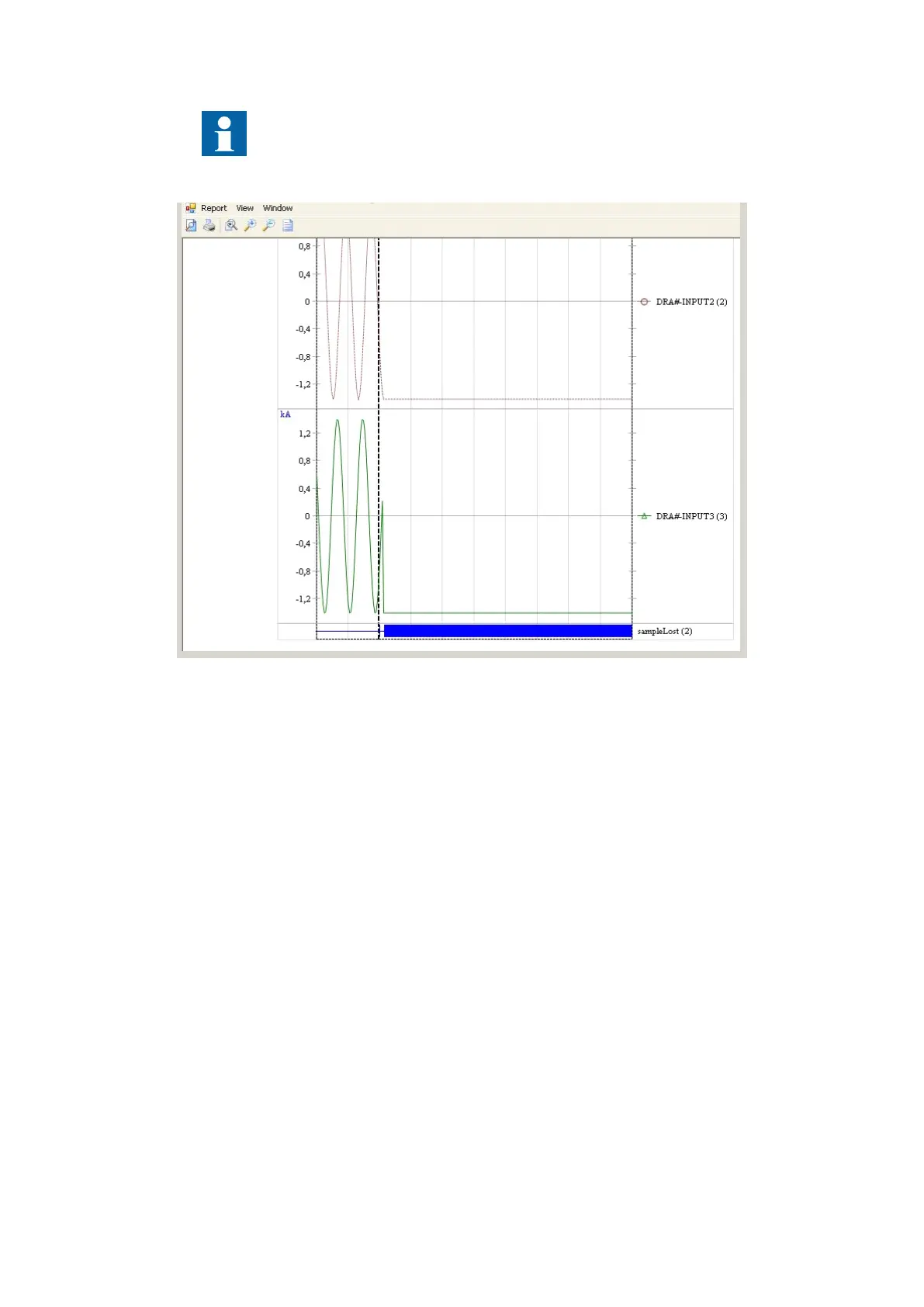
If the IEC/UCA 61850-9-2LE communication is interrupted during current injection,
the disturbance report tool in PCM600 will display the current that was injected
before the interruption.
IEC10000032 V1 EN-US
Figure 20: PCM600 disturbance report tool display after communication interruption
10.7 Testing the protection functionality
GUID-125B6F28-D3E5-4535-9CD6-6C056B79F496 v2
Each protection function must be tested individually by secondary injection.
• Verify operating levels (trip) and timers.
• Verify alarm and blocking signals.
• Use the disturbance handling tool in PCM600 to evaluate that the protection function has
received the correct data and responded correctly (signaling and timing).
• Use the event viewer tool in PCM600 to check that only expected events have occurred.
10.8 Forcing of binary input/output signals for testing
10.8.1 Forcing concept
GUID-3FD8C676-10E5-432A-8CD5-4643299AD794 v2
Forcing of binary inputs and outputs is a convenient way to test wiring in substations as well as
testing configuration logic in the IEDs. Basically it means that all binary inputs and outputs on the IED
I/O modules (BOM, BIM, IOM & SOM) can be set to a value (i.e active or not-active), selected by the
user, while the IED is in test mode. For inputs, this is true regardless of the actual signal voltage
present on the input. For outputs, any output relay can be forced to be active or not, regardless of the
current requested state of the output in the IED logic configuration.
Section 10 1MRK 505 378-UEN Rev. K
Testing IED operation
84 Line differential protection RED670
Commissioning manual
© 2017 - 2022 Hitachi Energy. All rights reserved



 To Next Page