
 Need help?
Do you have a question about the Holley 550-407 and is the answer not in the manual?
Crucial safety warnings, operational notes, and notices for installation and use.
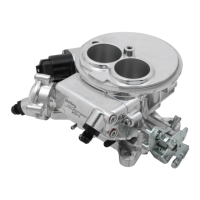
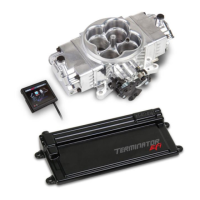
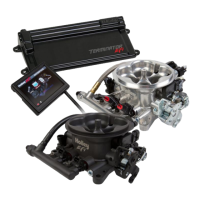
Lists and identifies all components included in the EFI system kit.
Lists essential items not included in the kit but necessary for installation.
Lists all necessary tools for performing the installation.
Instructions for properly installing the coolant temperature sensor.
Steps for removing old components before installing the new EFI system.
Installing the throttle body and connecting throttle controls and linkage.
Installing MAP sensor, fuel system components, and oxygen sensor.
Guidelines for ECU mounting and oxygen sensor installation steps.
Key do's and don'ts for proper EFI system wiring installation.
How to connect the main power and ground wires to the battery.
Identifying ECU connectors and routing the main wiring harness.
Connecting key sensors like TPS, CTS, WB02, and Fuel Pressure.
Instructions for connecting various loose wires in the main harness.
Different methods for connecting engine speed signals and their wiring.
Wiring for the "Coil -" engine speed input method.
Wiring for "Tach Out" and GM Small Cap HEI ignition systems.
Configuration and wiring for optional outputs like A/C shutdown and fans.
Connecting the transmission harness to the ECU and transmission.
Detailed pinout information for ECU connectors J1A and J1B.
Requirements that must be met before proceeding with tuning.
Overview of the tuning process and capabilities of the system.
Steps for powering on the system for the first time.
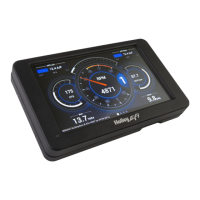
How to navigate and use the handheld controller for adjustments.
Overview of the main menu selections on the handheld display.
Step-by-step guide to creating the initial system calibration.
Process of uploading the generated calibration file to the ECU.
Procedure to calibrate the Throttle Position Sensor (TPS) range.
Configuring basic drivetrain parameters for electronic transmissions.
Setting up automatic transmission shift points and parameters.
Checking that all system sensors are providing correct data before starting.
Steps for starting the engine and initial checks.
How to synchronize the engine's ignition timing with the ECU.
Performing checks after the engine has started and warmed up.
Setting the desired idle speed and optimizing throttle plate position.
How the system learns and adapts to the engine during driving.
Accessing and viewing live telemetry and gauge displays.
Creating and configuring custom gauge displays on the handheld.
Configuring caution and warning indicators for display channels.
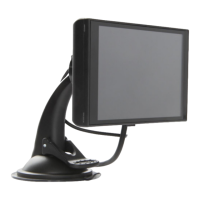
Configuring custom gauge layouts on the 3.5" Touch Screen.
Saving, loading, and transferring calibration files.
Viewing ECU configuration and managing global calibration folders.
Using data logging features and updating ECU firmware.
Configuring handheld settings like touch calibration and local options.
Modifying air/fuel ratio settings for idle, cruise, and wide open throttle.
Adjusting target air/fuel ratios for different engine operating conditions.
Adjusting fuel enrichment for acceleration and fuel prime settings.
Configuring fuel learning behavior and target idle speed.
Adjusting ignition timing for idle, cruise, and wide open throttle.
Configuring upshift and downshift points for transmission gears.
Setting the RPM for upshifts at Wide Open Throttle (WOT).
Adjusting TCC engagement and disengagement parameters.
Configuring TCC lock and unlock speeds based on vehicle speed.
Adjusting transmission line pressure based on TPS or MAP.
Accessing and modifying system-wide tuning parameters.
Configuring optional outputs like fan temperatures and A/C shutdown.
Adjusting engine-specific parameters like injector flow and fuel pressure.
Configuring ignition input type and setting the engine rev limiter.
Fine-tuning advanced fuel delivery parameters.
Adjusting parameters for closed-loop fuel control and sensor operation.
Fine-tuning idle air control functions for decel and startup.
Configuring IAC motor speed type and startup behavior.
Enabling and configuring idle spark timing adjustments for idle stability.
Interpreting status codes for the wideband oxygen sensor.
Understanding status codes for other sensors like MAP, TPS, and CTS.
Diagnosing closed loop operation and self-tuning status.
 General
| Part Number | 550-407 |
|---|---|
| Fuel Type | Gasoline |
| Boost Control | No |
| Nitrous Control | No |
| Brand | Holley |
| Fuel Inlet | Dual |
| Product Type | Carburetor |
| Throttle Bore Size | 1.75 in |
| Base Plate Material | Aluminum |
| Main Body Material | Aluminum |



 To Next Page