22
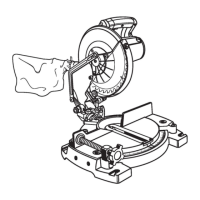
Fig. 26
BEVEL CUT
OPERATION
TO BEVEL CUT
See Figures 25 - 26.
A bevel cut is made by cutting across the grain of the workpiece
with the blade angled to the workpiece. A straight bevel cut
is made with the miter table set at the zero degree position
and the blade set at an angle between 0° and 45°.
Pull out and rotate the lock pin and lift saw arm to its full
height.
Loosen the miter lock levers.
Rotate the saw table until the pointer aligns with zero on
the miter scale.
Tighten the miter lock levers securely.
Loosen the bevel lock knob and move the saw arm to the
left to the desired bevel angle.
Bevel angles can be set from 0° to 45°.
Align the indicator point for the desired angle.
Once the saw arm has been set at the desired angle,
securely tighten the bevel lock knob.
Place the workpiece flat on the miter table with one edge
securely against the fence. If the board is warped, place
the convex side against the fence. If the concave edge
of a board is placed against the fence, the board could
collapse on the blade at the end of the cut, jamming the
blade.
When cutting long pieces of lumber or molding, support
the opposite end of the stock with a roller stand or with
a work surface level with the saw table.
Align the cutting line on the workpiece with the edge of
saw blade.
Grasp the stock firmly with one hand and secure
it against the fence or use the work clamp, or a C-clamp,
to secure the workpiece.
Before turning on the saw, perform a dry run of the cutting
operation just to make sure that no problems will occur
when the cut is made.
Grasp the saw handle firmly then squeeze the switch
trigger. Allow several seconds for the blade to reach
maximum speed.
Slowly lower the blade into and through the workpiece.
Release the switch trigger and allow the saw blade to stop
rotating before raising the blade out of workpiece. Wait
until the electric brake stops blade from turning before
removing the workpiece from miter table.
Fig. 25
MOUNTING
BRACKET
INDICA
TOR
POINT
SCALE


 To Next Page
 Loading...