
 Need help?
Do you have a question about the Honeywell C7110C1040 and is the answer not in the manual?
Describes the combined CO2/passive temp. wall modules for ventilation and AC systems.
Lists C7110C1040 and C7110C1080 with their descriptions.
Provides physical dimensions of the wall modules in mm.
Details power supply, power-up time, operating limits, and sensor life.
Lists classifications according to EN standards for safety and enclosure protection.
Covers CO2 measurement range, output, accuracy, pressure dependence, and response time.
Highlights electrical shock and equipment damage risks during mounting.
Illustrates wiring for C7110C1040/1080 to controllers and transformers.
Explains how to set CO2 measuring range (2000/3000 ppm) using a jumper.
Details the procedure for performing Zero Calibration using CO2-free air.
Explains Fast Background Calibration to set the level to 400 ppm.
Explains the self-calibration feature for drift correction.
Explains how the potentiometer can be used for CO2 output modes.
Describes the analog output of terminal 2 based on CO2 level.
Details the digital output for threshold levels and hysteresis.
Tabulates meanings of Service LED states and modes.
Explains functionality depends on controller programming.
Describes the module for accessing external buses.
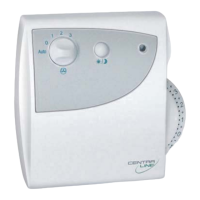
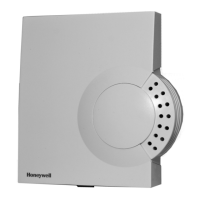
The Honeywell C7110C1040 and C7110C1080 are wall-mounted modules designed for use in indoor ventilation and air conditioning systems. These devices combine CO2 and passive temperature sensing capabilities, allowing them to work in conjunction with Honeywell controllers to manage the flow of incoming air. This integrated approach helps to improve indoor air quality while simultaneously reducing energy consumption.
The primary function of these wall modules is to monitor CO2 levels and temperature within a space. By providing real-time data to a connected Honeywell controller, the system can dynamically adjust ventilation based on occupancy and air quality requirements. During periods of high occupancy, the modules ensure that sufficient fresh air is supplied to maintain desired air quality levels. Conversely, during low-occupancy periods, the system can reduce unnecessary air conditioning and ventilation, leading to significant energy savings.
The C7110C1040 model offers a 0-10 VDC CO2 sensor output and a PT1000 passive temperature sensor. It also includes an internal service LED, which becomes visible after the cover is removed. The C7110C1080 model shares the 0-10 VDC CO2 sensor output and the service LED, but features an NTC20kΩ passive temperature sensor and an additional Occupancy Bypass Button, also accessible after removing the cover.
The modules are designed for straightforward integration and operation within a building management system. They are fully compatible with Honeywell controllers, ensuring seamless communication and control.
A key feature is the CO2 sensor, which utilizes state-of-the-art Non-Dispersion Infrared (NDIR) technology. This advanced sensing method provides accurate and reliable CO2 measurements. Users can select from different CO2 measurement ranges, specifically 400-2000 ppm or 400-3000 ppm, to suit various application needs. This range selection is performed via a configuration jumper located on the Printed Circuit Board (PCB). The default setting for the CO2 measuring range is 400-2000 ppm. By repositioning the jumper to the "3000" ppm position, the range can be expanded to 400-3000 ppm.
The device also includes a configuration potentiometer, accessible after removing the top cover. This potentiometer allows for further customization of the CO2 output. It can be set to operate in either "Sensor Output" mode (analog) or "Relay Output" mode (digital). In "Sensor Output" mode, the module delivers an analog output of 0-10 V, with the measuring range determined by the configuration jumper. In "Relay Output" mode, it provides a digital output (0/10 V), and the potentiometer can be used to configure a "Threshold Level" in ppm, with a fixed hysteresis value of 100 ppm.
The Occupancy Bypass Button, exclusive to the C7110C1080 model, offers additional flexibility in controlling the system. Its functionality, along with the behavior of the calibration LED, is dependent on the programming of the connected controller.
The C7110C1040 and C7110C1080 modules are designed for low maintenance, largely due to their self-calibrating capabilities. The CO2 sensor incorporates an Automatic Baseline Correction (ABC) algorithm, which automatically corrects for any initial drift (e.g., from rough handling during shipping) or subsequent long-term drift. This correction is gradual, with a maximum adjustment of 50 ppm per week, based on a long-term evaluation of the lowest measured CO2 value over a 7.5-day period, comparing it to an expected fresh air level of 400 ppm. This ABC feature is enabled by default.
For specific situations, the ABC function can be switched OFF by repositioning a configuration jumper. If ABC is switched OFF, it is recommended to perform manual calibrations at least once per year to ensure accurate CO2 readings.
The modules also offer quick calibration methods for situations where immediate correction of measurement errors is needed, rather than waiting for the gradual ABC process. These methods include "Zero Calibration" and "Fast Background Calibration." "Zero Calibration" is performed by setting a jumper to "CAL0" and testing the module with CO2-free air. "Fast Background Calibration" is initiated by setting a jumper to "CAL400," which sets the current CO2 level to 400 ppm (the normal expected fresh air level) in a single step. Before performing a Fast Background Calibration, it is advised to ventilate the room with fresh outdoor air.
During these quick calibration processes, the internal Service LED provides visual feedback. It flashes once per second for 90 seconds (sensor warm-up) and then twice per second for 10 seconds (sensor calibration). Once calibration is complete, the LED stops flashing and returns to normal operational behavior. If a calibration fails, often due to wildly fluctuating CO2 levels, the device should be power-cycled and the calibration re-attempted.
The internal Service LED is also used to indicate various operational states and CO2 levels, providing a quick diagnostic tool. For instance, in "Sensor Output" mode, the LED is dark for CO2 levels below 1000 ppm and also dark for CO2 levels above 1000 ppm. In "Relay Output" mode, it flashes when CO2 is below the threshold and is lit continuously when CO2 is above the threshold. It also indicates when ABC is switched ON or OFF.
The robust design and intelligent self-calibration features contribute to a sensor life expectancy of over 15 years, minimizing the need for frequent manual intervention and ensuring reliable performance over time.
 General
| Weight | 0.5 kg |
|---|---|
| Application | Fan Control |
| Output | 4-20 mA |
| Power Supply | 24 Vac |
| Frequency | 60 Hz |
| Pressure Range | Not applicable |
| Electrical Connection | Screw terminal |
| Process Connection | Not applicable |
| Material | Plastic |


 To Next Page
