EasyManua.ls Logo

Honeywell Notifier FST-951 - User Manual

Honeywell Notifier FST-951
2 pages
Print Icon
To Next Page IconTo Next Page
Loading...
3. Devices are point addressable up to 159 addresses.
4. The heat sensor operates as a programmable heat detector.
NOTE: In panels where this feature is not available, the FST-951 and
FST-951-IV will default to a 135°F fixed heat detector. FST-951R and
FST-951R-IV will default to a 135°F fixed heat detector and rate-of-rise.
FST-951H and FST-951H-IV will default to a 190°F high temperature heat
detector.
Intelligent programmable temperature sensors require compatible addressable
communications to function properly. Connect these sensors to listed-compat-
ible control panels only.
WIRING GUIDE
All wiring must be installed in compliance with the National Electrical Code,
applicable local codes and the Authority Having Jurisdiction. Proper wire
gauges should be used. The installation wires should be color coded to limit
wiring mistakes and ease system troubleshooting. Improper connections will
prevent a system from responding properly in the event of a fire.
Remove power from the communication line before installing sensors.
1. Wire the sensor base (supplied separately) as shown in the wiring
diagram. (See Figure 2.)
2. Set the desired address on the rotary dial switches. (See Figure 1.).
3. Install the sensor into the sensor base. Push the sensor into the base
while turning it clockwise to secure it in place.
4. After all sensors have been installed, apply power to the control unit and
activate the communication line.
5. Test the sensor(s) as described in the TESTING section of this manual.
FIGURE 2. WIRING DIAGRAM:
2
3
1
2
3
3
1
2
1
(–)
(+)
+ -
UL Listed Compatible
Control Panel
CAUTION: Do not loop wire under
terminal 1 or 2. Break wire run to
supervise connections.
CLASS A OPTIONAL WIRING
Remote
Annunciator
(–)
(+)
RA
+
+
RA
+
+
RA
+
+
C0129-10
SPECIFICATIONS
Operating Voltage Range: 15 to 32 Volts DC Peak
Operating Current @ 24 VDC: 200 uA (one communication every 5 seconds with green LED blink on communication)
Maximum Alarm Current: 2 mA @ 24 VDC (one communication every 5 seconds with red LED solid on)
Maximum Current: 4.5 mA @ 24 VDC (one communication every 5 seconds with amber LED solid on)
Operating Humidity Range: 10% to 93% Relative Humidity, Non-condensing
Installation Temperature: Set for fixed-temperature or rate-of-rise (ROR): –4°F to 100°F (–20°C to 38°C)
Set for high-heat: –4°F to 150°F (–20°C to 66°C)
Fixed Temperature Rating: 135°F (57°C)
High Heat Temperature Rating: 190°F (88°C)
Rate-of Rise Detection: Responds to greater than 15°F/minute or 135°F (8.3°C/minute or 57°C)
Height: 2.0˝ (51 mm) installed in B300-6 Base
Diameter: 6.2˝ (156 mm) installed in B300-6 Base
Weight: 3.4 oz. (95 g)
UL 521 listed for Heat Detectors
This sensor must be installed in compliance with the control panel system
installation manual. The installation must meet the requirements of the Au-
thority Having Jurisdiction (AHJ). Sensors offer maximum performance when
installed in compliance with the National Fire Protection Association (NFPA);
see NFPA 72.
Before installing sensors, please read the system wiring and installation man-
ual thoroughly. This manual provides detailed information on sensor spac-
ing, placement, zoning, and special applications. Copies of these manuals are
available from Notifier.
GENERAL DESCRIPTION
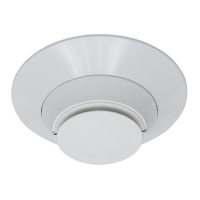
Models FST-951, FST-951-IV, FST-951R, FST-951R-IV, FST-951H, and
FST-951H-IV are field programmable intelligent sensors that utilize a state-of-
the-art thermistor sensing circuit for fast response. These sensors are designed
to provide open area protection with 50-foot spacing capability as approved
by UL 521. The intelligent temperature sensor can be programmed as either
a 135°F fixed temperature sensor, a rate of rise and 135°F fixed temperature
sensor or a 190°F high temperature sensor through the Fire Alarm Control
Panel (FACP).
Two LEDs on each sensor light to provide a local, visible sensor indication.
Remote LED annunciator capability is available as an optional accessory
(Part No. RA100Z). Rotary dial switches are provided for setting the sensor's
address. (See Figure 1.)
FIGURE 1: ROTARY ADDRESS SWITCHES
TENS ONES
9
10
11
12
13
14
15
8
7
6
5
4
3
2
1
0
9
8
7
6
5
4
3
2
1
0
C0162-00
Notifier panels offer different feature sets across different models. As a result,
certain features of the Intelligent Programmable Temperature Sensors may
be available on some control panels, but not on others. FST-951, FST-951R,
and FST-951H will support only FlashScan® protocol mode. FST-951-IV,
FST-951R-IV, and FST-951H-IV will support either FlashScan or CLIP (Classic
Loop Interface Protocol) mode.
The possible features available if supported by the control panel include:
1. The sensor’s LEDs can operate in three ways—on, off, and blinking–and
they can be set to red, green, or amber. This is controlled by the panel.
2. The remote output may be synchronized to the LED operation or con-
trolled independent of the LEDs. Please refer to the operation manual for
the UL listed control unit for specific operation of these models
I56-6522-000
INSTALLATION AND MAINTENANCE INSTRUCTIONS
12 Clintonville Road
Northford, CT 06472-1653
Phone: 203.484.7161
FST-951, FST-951-IV, FST-951R,
FST-951R-IV, FST-951H, and FST-951H-IV
Intelligent Programmable Temperature Sensors
1 I56-6522-000
11/15/2017
Question and Answer IconNeed help?

Do you have a question about the Honeywell Notifier FST-951 and is the answer not in the manual?

Summary

Specifications

General Description

Wiring Guide

Sensor Base Wiring

Wire the sensor base as shown in the wiring diagram for installation.

Address Setting

Set the desired sensor address using the rotary dial switches.

Sensor Installation

Install the sensor into the base by pushing and turning clockwise.

Power Up and Activation

Apply power to the control unit and activate the communication line after installation.

Sensor Testing

Test the sensor(s) as described in the TESTING section of the manual.

Tamper Resistance

Testing Procedures

Test Magnet Method

Use the optional test magnet to activate the sensor's test feature.

Direct Heat Method

Apply heat using a hair dryer to the sensor for testing.

Cleaning Instructions

FM Classification

FCC Statement

Overview

The FST-951 series of intelligent programmable temperature sensors, including models FST-951, FST-951-IV, FST-951R, FST-951R-IV, FST-951H, and FST-951H-IV, are designed to provide reliable fire detection in open areas. These sensors utilize a state-of-the-art thermistor sensing circuit, enabling a fast response to changes in temperature. They are approved by UL 521 for heat detectors and are capable of providing protection with a 50-foot spacing.

Function Description

These intelligent temperature sensors are field programmable, meaning their operational mode can be configured through the Fire Alarm Control Panel (FACP). They can be set to operate in one of three primary modes:

  • 135°F Fixed Temperature Sensor: In this mode, the sensor will alarm when the ambient temperature reaches 135°F (57°C).
  • Rate-of-Rise and 135°F Fixed Temperature Sensor: This mode combines two detection methods. The sensor will alarm if the temperature rises rapidly (greater than 15°F per minute or 8.3°C per minute) or if the ambient temperature reaches 135°F (57°C).
  • 190°F High Temperature Sensor: This mode is designed for environments where a higher fixed temperature threshold is appropriate, alarming when the ambient temperature reaches 190°F (88°C).

It's important to note that the availability of these programming features may vary depending on the specific control panel used. In panels where programmable features are not available, the FST-951 and FST-951-IV models will default to a 135°F fixed heat detector. The FST-951R and FST-951R-IV will default to a 135°F fixed heat detector with rate-of-rise functionality. The FST-951H and FST-951H-IV will default to a 190°F high temperature heat detector.

The FST-951, FST-951R, and FST-951H models support FlashScan® protocol mode, while the FST-951-IV, FST-951R-IV, and FST-951H-IV models support either FlashScan or CLIP (Classic Loop Interface Protocol) mode. These intelligent programmable temperature sensors require compatible addressable communications to function correctly and must be connected to UL listed-compatible control panels.

Usage Features

The sensors are designed for ease of installation and monitoring.

  • Visual Indication: Each sensor is equipped with two LEDs that provide local, visible status indication. These LEDs can be programmed by the control panel to operate in three ways (on, off, or blinking) and can display red, green, or amber colors, offering flexible visual feedback.
  • Remote Annunciator Capability: An optional accessory, the RA100Z remote LED annunciator, can be connected to provide remote visual indication, which can be synchronized with the sensor's LED operation or controlled independently.
  • Addressability: The devices are point addressable, supporting up to 159 unique addresses. This is configured using rotary dial switches located on the sensor, allowing for precise identification within the fire alarm system.
  • Installation: Sensors are installed by pushing them into a separately supplied sensor base and turning them clockwise to secure them. Wiring is straightforward, following a diagram that ensures proper connection to the control panel and any optional remote annunciators. It is crucial to set the desired address on the rotary dial switches before installing the sensor into its base.
  • Tamper Resistance: The intelligent programmable temperature sensors include a tamper-resistant capability that prevents unauthorized removal from the base without the use of a specialized tool, enhancing system security.

Maintenance Features

Regular testing and cleaning are essential to ensure the continued optimal performance of the FST-951 series sensors.

  • Testing: All sensors must be tested after installation and periodically thereafter, in compliance with NFPA 72 and the Authority Having Jurisdiction (AHJ). Before testing, it is critical to notify the proper authorities that the system will be temporarily out of service and to disable the system to prevent unwanted alarms.
    • Test Magnet Method (Model No. M02-04 - optional): An optional test magnet can be placed against the sensor's cover in the designated magnet test area. This action activates the test feature, causing the LEDs to latch on within 10 seconds, indicating an alarm and annunciating at the panel. The detector is then reset at the system control panel.
    • Direct Heat Method (Hair Dryer): A 1000-1500 watt hair dryer can be used to direct heat towards the sensor from about 6 inches (15 cm) away. The LEDs on the detector should light when the temperature reaches the alarm setpoint. If the LEDs fail to light, power to the detector and wiring in the base should be checked. The detector is then reset at the system control panel.
  • Cleaning: If a detector fails testing, it may need to be cleaned. Before cleaning, notify the proper authorities and disable the zone or system to prevent unwanted alarms.
    1. Remove the sensor from the system.
    2. Use a vacuum cleaner or compressed air to remove dust and debris from the sensing area.
    3. Reinstall the detector.
    4. Test the detector as described above.
    5. Reconnect any disabled circuits.
    6. Notify the proper authorities that the system is back online.

Proper installation and maintenance, in compliance with the National Electrical Code and local codes, are vital for the system's reliability. The use of proper wire gauges and color-coded wiring is recommended to minimize mistakes and facilitate troubleshooting.

Honeywell Notifier FST-951 Specifications

General IconGeneral
Operating Voltage Range15 to 32 VDC
Weight0.5 lbs (0.23 kg)
ColorWhite
Humidity10% to 93% RH non-condensing
Height (including base)51 mm (2.0 in)
CertificationsUL, ULC, CSFM, FM
MaterialPlastic
Standby Current200µA @ 24 VDC (one communication every 5 seconds with LED enabled)

Related product manuals