EasyManua.ls Logo

Hoymiles HMS-1600B-4T - User Manual

Hoymiles HMS-1600B-4T
2 pages
Print Icon
To Next Page IconTo Next Page
Loading...
Region: Global AP040390 REV1.2 This Installation Guide is applicable to 1600/1800/2000/1600B/1800B/2000B-4T microinverters
© 2021 Hoymiles Power Electronics Inc. All rights reserved.
01
2. Installation Steps
1. Accessories
Step 1. Plan and install the Microinverter
All accessories above are not included in the package and should be purchased separately.
Note:
1. Install the microinverter and all DC connections under the PV module to avoid direct sunlight, rain exposure, snow buildup, UV, etc.
2. Leave at least 2 cm of space around the microinverter enclosure to ensure ventilation and heat dissipation.
3. Mounting torque of the 8 mm screw should be 9 N·m. Please do not over-torque.
The order of Step 1 and Step 2 can be reversed according to your planned needs.
Item Description
A AC Trunk Cable, 12/10 AWG Cable
B M8*25 screws (Prepared by the installer)
C AC Trunk Connector
D AC Trunk Port Cap
E AC Trunk Port Disconnect Tool
F AC Trunk End Cap
G AC Trunk Connector Unlock Tool
- Use the AC Trunk Connector Unlock Tool to
unlock the connector upper cover.
1 ) Disassemble the AC Trunk Connector and remove the cable.
2 ) Install the AC Trunk End Cap at one side of AC Trunk Cable (The end of AC Trunk Cable)
3 ) Install AC end cable on the other side of AC Trunk Cable (connected to the distribution box)
- Loosen the three screws with screwdriver.
Untighten the cap and remove the cable.
*Note:
HMS-1600/1800/2000-4T Quick Installation Guide
FA B C E GD
A ) Mark the position of each microinverter on the rail, according to the PV module layout.
Step 2. Plan and build the AC Bus Cable
AC Trunk Cable is used to connect the microinverter to distribution box.
A ) Select the appropriate AC Trunk Cable according to the spacing between microinverters. The connector spacing of
the AC Trunk Cable should be close to spacing between microinverters to ensure that they are well-matched. (Hoymiles
provides AC Trunk Cable with different AC Trunk Connector spacing.)
B ) Determine how many microinverters you plan to install on each AC branch and prepare AC Trunk Connectors
accordingly.
C ) Take out segments of AC Trunk Cable as you need to make AC branch.
B ) Fix the screw on the rail.
C ) Hang the microinverter on the
screws, and tighten the screws. The silver
cover side of the microinverter should be
facing the panel.
- Insert the AC Trunk End cap and screw the
cap back to port, then tighten the cap.
- Unlock the port upper cover, loosen the screws
with screwdriver and remove the extra cable.
(Skip this step if there is no cable at this side.)
- Plug the upper cover back to the Trunk
connector.
4.0±0.5N·m
Mounting Torque : 9 N·m
click


Questions and Answers

Overview

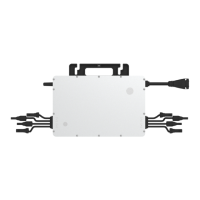
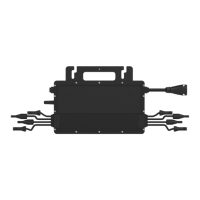
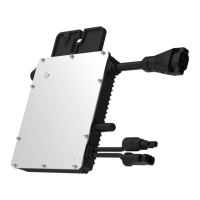
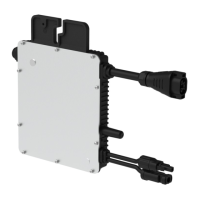
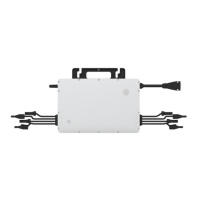
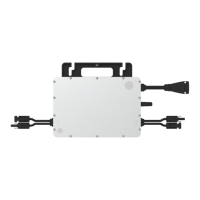
The Hoymiles HMS-1600/1800/2000-4T is a series of microinverters designed for solar power systems. These devices convert direct current (DC) generated by solar photovoltaic (PV) modules into alternating current (AC) for use in homes or connection to the grid. The "4T" in the model name likely indicates that these microinverters are designed to handle four PV modules simultaneously, optimizing power generation at a granular level. The range of 1600W, 1800W, and 2000W refers to the maximum output power capacity of different models within this series, allowing for flexibility in system design based on the total wattage of the connected PV modules.

Function Description:

The primary function of the Hoymiles HMS-1600/1800/2000-4T microinverter is to perform DC to AC power conversion. Each microinverter is connected to multiple PV modules (likely four, given the "4T" designation), allowing for independent Maximum Power Point Tracking (MPPT) for each module or a group of modules. This independent MPPT ensures that even if one module is shaded or underperforming, the overall system's power output is not significantly impacted, maximizing energy harvest. The converted AC power is then fed into the home's electrical system or directly to the utility grid. The system also supports monitoring capabilities, allowing users to track the performance of their solar array.

Important Technical Specifications:

While specific electrical parameters like input voltage range, output voltage, and frequency are not explicitly detailed in the provided pages, the model numbers (1600/1800/2000W) indicate the maximum continuous AC output power. The installation guide mentions the use of an "AC Trunk Cable, 12/10 AWG Cable" for connecting the microinverters to the distribution box, suggesting a robust wiring system capable of handling the specified power outputs. The mounting torque for the 8mm screw is specified as 9 N-m, and for the AC Trunk Connector cap, it's 4.0±0.5 N-m, with the locking screw at 0.4±0.1 N-m. These torque specifications are crucial for ensuring secure and reliable electrical connections and mechanical mounting. The microinverters are designed to be installed under the PV modules to protect them from direct sunlight, rain, snow, and UV exposure, indicating a need for environmental protection. A minimum of 2 cm of space around the microinverter enclosure is required for ventilation and heat dissipation, highlighting the importance of thermal management.

Usage Features:

The installation process for the Hoymiles HMS-1600/1800/2000-4T microinverters is designed to be straightforward, with clear steps for planning, installation, and connection.

  1. Flexible Installation Order: The guide notes that Step 1 (planning and installing the microinverter) and Step 2 (planning and building the AC Bus Cable) can be reversed based on installation needs, offering flexibility.
  2. Microinverter Placement: Microinverters are planned and installed based on the PV module layout, with specific instructions to fix them to the rail using screws and ensure the silver cover side faces the panel. This orientation is likely for optimal heat dissipation or aesthetic reasons.
  3. AC Bus Cable Assembly: The AC Trunk Cable is a key component, and the guide provides detailed instructions for its assembly. This includes selecting the appropriate cable based on microinverter spacing, disassembling and reassembling the AC Trunk Connector, installing an AC Trunk End Cap, and connecting the AC end cable to the distribution box. The use of an "AC Trunk Connector Unlock Tool" and "AC Trunk Port Disconnect Tool" simplifies the assembly and disassembly process.
  4. Secure Connections: Specific torque values are provided for tightening screws and caps on the AC Trunk Connector, ensuring secure and waterproof electrical connections. The instruction to plug an "AC Trunk Port Cap" into any vacant port emphasizes maintaining water and dust-proof integrity.
  5. System Energization: The system is energized by turning on the AC breaker for the branch circuit, followed by the main AC breaker for the house. The system is expected to start generating power within approximately two minutes, indicating a quick startup time.
  6. Monitoring System Integration: The microinverters are designed to integrate with a monitoring system, requiring reference to separate manuals for the DTU (Data Transfer Unit) and S-miles Cloud for setup. This feature allows users to track performance, diagnose issues, and ensure optimal operation.
  7. Installation Map: The guide includes a step for creating an installation map by affixing serial number labels from each microinverter to a corresponding location. This is crucial for system documentation, troubleshooting, and monitoring, as it allows for easy identification of individual microinverters within the array.

Maintenance Features:

While the guide primarily focuses on installation, several aspects touch upon maintenance or ease of future servicing:

  1. Environmental Protection: The instruction to install microinverters and DC connections under PV modules helps protect them from harsh environmental conditions, which contributes to their longevity and reduces the need for frequent maintenance.
  2. Ventilation: The requirement for 2 cm of space around the enclosure for ventilation is a critical design consideration that prevents overheating, a common cause of electronic component failure, thereby extending the lifespan of the microinverter.
  3. Water and Dust Proofing: The detailed instructions for assembling the AC Trunk Cable, including tightening caps to specified torques and plugging vacant ports, are all aimed at ensuring the system is water and dust-proof. This protection is vital for preventing corrosion and electrical faults, reducing the need for repairs.
  4. AC Trunk Port Disconnect Tool: The mention of an "AC Trunk Port Disconnect Tool" for removing the inverter AC cable from the AC Trunk Connector indicates that connections are designed to be safely and easily disconnected if maintenance or replacement is required, without damaging the components.
  5. Installation Map for Troubleshooting: The creation of an installation map with serial numbers is a key maintenance feature. In case of a fault or performance issue, the map allows technicians to quickly identify the specific microinverter that needs attention, streamlining troubleshooting and repair processes.
  6. Monitoring System: The integration with a monitoring system (DTU and S-miles Cloud) is a proactive maintenance feature. It allows for remote monitoring of system performance, enabling early detection of issues and potentially preventing system downtime. This can alert users or technicians to problems before they escalate, facilitating timely intervention.
  7. Robust Cable Connections: The use of 12/10 AWG AC Trunk Cable and specified torque values for connections ensures robust and reliable electrical pathways, minimizing the risk of loose connections or power loss, which would otherwise require maintenance.
  8. Product Information Updates: The note that "Product information is subject to change without notice" and the recommendation to "download reference manuals at www.hoymiles.com" suggest that Hoymiles provides updated documentation, which is helpful for staying informed about product changes, best practices, and maintenance procedures.

Hoymiles HMS-1600B-4T Specifications

General IconGeneral
BrandHoymiles
ModelHMS-1600B-4T
CategoryInverter
LanguageEnglish

Related product manuals