EasyManua.ls Logo

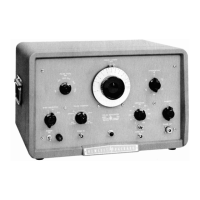
HP 212A - Voltage Supply

HP 212A
60 pages
Print Icon
To Next Page IconTo Next Page
To Previous Page IconTo Previous Page
Loading...
volts
depending
upon
setting
of
the
AMPLITUDE
control.
A
flat-top
pulse
is
now
formed
for
application
to
the
output
amplifier
V11.
V11
is
biased
well
beyond
cutoff.
As
a
result
of
the
high
bias
voltage
only
the
top
portion
of
the clipped
pulse
generated
by
Vb
is
passed
through
V
1
1.
The
very
high
bias
on
V
1
1
removes
unwanted
signals
of
low
am
-
plitude
that
would
otherwise
appear
on the
baseline
fallowing
the
output
pulse.
See
items
24
and
25
in
trouble
shooting
chart.
The
body
of
the
final output pulse depends
upon
sufficient
power
from
the
high
voltage
supply
to
maintain
high
initial
pulse
amplitude.
A
droop
in
in
the
pulse
body
generally
indicates
a
defective
component
in
the
high-
voltage
supply.
See
item
b
of
trouble
shooting
chart.
If
the
pulse
contains
peaks
or
humps
above
the
normal
level
of
the
top,
it would
indicate
ineffective
clipping,
see
items
7
and
8
of
trouble
shoot-
ing
chart.
When
the
top
has
a
gradual
rise
or
drop,
the
correction
may
be
a
matter
of
adjustment
and
is
covered
in
item
11
of
the
trouble
shoot-
ing
chart.
Trailing
Edge
--
V16
the
'stopt
thyratron, 'turns off' the output
pulse.
When
V16
is
triggered,
it
forms
the
trailing
edge
of
the
pulse.
The
trig-
g
er
pulse
for
the
stop
tube
is
developed
by
the
circuits
of
amplifier 107a,
multivibrator
V
1
OS
and
blocking
oscillator
V
l09a.
The
condition
of
the
trailing
edge
is the
result
of
all
these
circuits,
plus
V8
which
is
In
series
with
'stop'
thyratron
V16.
The
effects
of
these circuits
can
appear
only
-
on
the
trailing
edge
of
the output pulse.
See
items
13
and
14
of
trouble
s
hooting
chart.
t'Both'Edges
of
Output
Pulse
--
If
a
trouble
such
as
'jitter'
appears
on
both
leading
and
trailing
edges
of the output pulse,
the
defect
is
generally
in
a
circuit
which
affects
both
start
and
stop
thyratrons
simultaneously.
All
circuits
preceding
V107b,
(V101
through
V
106b)
affect
both
leading
and
trailing
edges
and
do
not
affect
one
edge
without
affecting the
other.
Pulse
Length
--
A
change
in
pulse
length
caused
by
an
increase
or
de-
crease
in
rate
is
generally
due
to
one
of
the
thyratrons.
In
some
thyratrons
-
there
is
a
very
small
time
lapse
between
the
time the
tube
is
triggered
and
the
time
the
gas
is
fully
ionized.
The
degree
of
time
lapse
depends
on
the
duty
cycle.
This
characterisitic
causes
the
pulse
length
to
vary
with
rate.
Generally,
the
time
lapse
increases
with
an
increase
in
duty
cycle.
If
the
start
tube
has
this characteristic,
an
increase
in
pulse
rate
will
cause
the
output
pulse
to
shorten.
If
the
stop
tube
has
this
characteristic,
the
output pulse
will
lengthen
with
an
increase
in
rate.
See
item
17
of
trouble
shooting
chart.
High
pulse
rates
tax
both
thyratrons
to
a
greater
degree
than
low
rates.
The
symptoms
of
a
failing thyratron
therefore
become
more noticeable
at
higher
pulse
rates.

Related product manuals